PART 3
He owned several commercial buildings, a construction company, and the shopping center on the edge of town. People said he could buy almost anything he wanted without checking the price.
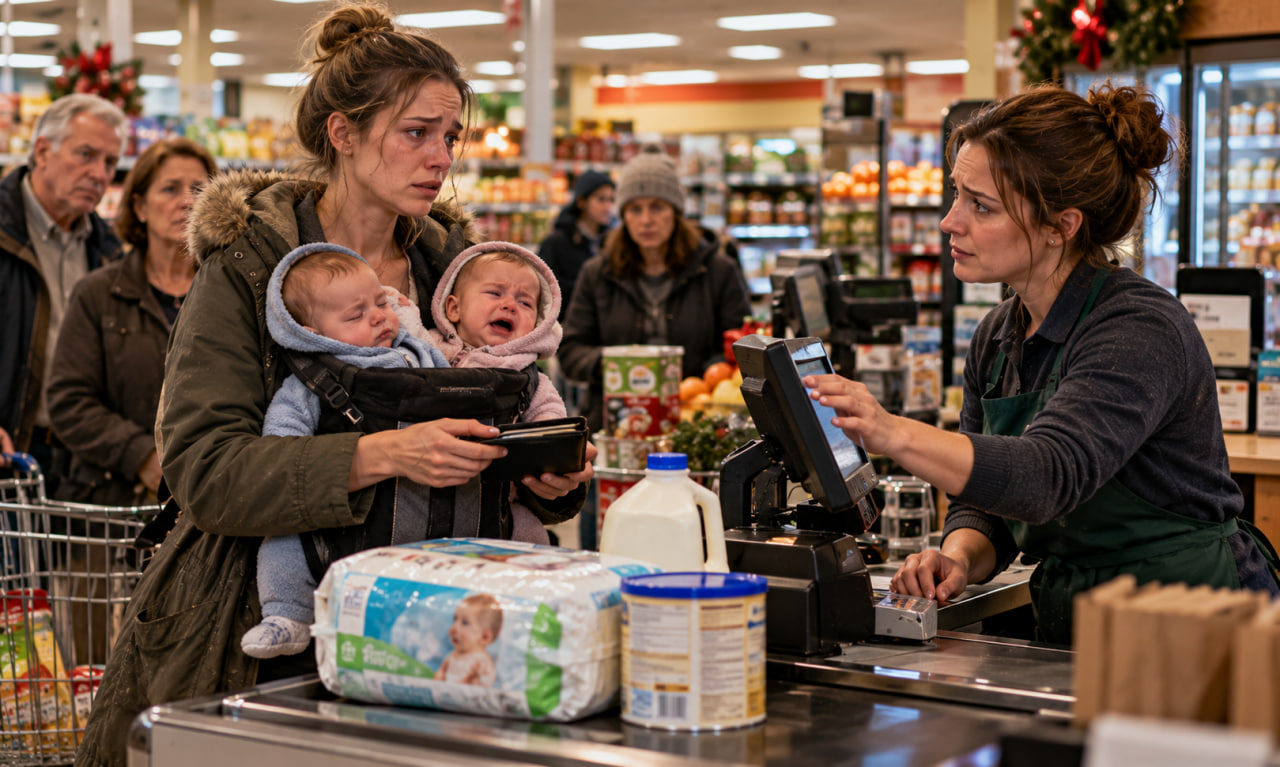
Yet the woman standing beside him in that photograph had looked as exhausted and frightened as anyone I had ever seen at my register.
I turned the photograph over.
Written on the back were six words.
My father. The twins’ grandfather. Gone yesterday.
I read the words again.
Then I looked at Mike.
“What does this mean?”
Mike leaned back in his chair, rubbing his forehead.
“I don’t know the whole story, Rachel. She didn’t tell me everything. But she asked me to give you the envelope personally. She said you deserved to know why she couldn’t explain anything yesterday.”
I carefully unfolded the letter.
The handwriting was uneven, as though the person writing it had stopped several times to wipe away tears.
Dear Rachel,
You don’t know me, and yesterday I couldn’t find the courage to tell you who I was. I was embarrassed, frightened, and so tired that I could barely think straight.
When my card was declined, I wasn’t just worried about the groceries. I was terrified because the diapers were the last thing I could possibly go without.
My boys are only four months old. They don’t understand why their mother sometimes cries when she thinks they’re asleep. They don’t understand why I sit beside their crib at night, counting the cans of formula and wondering how many days they will last.
But yesterday, when everyone behind me was becoming impatient, you looked at me as though I were a person instead of a problem.
You paid $8.42.
You probably thought it was a small thing.
For me, it was the difference between walking out of that store with everything my children needed and walking out feeling like I had failed them again.
I stopped reading.
My throat had tightened.
I had spent six years standing behind that register, scanning groceries, greeting customers, and watching people come and go. Sometimes I helped someone carry a heavy bag to their car. Occasionally, I gave a customer a few extra seconds to find the money they needed.
I never imagined that eight dollars and forty-two cents could mean so much.
I continued reading.
My name is Emily Whitmore.
Robert Whitmore was my father.
He died Thursday night.
I lowered the letter.
Mike was watching me quietly.
“Her father died the night before you met her?” I asked.
Mike nodded.
“Apparently, she’d just come back into town.”
I looked down at the photograph again.
The young woman who had stood in front of my register with trembling hands was the daughter of a man whose name was on buildings, charitable foundations, and plaques throughout the county.
And yet, yesterday, she hadn’t even been able to afford a package of diapers.
How could that be possible?
I returned to the letter.
My father and I hadn’t spoken properly in almost three years.
We had a terrible argument when I married Daniel, the man who is now my late husband. My father believed Daniel was using me to gain access to the family business. Daniel was proud, and he refused to accept my father’s money or apologize for something he hadn’t done.
I took Daniel’s side.
I left home with him, and for a while, I believed love would be enough to build a life.
We were happy. We worked hard. We rented a small apartment, saved what we could, and welcomed our twin boys, Noah and Nathan.
Then Daniel became ill.
The medical bills consumed our savings. I left my job to care for him, and by the time he died six weeks ago, we had almost nothing left.
I felt my eyes sting.
Six weeks.
She had lost her husband six weeks ago, her father the day before I met her, and she was raising two four-month-old babies alone.
I could barely imagine surviving one of those losses.
Emily had endured all three.
But the letter wasn’t finished.
You may wonder why I didn’t ask my father for help.
I tried.
Three days before he died, I went to his house. I wanted to tell him Daniel was gone and that I needed help getting back on my feet. I wanted to apologize for the years we had lost.
But I never got inside.
His assistant told me he was too ill to see anyone. She said he had been asking about me, but he had instructed everyone not to let me disturb him.
I went home believing my father had chosen to die without seeing me.
Yesterday morning, a lawyer called to tell me that my father had passed away. He asked me to attend a meeting about the estate next week.
I had no idea what my father had left me, or whether he had left me anything at all. I had no money to spare, and I was too ashamed to explain my situation to strangers.
So I went to the grocery store with the little money I had left.
And then I met you.
I wiped my cheek with the back of my hand.
There was another page.
This one was shorter.
Rachel, I came back to the store after you left because I wanted to thank you. Mike told me you had gone home, so I left this envelope with him.
I am not asking you to feel sorry for me. I am writing because something happened after I left your register yesterday, something I still cannot understand.
The lawyer called again.
He told me my father had left specific instructions concerning the woman who helped me buy diapers.
I stopped.
I read that sentence three times.
Concerning me?
I looked at Mike.
“Did she explain what that means?”
He shook his head.
“She only asked me to make sure you read the letter before opening the white card.”
I glanced at the card beside the photograph.
My fingers suddenly felt cold.
The card carried the name of a law firm in the city. Beneath it was a handwritten message.
Rachel, please call me when you have finished reading the letter. There is something your father should have told you himself.
I frowned.
“My father?”
Mike leaned forward.
“That’s what I wondered when she left it.”
I was about to explain that my father had died eleven years earlier when I noticed something written at the bottom of the card.
A name.
Thomas Bennett.
My breath caught.
I knew that name.
Thomas Bennett had been my father’s closest friend.
And he was the man who had attended my father’s funeral, placed a hand on my shoulder, and promised that if I ever needed anything, I could come to him.
I hadn’t seen him in years.
After my father died, our family had fallen apart in ways I didn’t fully understand. My mother had spent years working to keep us afloat, and I had started working as soon as I could to help with the bills.
Thomas had moved away shortly afterward.
I had assumed he had simply moved on with his life.
Now, somehow, his name was connected to a grieving mother, a wealthy businessman, and the $8.42 I had spent on diapers.
I looked at Mike.
“I need to make a phone call.”
He nodded.
“Take your time. I’ll cover your register.”
I walked into the break room and dialed the number.
The phone rang twice.
A man answered.
“Thomas Bennett speaking.”
“Mr. Bennett? My name is Rachel. Rachel Miller. I received a card from you this morning.”
There was a long silence.
Then I heard him take a slow breath.
“Rachel Miller,” he repeated. “Your father’s daughter?”
“Yes.”
“Oh, my goodness.”
His voice changed completely.
“Are you all right?”
“I’m fine, sir. But I don’t understand why a woman named Emily Whitmore left me your card.”
Another silence followed.
Then he said something I never expected.
“Because your father asked me to find you if something happened to Robert Whitmore’s daughter.”
I gripped the phone.
“What does my father have to do with Robert Whitmore?”
Thomas sighed.
“Rachel, there are things your father never told you. Some of them concern the years before you were born. Others concern a decision he made shortly before he died.”
I sat down.
“Please tell me.”
“I think you should hear the story in person,” he replied. “But there is something I can tell you now. Robert Whitmore and your father were partners once. Not in the way people assume. They were involved in a project that could have changed both of their lives.”
“What kind of project?”
“A small community trust. Your father wanted to use it to help families who had fallen on hard times. Robert wanted to build something much larger. They disagreed about how the money should be used, and eventually, they went their separate ways.”
I tried to make sense of his words.
“My father never owned a business.”
“He didn’t want one. He believed money was useful only when it helped someone who needed it.”
That sounded exactly like the man I remembered.
My father had never been wealthy, but he had never turned away a neighbor who needed a ride, a meal, or a little help paying a bill.
He used to say that people didn’t always remember how much money you had, but they remembered how you treated them when they had none.
I had heard those words so many times that I could practically hear his voice saying them.
Thomas continued.
“Before your father died, he asked me to keep an envelope safe. He told me to give it to you only when I believed you were ready to understand what was inside.”
“What was inside?”
“A letter. And a document that I think you’ll find surprising.”
My heart began to pound.
“Why didn’t you give it to me years ago?”
“Because your father asked me to wait.”
“Wait for what?”
Thomas paused.
“Until you did something for someone without expecting anything in return.”
I stared at the wall.
For a moment, I couldn’t speak.
“You mean yesterday?”
“I believe so,” he said quietly. “Emily contacted me after she left the grocery store. She told me what you had done. She said it reminded her of something her father had told her many years ago.”
I pressed the phone closer to my ear.
“What did he tell her?”
Thomas answered slowly.
“He told her that one day, she would meet someone who understood the value of a small kindness. He said that person might never be rich, famous, or powerful. But they would possess something money couldn’t buy.”
I swallowed.
“What?”
“Character.”
I closed my eyes.
I didn’t know what to say.
Then Thomas added, “Emily has asked to meet you. She wants to explain why your name appeared in her father’s final instructions. I think you should hear her side of the story before you decide what to do next.”
I looked through the break-room window toward the checkout lanes.
Customers were filling their carts. My coworkers were moving between registers. Somewhere near the entrance, a little boy was laughing as his mother pushed him in a shopping cart.
Everything looked ordinary.
But my life no longer felt ordinary.
“Where can I meet you?” I asked.
“At my office, Monday morning. I’ll arrange for Emily to be there, too.”
I agreed, thanked him, and ended the call.
For several minutes, I sat alone.
I had gone to work expecting another normal Saturday. Instead, I had learned that my late father had left behind a secret, that a wealthy man’s daughter had been searching for help, and that a simple act of kindness had somehow connected all of us.
I returned to Mike’s office and handed him the envelope.
“Can you keep this safe for me?”
“Of course.”
He studied my face.
“Rachel, whatever is happening, remember something. You did the right thing yesterday. You don’t need an envelope or a rich man’s approval to prove that.”
His words helped me breathe again.
Because he was right.
I hadn’t paid for those diapers because I wanted something in return.
I had paid because I knew what it felt like to struggle.
When I was seventeen, my mother had been laid off from her job at a factory. For months, we counted every dollar. There were evenings when she pretended she wasn’t hungry so I could have the last portion of dinner.
I remembered the shame of standing in a shop and putting things back because we couldn’t afford them.
I remembered how one neighbor had quietly left a bag of groceries on our doorstep without telling anyone.
That small act had stayed with me for years.
Yesterday, I had simply passed it forward.
And now, somehow, the past was reaching back toward me.
That afternoon, I finished my shift, drove home, and tried to forget about the envelope.
I failed.
Every time I sat down, my thoughts returned to Emily and her twins.
Were they safe?
Did she have enough formula for the weekend?
Was there anyone helping her?
I finally decided that waiting until Monday was ridiculous.
I went to a nearby pharmacy and bought diapers, wipes, formula, and a few other necessities. Then I drove back to the grocery store to ask Mike whether he knew how to contact Emily.
He gave me a worried look.
“You don’t have to keep spending your own money, Rachel.”
“I know,” I said. “But I want to make sure the babies are okay.”
Mike checked the note Emily had left with the envelope. She had written her phone number at the bottom.
I called her.
She answered after the fourth ring.
“Hello?”
“Emily? It’s Rachel, from the grocery store.”
There was a brief silence.
Then her voice broke.
“Oh, Rachel.”
“Are you all right?”
“I’m trying to be.”
“Do you have everything you need for the boys?”
She hesitated.
“Honestly? Not really. But I’ll manage.”
I looked at the bags beside me.
“I bought a few things for them. Nothing fancy. Would it be all right if I brought them over?”
She began to protest immediately.
“Rachel, you’ve already done enough. I can’t keep accepting things from you.”
“You aren’t asking me for anything,” I said gently. “I’m offering. There’s a difference.”
She went quiet.
Finally, she gave me her address.
Her apartment was in an older building on the edge of town. The parking lot was cracked, the stairwell smelled faintly of detergent, and several lights in the hallway had burned out.
When Emily opened her door, I understood how difficult the past few weeks must have been.
The apartment was clean, but nearly empty. A secondhand sofa stood against one wall. Two bassinets sat beside a small bed. Bottles and folded baby clothes covered the kitchen table.
One twin was crying.
The other slept with his tiny hands tucked beneath his chin.
Emily looked embarrassed.
“I’m sorry about the mess.”
I glanced around.
“There isn’t a mess.”
She gave a tired little laugh.
“You haven’t seen the kitchen.”
“I’ve seen kitchens.”
For the first time, she smiled.
It was a small smile, but it changed her whole face.
I placed the bags on the table and began unpacking them.
When she saw the formula, she covered her mouth.