The money was a benefit.
But controlling how the family viewed me had been part of the deception.
I looked toward Desmond.
“How much did you know?”
He rubbed his forehead.
“Ranata told me her parents were helping with some expenses.”
“Whose expenses?”
He hesitated.
“Desmond.”
“Our expenses,” he finally admitted.
“Are you seriously turning against me?”
He looked exhausted.
“You told me your parents were giving us early inheritance money.”
Mom gasped.
Dad stared at him.
“Early inheritance?”
“That’s what I believed.”
Ranata looked around the room.
“You’re all acting like I stole something!”
Dad’s voice trembled.
“You told us your sister was going to lose her farm.”
“She was having problems!”
“No,” I answered.
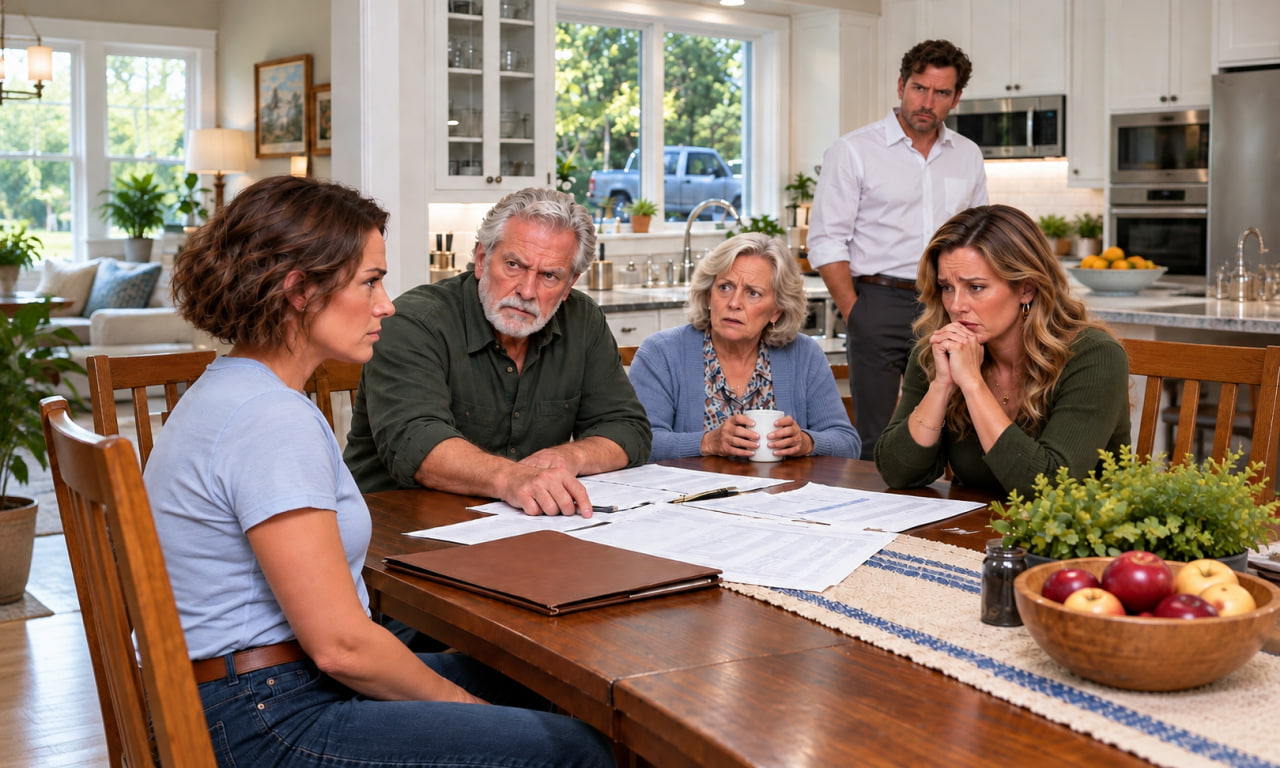
I opened my brown folder and removed several financial records.
“I wasn’t.”
I placed my tax documents, loan confirmations, and equipment invoices on the table.
“I bought my property using money I earned. I paid my mortgage myself. Every insurance premium, every repair, every tax bill—those were my responsibilities.”
I looked directly at my sister.
“You never helped me financially because I never asked you to.”
Then I turned toward my parents.
“And I never asked you because I didn’t want you worrying about me.”
Mom began crying.
Dad stared at the documents.
“Then all these payments went somewhere else?”
“Yes.”
Ranata sank into her chair.
For the first time that evening, she seemed genuinely frightened.
Dad covered his face.
“Why didn’t we simply ask Fay?”
Mom wiped her cheeks.
“Ranata said she’d be humiliated if we mentioned it.”
I looked at my sister.
She refused to meet my eyes.
“She said Fay was too proud to admit she needed help,” Mom continued. “She told us sending money through her was the only way to help without embarrassing you.”
That revelation hurt more than I expected.
All those years, my parents had believed they were rescuing me.
Whenever I spoke proudly about buying new equipment, they probably thought I was pretending.
Whenever I brought homemade gifts at Christmas, perhaps they assumed I couldn’t afford anything nicer.
Whenever I thanked them for a birthday present without mentioning money, they must have wondered why I was so ungrateful.
Dad finally looked at me.
“Fay, we thought you knew.”
I swallowed.
“I didn’t.”
He nodded slowly.
Then he faced Ranata.
“I want every bank statement. Every invoice. Every record showing where this money went.”
She shook her head.
“Dad, you can’t seriously expect me to—”
“I expect the truth.”
Her eyes widened.
“And until we understand what happened, you won’t receive another dollar from us.”
Ranata turned toward Mom.
“Are you going to let him do this?”
Mom stared at her.
“I was giving you money because I believed your sister might be going hungry.”
Her voice broke.
“I worried about Fay working outdoors in winter. I worried that she’d lose her land. I worried she couldn’t afford groceries or repairs.”
She looked at me.
“And you were managing all this time?”
I hesitated.
“There were difficult years, Mom. But I handled them. If I’d truly needed help, I would have told you.”
She began sobbing.
I reached across the table and held her hand.
“I wish you’d asked me directly.”
“I do too, sweetheart.”
Ranata stood again.
“I can’t believe everyone is blaming me for destroying this family.”
Dad looked up sharply.
“You accepted money based on false information.”
“I intended to repay it!”
“With what?” Desmond asked.
She turned toward him.
“Don’t start.”
He sighed.
“We refinanced our house twice, Ranata. We have credit card debt. You told me we were using inheritance advances to stay afloat.”
I looked at him.
“What happened to nearly seven hundred thousand dollars?”
He stared at the floor.
“The boutique. Home renovations. Private-school tuition. Vacations. Vehicles. Then we used more money to cover earlier debts.”
I remembered Ranata’s social-media photographs.
The beautifully remodeled kitchen.
Designer handbags.
European vacations.
Her new SUV.
She had presented those luxuries as proof of how successful her family was.
At the same time, she was telling our parents that I could barely afford electricity.
I closed my folder.
Then Dad looked at the remaining documents.
“What haven’t you shown us yet, Fay?”
I hesitated.
Until that moment, I hadn’t decided whether to reveal the sale.
But my sister’s lies had survived partly because I’d never bothered to correct the family’s assumptions.
I wasn’t responsible for her deception.
Still, I wasn’t going to allow her to keep defining my life.
I removed the final closing statement.
“Three days ago,” I said quietly, “I sold my farm.”
Mom blinked.
“You sold it?”
“Yes.”
Dad’s expression filled with concern.
“Fay, why didn’t you tell us things had gotten so bad?”
I almost smiled.
“Dad, nothing went wrong.”
I slid the document across the table.
He lowered his eyes.
Read the page.
Then stopped.
He adjusted his glasses.
Read the number again.
Finally, he looked up.
“Thirty-nine million dollars?”
The room went completely silent.
Ranata froze.
Mom stared at me.
Desmond stepped closer.
Dad examined the closing statement once more.
“Fay… is this real?”
“Yes. The transaction closed three days ago.”
For several seconds, nobody spoke.
Then Ranata gave a nervous laugh.
“That’s impossible.”
I looked at her.
“Why?”
“Because the farm was barely surviving.”
“According to whom?”
She opened her mouth.
Nothing came out.
I leaned forward.
“You spent years telling people I couldn’t pay my bills. You told Mom and Dad I needed money for machinery, repairs, and emergencies.”
I paused.
“And somehow, you never noticed that I never asked for anything.”
Ranata stared at the sale price.
“Thirty-nine million,” she whispered.
“Yes.”
Then I saw her expression change.
The fear remained, but something new appeared.
Calculation.
She glanced at our parents.
Then back at me.
“Fay, surely you understand that we’ve been under enormous financial pressure.”
I nearly laughed.
Not an apology.
Not an explanation.
She was already thinking about my money.
“No,” I said firmly.
She blinked.
“What?”
“My money is not going to solve the problems you created.”
“I wasn’t asking for anything!”
“You were about to.”
She looked away.
Dad pushed back his chair.
“I think everyone needs some time.”
Ranata began protesting, but he stopped her.
“No. I need to understand how my own daughter could mislead us for eleven years.”
Then he turned toward me.
“And I need to understand why I believed you were struggling without asking you directly.”
I stood and gathered my folder.
Mom reached for my hand.
“Fay, please don’t leave angry.”
“I’m not leaving because I’m angry.”
“Then why?”
“Because I need time to think.”
She nodded sadly.
As I reached the doorway, Ranata spoke.
“So you’re going to walk away with thirty-nine million dollars while the rest of us deal with this mess?”
I turned around.
“Ranata, I spent fifteen years building something real.”
She stared at me.
“You spent eleven years convincing everyone I was failing.”
I paused.
“Now we both have to live with what we built.”
Then I walked outside.
The next morning, my phone began ringing before seven.
Dad called.
Then Mom.
Then relatives I hadn’t spoken to in months.
By lunchtime, several people had congratulated me on the farm sale.
Others wanted to discuss investment opportunities.
Two relatives casually mentioned family business ideas.
And Ranata sent a long message beginning:
After everything I’ve done for you…
I didn’t respond.
Instead, I called my attorney, Evelyn Shaw.
She had handled the property sale and was one of the few people who already knew about the money.
After I explained the situation, she listened carefully.
“Fay, your sister’s financial obligations aren’t automatically yours simply because you’re related.”
“I understand.”
“Good. Don’t make loans or financial promises while everyone is emotional. And don’t sign documents without independent review.”
I agreed.
She also recommended protecting my financial information and reviewing my estate plans.
By the end of that week, I’d spoken with my accountant, a tax specialist, and a financial adviser.
I changed account passwords and updated important documents.
I made certain nobody in my family had access to my banking information.
I wasn’t opposed to helping people.
But I refused to become a convenient solution for relatives who’d barely shown interest in my happiness until they discovered I was wealthy.
A week later, Dad invited me over.
This time, Ranata wasn’t there.
Mom had prepared coffee.
Dad sat at the kitchen table with a thick folder.
When I entered, he stood.
Then he did something I hadn’t expected.
He hugged me.
A real hug.
His shoulders trembled.
“I’m sorry, Fay.”
I closed my eyes.
For years, I’d wanted him to see more than my faded clothes and old truck.
But standing there, I finally realized I hadn’t wanted him to admire my success.
I’d wanted him to understand me.
Dad stepped back.
“I believed Ranata because her story matched what I thought I saw. Your old pickup. Your work clothes. How tired you always looked.”
He wiped his eyes.
“I assumed you were struggling without ever asking what you were actually building.”
“I didn’t share much,” I admitted.
“That doesn’t excuse it. You shouldn’t have had to prove you were wealthy to deserve respect.”
Mom began crying quietly.
Dad opened the folder.
“We’ve hired an attorney.”
Inside were years of bank statements, transfer confirmations, and messages from Ranata.
Mom pointed toward one.
“She said your tractor needed a replacement engine.”
I recognized the date.
I had repaired the tractor myself that month for less than four hundred dollars.
The transfer Ranata received was $12,000.
Another message claimed I needed help paying property taxes.
The payment was $18,000.
My taxes had already been paid.
Then I saw a message claiming I’d been hospitalized and couldn’t afford medical expenses.
I stared at the page.
“I wasn’t in the hospital.”
Dad’s voice broke.
“She used our worry about you.”
I nodded.
“Yes.”
Their attorney was examining the transfers and determining what financial recovery options might be available.
Dad explained that Ranata had been asked to provide a complete accounting.
“That’s between you and her,” I told him.

One Comment on “I Sold My Farm for $39 Million—3 Days Later, I Overheard My Sister Telling Our Parents I Was Broke”