PART 3
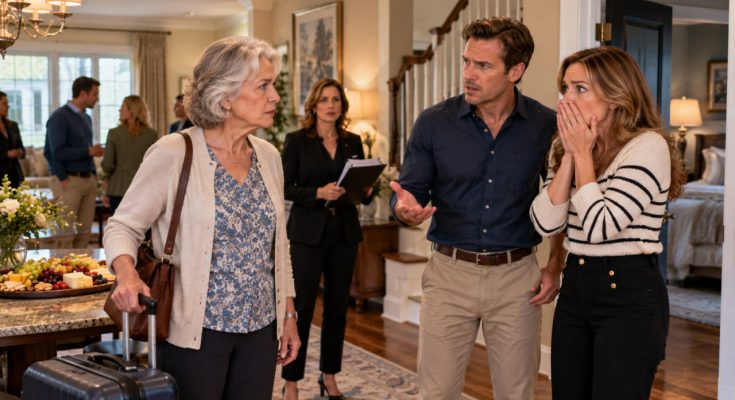
I placed the envelope on my dining table, right beside the cheese platter someone had brought into my home without my permission.
The first was a copy of the mortgage agreement.
The second was a letter from the lender confirming the outstanding balance.
The third was a business card.
I slid the business card across the table toward the young couple.
The man picked it up.
His eyes moved from the printed name to my face.
Then he looked at his wife.
“Oh,” he whispered.
His wife took the card from him.
Then again.
And suddenly, the two of them were no longer looking at my house as if they were imagining where to put their furniture.
They were looking at me.
“You’re the lender?” the woman asked.
“I am.”
Paul let out a sharp, disbelieving laugh.
“That’s impossible.”
I turned toward him.
“Is it?”
“You can’t just lend money against a house and call yourself the lender!”
“Actually, Paul, that’s precisely what I did.”
Denise stepped forward.
“Mom, stop. You’re confusing everyone. What is this supposed to prove?”
I picked up the mortgage agreement and held it between two fingers.
“In March 2022, I established a private lending arrangement. I used a portion of my retirement investments to fund loans secured by real estate. This house was one of the properties involved.”
I paused.
“More specifically, I became the lender on a mortgage secured by this house.”
Paul’s face had turned pale.
“But you own the house.”
“Yes.”
“Then why would you mortgage your own property?”
“Because I needed money for an investment, and I was perfectly entitled to make that decision.”
“How much?” Denise demanded.
I looked at her.
“That’s not the question you should be asking.”
“Then what should I be asking?”
I tapped the second document.
“How much is still owed?”
Nobody spoke.
I answered for them.
“Four hundred and twenty thousand dollars.”
The young couple exchanged another glance.
Melissa slowly reached for the paperwork.
Paul looked as though someone had just pulled the floor out from beneath him.
“Four hundred and twenty thousand?” he repeated.
“That’s the outstanding balance as of this month.”
“But the house is worth six hundred thousand!”
“Approximately, yes.”
“So there’s still equity!”
“Of course there is. But the property is subject to an existing mortgage, and you cannot simply pretend that mortgage doesn’t exist because you found a buyer.”
Paul turned toward Melissa.
“You said the paperwork was fine.”
Melissa’s face tightened.
“I said the documentation you provided appeared sufficient for listing purposes. The title and mortgage status must be verified through the appropriate legal process before closing.”
The question came from the young woman.
It was the first thing anyone had said all afternoon that made me want to smile.
Paul looked at her.
“Excuse me?”
She gestured toward my bedroom.
“You invited strangers into her private space. You accepted an offer on her home while she was away. And now you’re arguing about the money instead of apologizing.”
Her husband gently touched her arm, perhaps reminding her that they were standing in the middle of a family dispute.
But she didn’t look away.
“We’re withdrawing,” she said.
Melissa blinked.
“Ma’am, you haven’t signed a purchase agreement.”
“Then we’re fortunate we haven’t.”
The young couple placed their brochures on the table and walked toward the front door.
Before leaving, the woman turned to me.
“I’m sorry this happened to you.”
“Thank you,” I said.
Then she was gone.
One by one, the other visitors began leaving, too.
The cheese platter remained untouched.
By the time Melissa gathered her papers, my house had become quiet again.
She approached me with a much more professional expression.
“Mrs. Whitaker, I need to be clear about something. If your children have misrepresented their authority, I need to notify my broker and our legal department. I’ll also need a copy of the power of attorney they provided.”
“Certainly.”
I took another document from my envelope.
“This is a certified copy of the original power of attorney.”
Melissa read the first page.
Then the second.
She stopped halfway through the third.
Her eyes narrowed.
“There’s a limitation here.”
“Yes.”
She read it again.
“This document grants authority for medical decisions and related administrative matters. It doesn’t appear to grant authority to sell real property.”
“That’s correct.”
Paul suddenly moved toward her.
“That’s not what the attorney told us!”
Melissa raised a hand.
“Please don’t put words in my mouth. I’m telling you what this document appears to say. A property sale would require proper legal authority, and the relevant professionals would need to determine whether any other documents exist.”
Denise stared at the pages.
“But Mom signed it.”
“Yes,” I replied. “I did.”
“You knew we were going to help you!”
“I did.”
“We were trying to make things easier!”
I looked around the room.
At the strangers’ footprints on my polished floor.
At the brochures spread across the table where Frank and I had celebrated forty-three anniversaries.
At the front door still standing open because nobody had thought to close it after inviting half the neighborhood inside.
“Tell me something, Denise.”
She folded her arms.
“What?”
“At what point did helping me become the same thing as selling my home without asking me?”
Her mouth opened.
Nothing came out.
Melissa quietly placed the documents into a folder.
“I’ll contact my broker and make sure no further steps are taken until the authority and title issues are properly reviewed.”
“Thank you.”
She left.
And then it was just the three of us.
For the first time since I had walked through my own front door, my children had nowhere to hide.
Paul rubbed his forehead.
“Mom, you have to understand that we thought we were doing the right thing.”
“Did you?”
“Yes.”
“Then explain something to me. Why did you wait until I was in Arizona to list the house?”
“Tucson,” Denise muttered automatically.
I turned toward her.
“What?”
“You went to Tucson. You weren’t in Arizona generally. You were visiting Aunt Carol in Tucson.”
I stared at my daughter.
She had just corrected the geography of my vacation while standing in a house she had tried to sell behind my back.
It was almost impressive.
“You’re right,” I said. “Tucson.”
I walked over to the front door and closed it.
Then I turned the lock.
“Now, both of you are going to sit down.”
Paul started to protest.
I raised my hand.
“No. You have spent the entire afternoon making decisions about my life. For the next ten minutes, you’re going to listen to me.”
Something in my voice must have reached him, because he slowly pulled out a chair.
Denise remained standing.
“Sit down, Denise.”
She sat.
I went to the kitchen and poured myself a glass of water. My hands were shaking slightly, but I refused to let them see it.
I had been angry before.
I had been disappointed before.
But I had never experienced the peculiar pain of discovering that your own children had looked at your home and seen a transaction rather than a lifetime.
I returned to the table.
“Let’s start with the beginning. Who decided to list the house?”
Paul looked at Denise.
Denise looked at Paul.
There it was.
The first answer neither of them wanted to give.
Finally, Paul spoke.
“We discussed it together.”
“Who brought it up first?”
“Mom, does that really matter?”
“Yes.”
He sighed.
“I did.”
I nodded.
“And why?”
He glanced toward the window.
“Because the house is too much for you.”
“That’s not an answer.”
“You’re seventy-one. You live alone. The yard is huge. The maintenance costs are increasing. The stairs are dangerous. What happens if you fall again?”
“I have lived here for forty-three years, Paul. I know every stair in this house.”
“You fell in the bathroom last year!”
“And I recovered.”
“You could have broken your neck!”
“But I didn’t.”
“That isn’t the point!”
He slapped his palm against the table.
The sound made Denise flinch.
I didn’t move.
“Then tell me the point,” I said quietly.
Paul looked at me, his frustration mixing with something that might have been genuine fear.
“The point is that we can’t keep waiting for something terrible to happen.”
I studied him.
For a moment, I saw the little boy who used to run down these same stairs in his pajamas, carrying a toy airplane and shouting that he was going to become a pilot.
I remembered Frank teaching him to ride a bicycle on the driveway.
I remembered sitting beside his hospital bed when he had pneumonia at age eight.
I remembered the first time he brought home a girlfriend, so nervous that he accidentally spilled orange juice on his shoes.
I remembered paying his college tuition when his scholarship fell short.
I remembered lending him money when his first business struggled.
And I remembered something else.
Three months before Frank died, Paul had sat at this very table and told his father that he would always make sure I was taken care of.
Frank had smiled.
“That’s all a father wants to hear,” he’d said.
I swallowed the memory.
“Paul, if you were truly worried about my safety, why didn’t you sit down with me and discuss your concerns?”
He rubbed his hands together.
“We tried.”
“When?”
“Several times.”
“You mentioned Meadowbrook twice. Denise mentioned the stairs once. Neither of you ever asked what I wanted.”
“We didn’t think you would be reasonable about it.”
The words landed harder than he intended.
I stared at him.
“Not reasonable?”
He looked away.
“You get attached to things.”
“Things?”
I gestured around us.
“This house is not a handbag, Paul. Your father and I built our lives here. We brought you home from the hospital through that door. We measured your height against that wall in the hallway. Your father planted the apple tree because you wanted one after reading a book about Johnny Appleseed.”
My voice trembled.
“You were married in this living room because it rained on your wedding day. Denise brought her newborn daughter here and slept on that sofa for three nights because she was frightened to be alone with a baby.”
Denise lowered her eyes.
“These are not things I’m attached to because I’m stubborn. These are the places where my life happened.”
Neither of them spoke.
“And you didn’t even have the courtesy to ask me before putting a sign in my yard.”
Denise finally looked up.
“We thought you’d refuse.”
“Then you knew I hadn’t agreed.”
She pressed her lips together.
For a long time, the only sound was the ticking clock in the hallway.
Then Paul said something that changed the conversation entirely.
“We needed the money.”
I stared at him.
“What money?”
He looked at Denise again.
She shook her head almost imperceptibly.
But it was too late.
“What money, Paul?”
He exhaled.
“The money from the sale.”
I waited.
He rubbed his forehead.
“We have debts.”
“What kind of debts?”
“Business debts.”
“What business?”
He didn’t answer.
Denise finally spoke.
“Paul’s company has been struggling for a while. There were some bad investments, and he borrowed money to keep things going. The payments have become difficult.”
I looked at my son.
“How much do you owe?”
He stared at the table.
“Paul.”
“About two hundred and eighty thousand.”
The room seemed to grow colder.
“Two hundred and eighty thousand dollars?”
“That’s the total, including the business loans and some personal obligations.”
I leaned back in my chair.
“And you thought selling my house would solve this problem?”
“We thought we could use the proceeds to pay off the debts and put the rest toward a smaller place for you,” he said quickly. “Somewhere safer. Somewhere you wouldn’t have to worry about maintenance.”
“How generous of you.”
“Mom—”
“No, I want to understand the mathematics of this wonderful plan.”
I picked up a napkin and began writing.
“The house sells for six hundred thousand dollars. The mortgage balance is four hundred and twenty thousand. That leaves one hundred and eighty thousand before transaction costs, taxes if applicable, and any other expenses.”
Paul stared at me.
I continued.
“Your debts are two hundred and eighty thousand dollars. So even if every remaining dollar from my house went toward your obligations, you would still be short.”
“We had other plans.”
“What plans?”
He hesitated.
Denise answered for him.
“We thought we’d negotiate with the creditors. We thought we could arrange payments. We were trying to prevent everything from collapsing.”
I set the pen down.
“By selling my house.”
“By finding a solution!”
“Without my consent.”
Neither child replied.
Then I asked the question I had been avoiding.
“Did you intend to tell me where the money was going?”
Paul’s eyes lifted to mine.
He opened his mouth.
And closed it again.
That silence told me more than a dozen explanations could have.
I stood and walked toward the window overlooking the garden.
The roses were still blooming. Their red petals glowed in the late-afternoon sunlight, and for one moment I could almost hear Frank laughing as he knelt in the dirt, insisting that the bushes would grow better if he talked to them.
He had been right about many things.
He had also been wrong about one.
He used to say that children who were loved would always remember the people who loved them.
I wondered whether love was enough to make someone remember.
Behind me, Denise began crying.
“Mom, please. We didn’t want to hurt you.”
I turned.
“Then why does it feel as though hurting me was the one part of the plan you were willing to risk?”
She covered her face.
Paul stood abruptly.
“This is going nowhere. We need to talk to a lawyer.”
“Yes,” I said. “We do.”
He looked surprised that I agreed.
“I’ll contact someone tomorrow.”
“I already have an attorney.”
That stopped him.
“You do?”
“Of course.”
“Since when?”
“Since your father died.”
Paul looked confused.
I returned to the table and gathered the documents into my envelope.
“Your father and I spent our entire adult lives preparing for the possibility that one of us would have to manage everything alone. We made wills. We reviewed our insurance. We discussed retirement. We planned for medical expenses.”
I slipped the mortgage agreement into my handbag.
“And after he died, I reviewed everything again.”
Denise wiped her cheeks.
“Why didn’t you tell us about the mortgage?”
“Because it was my private financial decision.”
“But we’re your children!”
“Yes. You are my children. That doesn’t make you entitled to every detail of my finances.”
Paul shook his head.
“This is unbelievable.”
“No, Paul. What’s unbelievable is that you thought being my children gave you the right to make me homeless.”
He looked as though I had slapped him.
I regretted the word for half a second.
Then I remembered the strangers in my bedroom.
I remembered the realtor’s brochures.
I remembered the red-and-white sign planted in the ground Frank had worked so hard to keep beautiful.
I didn’t take it back.
Instead, I walked to the hallway and opened the small drawer beneath the telephone table.
Inside was a folder containing documents I had kept for years.
I brought it back and placed it in front of them.
“There’s something else you should know.”
Paul looked at the folder with open suspicion.
“What now?”
I opened it.
Inside was a letter dated six months earlier, from an attorney named Eleanor Brooks.
Eleanor had handled Frank’s estate and had become my trusted legal adviser. She was thorough, direct, and absolutely uninterested in family drama unless it affected someone’s legal rights.
The letter confirmed that I had reviewed my estate plan and made several changes.
Paul scanned the first page.
Then he looked at the second.
His face changed.
Denise leaned forward.
“What is it?”
He didn’t answer.
She took the document from him.
Her eyes moved across the page, then stopped.
“Mom,” she whispered. “What does this mean?”
I closed the folder.
“It means I’ve been making plans for my future.”
“What plans?”
“Plans that do not depend on either of you deciding what happens to me.”
Paul pushed the papers away.
“You can’t just change everything because you’re angry.”
“I’m aware of my rights, Paul.”
“But we’re your heirs!”
“Being an heir is not the same as owning something while its owner is still alive.”
He stared at me.
I continued, my voice calm.
“Whatever happens to my estate will be determined by the valid documents I leave behind. Until then, my house is mine, my finances are mine, and my decisions are mine.”
Denise looked down at the letter again.
“Did you remove us from your will?”
I didn’t answer.
Not because I wanted to punish her.
Not because I wanted to see them frightened.
But because I had finally understood something that had taken me seventy-one years to learn.
I did not have to explain every private decision to people who had just demonstrated how little they respected my right to make one.
“That,” I said, “is a conversation for another day.”
Paul stared at me with an expression I had never seen on his face before.
Fear.
Not fear that I would fall down the stairs.
Not fear that I would become ill.
Fear that he might no longer be able to count on my money.
And that was when I realized the afternoon had revealed something much bigger than an attempted house sale.
My children had not merely underestimated me.
They had mistaken my love for permission.
I closed the folder.
“Now, I suggest you both go home.”
“Mom—”
“I need time to think. You need time to understand what you’ve done. And neither of us will accomplish either thing by shouting at this table.”
Denise rose slowly.
She came around the table and stopped beside me.
For a second, I thought she might hug me.
Instead, she whispered, “You’re really going to make us pay for this, aren’t you?”
I looked at my daughter.
The little girl who had once crawled into my bed during thunderstorms was standing in front of me, asking whether her mother intended to hold her accountable.
“No, Denise,” I said. “I’m going to stop paying for it myself.”
She stared at me.
Then she picked up her handbag.
Paul walked out first.
Denise followed him.
Neither said goodbye.
When the front door finally closed, I stood in the quiet foyer and listened to the familiar sounds of my house.
The clock ticked.
The refrigerator hummed.
Somewhere upstairs, a floorboard creaked as the temperature shifted.
My house was still here.
My memories were still here.
And for the first time in a very long while, I understood that protecting my home would require more than locking the front door.
It would require protecting the life I had built inside it.
I took out my phone and called Eleanor Brooks.
She answered on the second ring.
“Margaret? Is everything all right?”
“No,” I said. “But it will be.”
I explained what had happened, from the sign in the yard to the accepted offer, from the power of attorney to the mortgage.
