PART 5
He slowly put the money away.
“I understand.”
I hoped he did.
But I also knew that forgiveness was not something he could demand from me.
The following week brought another unexpected development.
My brother’s employer contacted my father.
Apparently, Ryan had been telling several people at work about the Christmas Eve incident.
He had described it as a misunderstanding and claimed that I had exaggerated my medical condition.
One of his coworkers happened to know someone who worked in the medical field.
When the coworker heard Ryan’s story, he questioned how Ryan could possibly determine whether someone had a neurological disability simply by watching them stand for a few seconds.
Ryan reportedly became defensive.
The conversation eventually reached his supervisor because Ryan had been using the incident to make jokes about people who used mobility aids.
His employer reminded him that such behavior could violate workplace conduct policies.
I didn’t celebrate.
I didn’t contact his employer.
I didn’t ask anyone to punish him.
But I also wasn’t going to protect him from the consequences of his own behavior.
Around the same time, I decided to make a formal written report about the physical incident.
I included the date, the names of witnesses, my medical documentation, and Aunt Nancy’s original video.
I kept copies of everything.
I didn’t do it because I wanted revenge.
I did it because what happened to me mattered.
And because I never wanted Ryan to believe that he could physically force someone with a disability to do something dangerous and then dismiss it as a joke.
January slowly became February.
My physical therapy continued.
Some days were encouraging.
Other days were discouraging.
There were mornings when I could stand between parallel bars with assistance.
There were afternoons when my legs became too weak to continue.
I stopped treating every difficult day as a personal failure.
Instead, I started measuring progress differently.
I celebrated being able to transfer more safely.
I celebrated making breakfast without exhausting myself.
I celebrated driving short distances again when my medical team considered it safe.
And I began seeing friends who had disappeared during the months of my illness.
One of them, Sarah, visited every Wednesday.
She never asked me to prove anything.
She simply came over, brought coffee, and talked about ordinary life.
One afternoon, she looked at me and said something I hadn’t realized I needed to hear.
“You know, Emily, you don’t have to be inspiring every day.”
I laughed.
“What does that mean?”
“It means you can be tired. You can complain. You can be angry. You can have a bad day without turning it into some motivational story.”
I smiled.
“That’s probably the nicest thing anyone has said to me in months.”
She raised her coffee cup.
“Then here’s to being allowed to have bad days.”
We laughed.
And for the first time in a long while, I felt like myself again.
In March, I received a letter from Ryan.
It arrived in a plain white envelope.
My name was written across the front.
I almost threw it away.
But curiosity got the better of me.
Inside was a handwritten apology.
It was four pages long.
He began by admitting that he had spent years believing his opinions were more important than other people’s feelings.
He wrote that he had become frustrated watching our parents help me and that he had convinced himself I was receiving special treatment.
He admitted that he had used my temporary physical limitations as evidence to support something he already wanted to believe.
Then came the sentence that surprised me most.
I think I was angry because you were getting attention for something you couldn’t control, while I had spent years expecting everyone to pay attention to me.
I read that sentence several times.
It didn’t excuse anything.
But it explained something about the way Ryan had always behaved.
He had spent much of his life competing for attention.
And when I became seriously ill, he apparently couldn’t tolerate a situation in which I needed more support than he did.
He had turned my suffering into a competition.
The letter ended:
I know you may never forgive me. I know I cannot undo what happened. I am going to get help because I don’t want to keep being the person who hurts people and then blames them for reacting.
I placed the letter on my kitchen table.
I didn’t call him.
I didn’t send a message.
I simply let myself think.
For years, I had believed that forgiveness meant returning to the relationship exactly as it had been.
But now I understood something different.
Forgiveness and access were not the same thing.
I could eventually forgive Ryan without allowing him to control my life again.
In April, my physical therapist surprised me.
During a session, she asked whether I wanted to try a few steps with a walker and close assistance.
I looked at her.
“Do you think I’m ready?”
“We’ll assess it together. There is no pressure.”
I stood carefully.
My legs trembled.
I held the walker while she supported me.
One step.
Then another.
Then a third.
I stopped.
My breathing was uneven, and my muscles were exhausted.
But I was smiling.
Not because I had suddenly recovered.
Not because I was ready to throw away my wheelchair.
I was smiling because I had done something difficult safely, with the right support, on my own terms.
My therapist smiled.
“That’s enough for today.”
I nodded.
“That’s enough.”
That evening, I called my father.
“Dad?”
“Yes, sweetheart?”
“I took three steps today.”
He became quiet.
Then I heard him laugh.
“Three steps?”
“Three.”
“I’m proud of you.”
I smiled.
“Me too.”
By summer, my condition had become more stable.
I still needed my wheelchair for longer outings and many daily activities.
I still had difficult days.
But I had regained some independence, and my rehabilitation plan was working.
I returned to work on a reduced schedule before gradually increasing my hours with my employer’s support.
I also began volunteering with a local organization that helped people with disabilities understand workplace accommodations and accessibility resources.
I didn’t tell my story to everyone.
But when someone asked why I cared so much about disability awareness, I told them that a person shouldn’t have to collapse in front of a room full of people before their limitations are taken seriously.
My parents became more involved in my life, but in a healthier way.
They stopped making decisions for me without asking.
They learned to respect my independence without pretending I didn’t need help.
And Ryan?
He remained distant.
He attended counseling.
He stopped making comments about my wheelchair.
He also stopped contacting me every few days to demand that I forgive him.
For the first time, he seemed to understand that rebuilding trust required more than sending an apology.
Almost one year after that terrible Christmas Eve, Mom called me.
“Emily, I want to ask you something.”
“What?”
“Would you come for Christmas this year?”
I looked at my calendar.
Then I looked toward my wheelchair, parked beside the living-room sofa.
For a moment, I remembered the previous Christmas.
The tree.
The laughter.
The hardwood floor.
My brother standing over me.
And the feeling that I had lost something far more important than my ability to walk.
But I also remembered the people who had stood beside me afterward.
My father.
Aunt Nancy.
Dr. Harris.
Sarah.
And eventually, even the family members who had admitted they were wrong.
“I’ll come, Mom,” I said.
She sounded relieved.
“Really?”
“Yes. But I have one condition.”
“Anything.”
“I don’t want anyone discussing my medical condition unless I choose to.”
“Of course.”
“And if anyone touches my wheelchair or tries to make me stand, I’m leaving.”
Mom was quiet for a moment.
Then she answered.
“I understand.”
Christmas Eve arrived.
The house looked almost exactly the same.
The same tree stood in the living room.
The same ornaments hung from its branches.
The same fireplace warmed the room.
But this time, Dad had made sure there was enough space for my wheelchair near the center of the family photograph.
Nobody asked me to move to the side.
When the family gathered, Aunt Nancy came over and hugged me.
“You look wonderful.”
“Thank you.”
She smiled.
“And you look happy.”
I realized she was right.
I was.
Ryan arrived about an hour later.
He carried a box of gifts and looked nervous when he saw me.
For a moment, we simply looked at each other.
Then he approached.
“Hi, Emily.”
“Hi.”
He glanced at my wheelchair.
“Would you like me to move anything so you have more room?”
I looked at him.
It was a small question.
But it was the first time he had acknowledged my needs without making assumptions.
“No, thank you. I’m comfortable.”
He nodded.
“Okay.”
A little later, he approached me again.
“Emily, can I say something?”
I took a breath.
“Go ahead.”
“I know this doesn’t erase what happened last year. But I’ve been thinking about it a lot.”
I waited.
He looked down.
“I was cruel to you. I made your illness about me. I embarrassed you, ignored you when you told me to stop, and hurt you.”
His voice cracked.
“I don’t expect you to forgive me tonight. I just want you to know that I’m sorry.”
For a moment, I couldn’t speak.
I looked at the brother I had grown up with.
The boy who used to steal the last cookie from my plate.
The teenager who once stayed awake all night when I had a fever.
The man who had pulled me out of my wheelchair.
They were all the same person.
And I finally understood that loving someone didn’t mean pretending their actions hadn’t hurt you.
“Ryan,” I said quietly, “I appreciate your apology.”
He nodded.
“But things are different now. I need time. And if we’re going to have a relationship again, I need respect to come before everything else.”
“I understand.”
“I don’t want to fight with you. I don’t want revenge. I just don’t want to be treated that way again.”
He looked at me.
“You won’t.”
I nodded.
Then I turned toward the Christmas tree.
It wasn’t a perfect reconciliation.
There was no dramatic embrace.
No magical moment in which the previous year disappeared.
But there was something real.
A beginning.
And for that evening, it was enough.
Later, when everyone gathered for the family photograph, Dad positioned my wheelchair in the center.
Mom stood beside me.
Aunt Nancy stood behind us.
Ryan was on the other side of Dad.
Before the photographer took the picture, Mom leaned toward me.
“Are you comfortable, sweetheart?”
I smiled.
“Yes.”
The camera flashed.
And this time, nobody tried to hide my wheelchair.
Nobody asked me to stand.
Nobody treated my disability like something embarrassing.
I was simply Emily.
A daughter.
A sister.
A woman who had survived a difficult year and was still finding her way forward.
After dinner, I rolled toward the Christmas tree and looked at the photograph on the mantel.
It was the picture from the previous year.
I had been sitting at the far edge of the frame.
My face was turned slightly away from everyone.
At the time, I thought I was being pushed out of the picture because of my wheelchair.
Now I understood that I had been trying to make myself smaller so other people wouldn’t feel uncomfortable.
I would never do that again.
I reached for my phone and opened the photograph from that Christmas.
The new one.
I was right in the middle.
And I was smiling.
That night, before going to bed, I wrote something in my journal.
One year ago, I believed my greatest challenge was learning to walk again.
I was wrong.
My greatest challenge was learning that I didn’t need to prove my pain to deserve compassion.
I learned that people can love you and still fail you. I learned that family is not an excuse for cruelty. I learned that an apology matters, but changed behavior matters more.
And I learned that being strong doesn’t mean standing on your own two feet.
Sometimes strength means accepting help.
Sometimes it means speaking up.
And sometimes it means walking away from people who refuse to respect you, even when they share your last name.
I closed the journal.
My legs were still weak.
My future was still uncertain.
I didn’t know exactly how much strength I would regain or how long recovery would take.
But I no longer measured my worth by how well I could stand.
I had a life to rebuild.
Dreams to pursue.
People to love.
And a future that belonged to me.
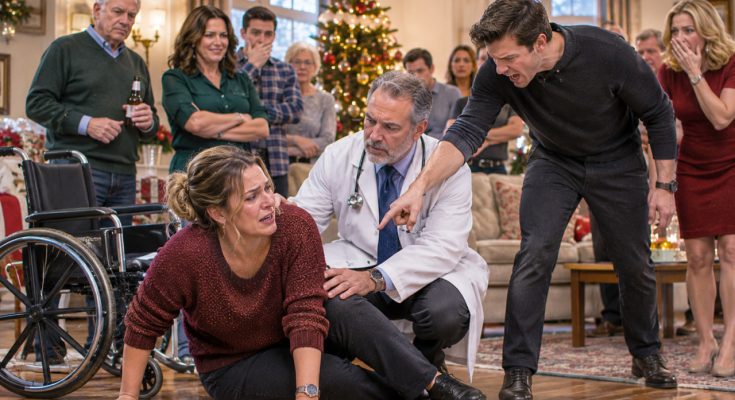
My brother had once pulled me out of my wheelchair because he wanted to prove I was pretending.
Instead, he had exposed something far more important.
He showed me who was willing to laugh when I fell, who was willing to remain silent, and who would kneel beside me when I needed help.
And I would never forget the difference.
Because the greatest victory wasn’t proving my brother wrong.
It was finally learning that I never needed his approval to believe in myself.

One Comment on “PART 5 – My Brother Pulled Me Out of My Wheelchair on Christmas Eve—Then My Neurologist Spoke Up”