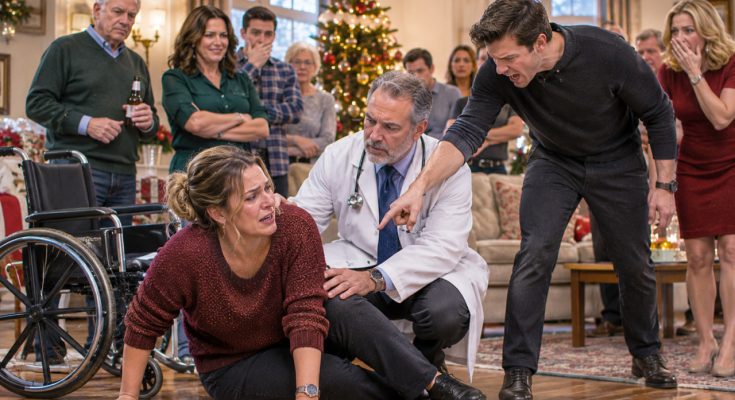
PART 3
Dad was already speaking to the emergency dispatcher.
Mom knelt beside me, her hands trembling.
“Emily, sweetheart, look at me.”
I turned my head.
“Did you know?”
She blinked.
“Know what?”
I pointed weakly toward the coffee table.
She followed my gaze.
Her eyes landed on Ryan’s phone.
For a second, I watched her expression change.
She understood.
She saw the message.
And she looked away.
That small movement hurt more than anything else that had happened that evening.
“Mom,” I whispered.
“Not now, sweetheart. Please. Let’s just get you checked out first.”
I wanted to ask her why she hadn’t defended me.
I wanted to ask whether she had known Ryan was planning something.
But before I could speak, Dr. Harris gently interrupted.
“Emily, I need you to concentrate on staying still. We’ll deal with everything else later.”
He checked my pulse and asked me several questions while keeping an eye on my breathing and movements.
Ryan stood near the fireplace.
His beer bottle was still in his hand.
He looked uncomfortable, but not particularly sorry.
Finally, he spoke.
“Everyone needs to calm down. I didn’t throw her.”
Dr. Harris slowly looked up.
“You pulled a woman with a documented neurological disability out of her wheelchair, ignored her request to stop, and released her when she couldn’t support her own weight.”
“I thought she was exaggerating.”
“You are not her physician.”
Ryan shook his head.
“Come on, man. You’ve known her for months. You’ve seen her stand.”
Dr. Harris didn’t raise his voice.
“Yes. With assistance, under controlled conditions, during supervised physical therapy. That does not mean she can safely stand independently.”
Ryan looked around the room, apparently searching for someone who would agree with him.
Uncle Gary cleared his throat.
“I think everybody just misunderstood what happened.”
Aunt Nancy turned toward him.
“Misunderstood? Gary, I watched him pull her up after she told him not to.”
Uncle Gary looked down.
Brandon slipped his phone into his pocket.
I noticed.
So did Dr. Harris.
“Don’t move anything,” he said.
Brandon froze.
“What?”
“The phone. Leave it where it is.”
Brandon glanced at Ryan.
Ryan immediately became defensive.
“Why are you treating us like criminals?”
Dr. Harris looked at him for several seconds.
“Because someone was injured, and the circumstances need to be documented.”
That was the first time Ryan seemed to understand that this wasn’t going to disappear with a family apology.
The paramedics arrived eleven minutes later.
Those eleven minutes felt longer than the four months I had spent learning how to live with my disability.
They asked questions, checked my condition, and carefully prepared to move me.
One of them asked whether I had experienced any new weakness or numbness.
“My right foot feels different,” I told him. “And my hip hurts.”
They exchanged a glance.
“Okay. We’re going to take you to the hospital to make sure there isn’t an injury.”
As they prepared the stretcher, Mom started crying harder.
“I’ll come with you.”
I nodded.
Dad grabbed my coat and handbag.
Dr. Harris spoke briefly with the paramedics and explained my medical history.
Ryan approached the stretcher.
“Emily.”
I looked at him.
He lowered his voice.
“Can we talk for a second?”
I said nothing.
He glanced toward the others.
“Look, I didn’t mean for you to fall.”
The paramedic adjusted the equipment.
Ryan continued.
“You know how you are sometimes. You take things personally. I was just trying to show everyone that you weren’t as helpless as you make yourself look.”
I stared at him.
For four months, I had been learning how to ask for help without feeling ashamed.
For four months, I had been trying to accept that my body could no longer do everything it once had.
And my own brother had turned that struggle into a joke.
“Ryan,” I said quietly, “you told everyone you were going to make me walk.”
He swallowed.
“I was joking.”
“No. You weren’t.”
His eyes shifted toward the coffee table.
I continued.
“You planned it. You told Brandon. You made a bet.”
“Emily, don’t make this bigger than it is.”
I almost laughed.
Not because anything was funny.
Because even after everything, he still believed he had the right to decide how serious my suffering was.
“Please move,” I told him.
The paramedic stepped between us.
Ryan backed away.
As they wheeled me toward the front door, I heard my father say something I had never heard him say to Ryan before.
“Don’t you dare follow her until you understand what you’ve done.”
At the hospital, the first few hours were a blur.
They examined my hip and back, checked for possible injuries, and performed neurological assessments to compare my condition with my previous examinations.
The doctors were particularly concerned about the new numbness in my right foot.
Fortunately, imaging showed no fracture or major traumatic injury.
But the fall had aggravated my existing pain, and my neurological symptoms needed further monitoring.
Dr. Harris stayed in contact with the emergency department.
He explained that my condition could fluctuate significantly, and that a brief period of standing did not mean I had regained normal strength or balance.
Around midnight, a nurse brought me a warm blanket.
Mom was sitting beside my bed.
Dad had gone home to retrieve my medications and medical records.
For a long time, neither of us spoke.
Then Mom finally whispered, “I’m so sorry.”
I looked at her.
“For what?”
She wiped her eyes.
“For tonight.”
I waited.
She took a breath.
“I should have stopped him before he touched you.”
“Yes.”
Her face crumpled.
“I was afraid he would make another scene.”
I turned toward the window.
“So you let him make one with me instead?”
She didn’t answer.
I wasn’t trying to hurt her.
But I was tired of protecting everybody else’s feelings while nobody protected mine.
“Mom, did you know Ryan was planning something?”
She shook her head quickly.
“No. I swear I didn’t know he was going to pull you out of the chair.”
“But you knew he thought I was pretending.”
She looked down.
“Yes.”
“How long?”
She hesitated.
“Since Thanksgiving, maybe even before.”
My chest tightened.
“What did he say?”
Mom took a tissue from her handbag.
“He kept telling us that you were making your condition seem worse than it was. He said you were using the wheelchair because you liked having everyone take care of you.”
I closed my eyes.
“And you believed him?”
“No, sweetheart.”
“Then why didn’t you tell him to stop?”
She started crying again.
“Because I thought he was just being insensitive. I thought if we ignored him, he would eventually get tired of it.”
I looked at her.
“Mom, I was the one who had to live with it.”
She reached for my hand.
“I know.”
“No, you don’t.”
My voice cracked.
“You don’t know what it’s like to wake up every morning and wonder whether your legs will work. You don’t know what it’s like to need someone to help you shower. You don’t know what it’s like to sit in a room full of people and wonder whether they’re looking at you because they feel sorry for you or because they think you’re lying.”
Mom lowered her head.
“I should have defended you.”
“Yes,” I whispered. “You should have.”
For the first time that evening, I allowed myself to cry.
Not because my brother had pulled me out of my wheelchair.
But because I had spent so much of my life believing my family would always be the safest place for me.
And now I wasn’t sure anymore.
At 1:37 a.m., my phone began vibrating.
It was Brandon.
I didn’t answer.
A message appeared.
Brandon: Emily, please don’t misunderstand what happened tonight.
Another message followed.
Brandon: Ryan was just trying to prove a point. Nobody thought you would actually fall.
I stared at the screen.
Then another message arrived.
Brandon: I know the bet looked bad, but it was just a joke.
I read it twice.
A joke.
Apparently, my brother’s cruelty was a joke.
My fall was a joke.
And the twenty dollars Brandon had wagered was also a joke.
I placed my phone facedown.
A few minutes later, Dr. Harris came into the room.
He had spoken with the hospital team and wanted to check how I was feeling.
After asking about my pain, he pulled a chair beside the bed.
“Emily, there’s something I want you to understand.”
I looked at him.
“What?”
“Your brother’s opinion does not change your diagnosis.”
I swallowed.
“I know.”
“Do you?”
I didn’t answer.
He continued.
“I’ve examined you. I’ve reviewed your test results. I’ve watched your strength fluctuate. I’ve seen you work through physical therapy. Your condition is real, and your limitations are real.”
My eyes filled again.
“Thank you.”
He nodded.
“And another thing. You are allowed to use a wheelchair even on days when you can stand. You don’t have to earn the right to use an accessibility device by being completely unable to move.”
That sentence stayed with me.
Because I had spent months feeling guilty every time I managed to take a few assisted steps.
I had somehow begun believing that every small improvement made my disability less legitimate.
Dr. Harris leaned forward.
“Recovery isn’t a performance, Emily. You don’t owe anyone a demonstration.”
For the first time that night, I felt someone had truly understood what I was going through.
The next morning, Dad returned with my medications and a bag of clothes.
He looked exhausted.
Mom was sitting in the corner, holding a cup of coffee she hadn’t touched.
Dad pulled a chair beside me.
“Your brother called.”
I looked at him.
“What did he say?”
“He wants us to tell everyone that it was an accident.”
I stared at him.
Dad rubbed his forehead.
“He says he didn’t intend to hurt you. He says everybody is making him look like a monster.”
I turned toward the ceiling.
“Did he apologize?”
Dad hesitated.
“He said he’s sorry you fell.”
I slowly turned my head.
“That’s not an apology.”
“I know.”
Dad looked down at his hands.
Then he said something that surprised me.
“Emily, I saw the message.”
My heart sank.
“What message?”
“The one on Ryan’s phone.”
I watched him carefully.
“He showed me something else before we left.”
“What?”
Dad took a breath.
“Brandon had sent him a message earlier that afternoon. Ryan had told him he was going to prove you could walk. Brandon replied that he would pay twenty dollars if you managed to stand for ten seconds.”
I closed my eyes.
Dad continued.
“I also saw a message from Ryan to your uncle.”
“What did it say?”
Dad’s jaw tightened.
“He wrote that if you fell, everyone would finally understand that you were exaggerating. If you stood, he would have proof that you didn’t need the wheelchair.”
I couldn’t speak.
Dad looked at me.
“I am ashamed.”
“Dad, why?”
“Because I knew Ryan had been saying terrible things about you. I kept telling myself he would grow out of it. I kept telling myself that he was your brother and that you two would work things out.”
He shook his head.
“But last night, I watched him hurt you, and I realized that I had been asking you to tolerate something you should never have had to tolerate.”
I reached for his hand.
He held mine tightly.
“I’m sorry, sweetheart.”
For once, I didn’t say it was okay.
Because it wasn’t.
But I squeezed his hand.
And that was enough for the moment.
Two days later, I was discharged.
I returned home with additional precautions, follow-up appointments, and instructions to avoid unnecessary transfers until my pain and neurological symptoms stabilized.
I expected the family messages to stop.
They didn’t.
Some relatives sent flowers.
Some sent cards.
A few called to ask how I was feeling.
But others seemed more concerned about Ryan.
My uncle Gary called first.
“Emily, I think it’s time everyone moved on.”
I was sitting on my sofa with a heating pad over my hip.
“Moved on from what?”
“Christmas. You know what I mean.”
“I was injured, Uncle Gary.”
“I know, but Ryan feels terrible.”
I almost dropped the phone.
“Does he?”
“He’s embarrassed. People are saying awful things about him.”
I looked at the wall.
“Did you say anything when he pulled me out of my wheelchair?”
Silence.
“Did you tell him to stop?”
Another silence.
“Then why are you calling me about his embarrassment?”
Gary sighed.
“I’m just trying to keep the family together.”
I closed my eyes.
“Then perhaps you should have tried keeping me safe.”
He didn’t respond.
I ended the call.
A few minutes later, my cousin Brandon sent another message.
This time, he wrote:
Brandon: I really didn’t think you would fall. I thought you could stand.
I typed a reply.
Then deleted it.
Typed another.
Deleted that too.
Finally, I sent one sentence.
Emily: You didn’t need to believe I would fall. You only needed to believe my brother had no right to pull me out of my wheelchair.
He never answered.
On December 29, I received an unexpected email.
The subject line read:
Request for a meeting – Christmas Eve incident.
It was from my aunt Nancy.
She wanted to speak with me privately.
I called her that evening.
“Emily, there’s something I think you should know.”
“What is it?”
“I took a photograph of the living room before the paramedics arrived.”
I frowned.
“Why?”
“Because I saw Ryan’s phone on the coffee table. I noticed the messages. I was afraid someone might try to deny what happened.”
My heart began beating faster.
“Do you still have the photograph?”
“Yes.”
She paused.
“And there’s something else.”
“What?”
“I recorded a short video before the incident.”
I sat up.
“What?”
“I was filming the Christmas decorations. I didn’t realize what was happening until Ryan started talking to you. The video captured some of the conversation.”
I couldn’t believe what I was hearing.
“Can you send it to me?”
“Of course.”
A few minutes later, a video appeared on my phone.
My hands trembled as I pressed play.
The video showed the Christmas tree, the fireplace, and several family members talking in the background.
Then Ryan’s voice became clear.
“You’re still using that thing?”
My own voice followed.
“I’m not discussing my medical condition with you.”
Then Ryan stepped behind me.
The camera moved slightly.
I heard myself say:
“Ryan, don’t.”
And then the image shook.
Aunt Nancy had turned the camera toward the room.
The video captured the moment he pulled me upward.
It captured my warning.
It captured my fall.
And most importantly, it captured his laughter.
But the video didn’t end there.
After I hit the floor, Ryan turned toward the people watching.
He said something that made my entire body go cold.
“See? That’s what I’ve been telling everyone. She doesn’t even try.”
Then Brandon’s voice came from somewhere behind the camera.
“Does that mean I win the twenty dollars?”
Ryan laughed.
“Give me my money after dinner.”
I stopped the video.
I couldn’t watch another second.
For four months, Ryan had been telling people I was pretending.
But now there was evidence that he had turned my disability into a planned public humiliation.
I looked at the screen.
Then I called Aunt Nancy.
“Nancy?”
“Yes, sweetheart?”
“Please don’t delete that video.”
“I won’t.”
“And please don’t send it to anyone yet.”
“Okay.”
I took a deep breath.
“I’m going to need it.”
Because I had finally understood something.
My brother was counting on everyone forgetting what happened.
He was counting on me apologizing for making Christmas uncomfortable.
He was counting on the family protecting him the way they always had.
But this time, I wasn’t going to help him rewrite the story.
And the next morning, when I opened my email, I found a message from Dr. Harris that would change everything.
He had reviewed my post-fall examination notes.
And he wanted me to come in for an urgent follow-up appointment.
Because there was something about my recovery that needed to be reassessed—and something he wanted me to understand before I faced my family again.
