PART 3
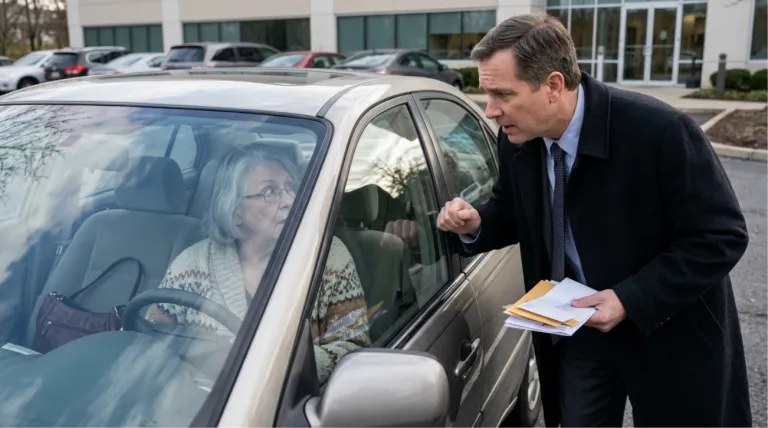
I stepped out of the car, straightened my cardigan, and picked up my purse.
Tom waited patiently.
Amanda hurried toward us.
“Mr. Harlan, I can explain. My mother and I were just on our way to her doctor’s appointment. I didn’t know she was coming here.”
Tom looked at her.
“That’s interesting, Amanda. Because your mother tells me you’ve been sitting in the parking lot for forty minutes.”
Amanda swallowed.
“I had an unexpected meeting.”
“An unexpected meeting that required your mother to sit in a car?”
“That’s not what I meant.”
Tom glanced at the coffee stain on her blouse.
“Then perhaps you can explain it inside.”
He turned toward the entrance.
I followed him.
Amanda followed us.
For the first time in six years, my daughter walked through those glass doors with me beside her.
And I noticed something.
The receptionist, who had been typing when Amanda entered earlier, immediately stood up.
“Good morning, Mr. Harlan.”
“Good morning, Susan. Please arrange the large conference room. I want the acquisitions team, legal department, and our chief financial officer there in fifteen minutes.”
“Of course, sir.”
Then he turned toward me.
“Mrs. Kessler, would you care for some water or coffee?”
“Water would be lovely.”
“Certainly.”
Amanda was standing a few feet behind us.
She looked as if she wanted to disappear into the polished marble floor.
Tom noticed.
“Amanda, please come with us. You’re going to want to hear this.”
We entered an elevator.
Nobody spoke during the ride.
When the doors opened, we stepped into a hallway lined with framed photographs of shopping centers, construction projects, and ribbon-cutting ceremonies.
Amanda had once shown me photographs of that hallway.
She had proudly explained that only senior employees were allowed to have offices on that floor.
She had never invited me to see it.
Now I was walking through it with the company president.
The receptionist brought us into a large conference room.
There was a long wooden table, leather chairs, and windows overlooking the highway.
Tom pulled out a chair for me.
“Please sit wherever you’re comfortable.”
I sat near the end of the table.
Amanda chose a chair across from me.
She kept adjusting her blouse.
Tom placed his phone on the table and looked at his watch.
“Before everyone arrives, Mrs. Kessler, I want to ask you something.”
“Go ahead.”
“Why haven’t you accepted any of our offers?”
I looked through the window.
From that height, I could see the highway, the old grain elevator, and the fields stretching toward the eastern side of the county.
Somewhere beyond those trees stood the farmhouse Walt and I had built our lives around.
“Because I don’t want to sell.”
Tom nodded slowly.
“I understand that. But I need you to understand what we’re planning.”
“I’ve read your letters.”
“Then you know we’re proposing a major commercial development. Shopping centers, restaurants, a hotel, medical offices, and a large distribution facility.”
“I know.”
“We’ve already invested more than seventy million dollars in surrounding properties, engineering, and infrastructure. The entire project depends on acquiring your eighty acres.”
I turned toward him.
“That sounds like an expensive problem.”
For the first time that morning, Tom smiled.
“It is.”
Amanda suddenly interrupted.
“Mr. Harlan, perhaps I should clarify something. My mother is getting older. She doesn’t always understand how complicated these transactions can be. I have been trying to help her make the right decision.”
I looked at my daughter.
I didn’t say anything.
Tom slowly leaned back.
“Is that so?”
“Yes.
I have explained the offers to her several times.”
“Have you?”
“Of course.”
He opened a folder.
“Then perhaps you can explain why the most recent proposal in our system lists your mother as having agreed to sell the property for two million dollars.”
My head turned toward him.
“Excuse me?”
Tom looked at me.
“That is what I wanted to discuss.”
Amanda’s face went pale.
“That was just a preliminary entry.”
Tom opened another document.
“It wasn’t preliminary. It was entered into our acquisition system six weeks ago. It states that the owner had verbally accepted the offer, subject to final documentation.”
I slowly placed my purse on the table.
“I never accepted two million dollars.”
“I know,” Tom replied.
He looked at Amanda.
“That’s why I asked you to come to this meeting.”
Amanda shifted in her chair.
“Mr. Harlan, I was handling the file.
There was a misunderstanding.”
“An expensive misunderstanding.”
“I was trying to move the project forward.”
“By recording an agreement that never happened?”
“I thought she would eventually accept.”
Tom closed the folder.
“That isn’t how we conduct business.”
I watched my daughter.
I remembered the countless times she had called me about the farm.
She had asked how much the land was worth.
She had asked whether I still intended to live there.
She had even suggested that I should move into a retirement community closer to her house.
At the time, I thought she was worried about me.
Now I wondered whether every question had been part of something else.
Tom turned toward me.
“Mrs. Kessler, I owe you an explanation. Your daughter has been the primary employee assigned to this acquisition file for nearly a year.
She has been responsible for coordinating the surrounding purchases and communicating with property owners.”
I nodded.
“Go on.”
“She has repeatedly told our leadership team that your property would eventually become available. In one meeting, she suggested that your lack of immediate family involvement meant the company could probably negotiate directly with her.”
I stared at him.
“Negotiate with her?”
Tom nodded.
“She said she was the person who understood your intentions.”
I looked across the table.
Amanda’s eyes were fixed on the papers.
“Is that true?” I asked.
“Mom, it’s not what you think.”
“Then tell me what it is.”
She opened her mouth, but no words came out.
At that moment, the conference room door opened.
Three people entered.
A woman from legal, a man carrying a laptop, and an older gentleman whom Tom introduced as the company’s chief financial officer.
Everyone greeted me politely.
Then Tom stood.
“Thank you for coming. We have an issue with the Kessler acquisition file, and I want everything reviewed before anyone takes another step.”
The woman from legal opened her notebook.
“Mr. Harlan, are we discussing the eighty-acre parcel?”
“Yes.”
She glanced at Amanda.
“Then I need to see the original correspondence and every internal communication relating to the owner.”
Tom nodded.
“Please pull everything.”
Amanda suddenly sat forward.
“Do we really need to do this in front of my mother?”
Tom’s expression became serious.
“Your mother is the property owner. She is the most important person in this room.”
Nobody spoke.
I looked at Amanda.
For years, I had been made to feel like an inconvenience.
At family dinners, she would correct the way I pronounced certain words.
When her friends visited, she would ask me not to discuss farming because it was “not very interesting to people in her industry.”
When she bought her expensive house, she introduced me to her neighbors as someone who “lived out in the country.”
I had never complained.
I thought perhaps she was embarrassed by my simple life.
But sitting there, I began to understand that she might have been embarrassed by something much more important.
She had never understood the value of the land she was so eager to sell.
And she certainly hadn’t understood the woman who owned it.
The legal director returned with a thick folder.
“Mr. Harlan, I have the correspondence.”
She placed several documents on the table.
Tom turned toward me.
“Mrs. Kessler, may I show you something?”
“Of course.”
He opened the folder.
The first document was a letter dated two years earlier.
I recognized it immediately.
It was the first offer.
Two million dollars.
I had read it at my kitchen table, placed it back in its envelope, and filed it away in the old wooden cabinet Walt had built.
Tom placed another letter beside it.
Then another.
Eleven letters in total.
“These were all sent to your home address,” he said.
“Yes.”
“Did anyone from our company ever speak to you directly?”
“Not until today.”
The legal director frowned.
“That’s strange.”
Tom looked at her.
“What do you mean?”
She flipped through the correspondence.
“According to our records, there were three scheduled attempts to arrange an in-person meeting with Mrs. Kessler. All three were marked as completed.”
I looked at the documents.
“Nobody came to my house.”
Tom’s eyes narrowed.
“Who marked them completed?”
The legal director turned a page.
“Amanda Kessler.”
The room became very quiet.
Amanda immediately stood.
“I was coordinating the schedule. Those were administrative updates.”
“Did you meet Mrs. Kessler?” Tom asked.
“No.”
“Did you speak with her?”
“No, but—”
“Then why were the meetings marked completed?”
Amanda looked around the table.
“I said it was an administrative error.”
Tom didn’t raise his voice.
That somehow made the situation worse.
“Sit down, Amanda.”
She slowly returned to her chair.
The legal director continued.
“There’s something else. The file contains a note indicating that Mrs. Kessler had allegedly expressed an intention to leave the property to her daughter.”
I looked up.
“What?”
Amanda rubbed her forehead.
“Mom, we talked about this.”
“No, Amanda. We didn’t.”
“Yes, we did. You said you wanted me to have the farm eventually.”
“I said I wanted you to have something meaningful from your father and me. I never said you could sell my land while I was still living on it.”
“That’s not what I meant.”
Tom raised one hand.
“Let’s stay with the documents.”
The legal director pulled out another page.
“This note was entered four months ago.
It states that the owner’s daughter was authorized to communicate on her behalf regarding potential sale terms.”
I shook my head.
“I never gave anyone that authority.”
“Do you have any written authorization?” she asked Amanda.
Amanda didn’t answer.
The legal director looked at her again.
“Any power of attorney? Any signed agency agreement? Anything showing that Mrs. Kessler authorized you to represent her?”
“No.”
“Then the note is unsupported.”
Amanda’s hands were shaking.
I looked at her, and for a moment I felt something I couldn’t quite describe.
It wasn’t anger.
It was sadness.
I had raised that girl.
I remembered her first bicycle.
I remembered the time she fell into the pond behind the barn and Walt jumped in wearing his Sunday clothes to pull her out.
I remembered how she used to run across the kitchen when I baked apple pies.
She had once been a little girl who believed that the farm was the most wonderful place in the world.
Now she seemed determined to erase it.
Tom closed the folder.
“Mrs. Kessler, I want to make one thing clear. Our company will not purchase your property through misleading representations or unauthorized negotiations. I will have the entire file independently reviewed.”
“Thank you,” I said.
He nodded.
“But I also want to make you another offer.”
Amanda immediately looked up.
Tom reached into his briefcase and placed a document in front of me.
“We are prepared to increase our offer substantially.”
I glanced at the number.
Five million dollars.
Amanda leaned forward.
“Five million?”
Tom nodded.
“That’s our current proposal. We believe it reflects the importance of your property to the project.”
I stared at the paper.
Five million dollars.
It was more money than Walt and I had ever imagined having.
It could buy a beautiful house in town.
It could pay for medical care.
It could leave enough for Amanda’s future.
But something about the number made me uncomfortable.
Tom was watching my reaction.
“Mrs. Kessler?”
I gently pushed the paper back.
“I appreciate the offer.”
“Would you like some time to consider it?”
“I don’t need time to consider something I don’t want.”
Amanda made a small frustrated noise.
“Mom, please. Five million dollars! Do you understand what that could do for you?”
I turned toward her.
“I understand perfectly.”
“Then why would you refuse it?”
I looked at the land visible through the window.
“Because your father and I didn’t spend fifty years building a home just so someone could put a parking lot where his apple trees used to grow.”
Amanda shook her head.
“You’re being emotional.”
“Of course I am. It’s my home.”
She looked away.
Tom slowly nodded.
“I respect that.”
He gathered the papers.
“Then I think we should discuss another possibility.”
“What possibility?”
“Perhaps you would consider a partnership instead of a sale.”
I looked at him.
He continued.
“We could redesign the eastern section of the development to preserve part of your land. We could build around the farmhouse, maintain access to the old road, and create a public green space along the creek.”
I hadn’t expected that.
For the first time that morning, I leaned forward.
“Would the old oak trees remain?”
“That would be part of the design discussion.”
“And the creek?”
“We can protect the natural drainage area.”
“What about the barn?”
“We would need an engineering assessment, but we could potentially preserve it.”
I considered his words.
Walt had always loved that barn.
He built it with his own hands, one board at a time.
When he was younger, he used to say that the barn would outlast both of us.
I looked at Tom.
“I would need to see those plans.”
“Absolutely.”
He smiled.
“That’s a reasonable place to start.”
But before anyone could say another word, the legal director’s phone vibrated.
She glanced at the screen.
Then she looked at Tom.
“Sir, I think you need to see this.”
“What is it?”
She handed him the phone.
Tom read the message.
His expression changed immediately.
“Where did this come from?”
“The county planning office. They just sent us a copy of a document submitted yesterday.”
He looked at me.
“Mrs. Kessler, have you signed anything with another developer?”
“No.”
“Have you given anyone permission to submit a development application involving your land?”
“No. I haven’t signed anything.”
He turned toward the legal director.
“What’s the document?”
She hesitated.
“It’s a preliminary planning application. It lists the Kessler property as part of a proposed commercial development.”
I frowned.
“But you just said your company was planning to buy my land.”
“We are,” Tom replied.
“Then who submitted that application?”
The legal director looked down at the screen.
“The applicant is a private development company called Greenfield Holdings.”
Tom’s face became rigid.
He looked at Amanda.
“Do you know anything about Greenfield Holdings?”
Amanda didn’t move.
For several seconds, nobody spoke.
Then she whispered something.
I almost didn’t hear it.
“They were supposed to wait.”
Tom slowly stood up.
“What did you just say?”
Amanda’s eyes widened.
“Nothing.”
But I had heard her.
And judging by Tom’s expression, so had everyone else.
He placed both hands on the conference table.
“Amanda, what were they supposed to wait for?”
She looked at me.
Then at the door.
And for the first time in my life, I saw my daughter looking at me as though I were a stranger.
“Mom,” she whispered, “please don’t make this worse.”
I felt a coldness settle in my chest.
“What have you done?”
She shook her head.
“I can explain.”
“Then explain.”
Her lips trembled.
Before she could speak, the legal director opened another file on her laptop.
“Mr. Harlan,” she said quietly, “I think there’s something else you should know.”
Tom turned.
“What now?”
She looked at the screen.
“Greenfield Holdings was registered eighteen months ago. The registered managing director is Amanda’s husband, Daniel.”
My daughter closed her eyes.
I stared at her.
Daniel.
My son-in-law.
The man who had eaten at my kitchen table every Thanksgiving for nine years.
The man who had once asked Walt to teach him how to repair the old tractor.
The man who had called me Mom when he wanted something.
Tom looked between us.
“Mrs.
Kessler, I’m afraid this situation is considerably more serious than I first understood.”
I couldn’t take my eyes off Amanda.
“Why would Daniel have a company buying land around my farm?”
Amanda started crying.
Not loudly.
Just a few tears slipping down her cheeks.
“Mom, we weren’t trying to hurt you.”
I slowly stood up.
“Then why didn’t you tell me?”
She wiped her face.
“Because you would have said no.”
I looked at her.
And there it was.
The truth.
Not a misunderstanding.
Not a business decision.
Not an administrative error.
She knew I would say no.
So she had decided that my answer didn’t matter.
I picked up my purse.
“Mr. Harlan, I think I’ve heard enough for today.”
He immediately stood.
“Mrs. Kessler, I can arrange for someone to drive you home.”
“No, thank you. I drove here with my daughter.
I can drive myself.”
Amanda stood quickly.
“Mom, wait.”
I turned toward her.
She looked desperate.
“Please. Don’t leave like this.”
I studied her face.
“How would you like me to leave, Amanda?”
She had no answer.
I walked toward the door.
But just before I reached it, Tom spoke again.
“Mrs. Kessler, one more thing.”
I turned.
He held up a document.
“Greenfield Holdings submitted a purchase option request to the county using a document that appears to contain your name.”
My stomach tightened.
“What do you mean, my name?”
He looked directly at me.
“The signature on the attached document is supposedly yours.”
I felt my fingers tighten around my purse.
“That’s impossible.”
Tom nodded.
“That’s what I suspected.”
He placed the paper on the table.
I walked back and looked down.
There it was.
My full name.
Dorothy Mae Kessler.
And underneath it was a signature that looked almost exactly like mine.
Almost.
But not quite.
I leaned closer.
Then I noticed the date.
The document had been signed three months earlier.
Three months earlier, I had been recovering from a bad fall in my kitchen.
I had spent two nights at Amanda’s house because she insisted I shouldn’t be alone.
I remembered that week very clearly.
Daniel had brought me several papers to sign.
He told me they were insurance documents and medical authorization forms.
I had trusted him.
I had signed where he pointed.
But I had never agreed to sell my farm.
I looked at Amanda.
“Was this one of the papers Daniel brought me?”
Her face crumpled.
And she didn’t answer.
That silence told me more than any confession could have.
I slowly placed the document back on the table.
“Tom,” I said, “I need a copy of this.”
“Of course.”
“And I want the original preserved.”
The legal director nodded.
“We’ll make sure of that.”
I took one last look at my daughter.
“Your father always told me that land remembers everything. Every footprint. Every fence post. Every promise made on it.”
Amanda began sobbing.
I continued.
“I used to think he was talking about the soil.”
I looked down at the signature.
“Now I think he was talking about people.”
Then I walked out.
For the first time in six years, I didn’t wait for Amanda to follow me.
I drove home alone.
The eighty acres looked exactly as they had that morning.
The old barn stood beside the farmhouse.
The apple trees were beginning to lose their leaves.
The creek moved quietly beneath the wooden bridge Walt had built in 1982.
I parked beside the porch and sat for several minutes.
Then I went inside.
I walked straight to the old wooden cabinet in the living room.
Walt had always kept important papers in the bottom drawer.
Property deeds.
Tax records.
Survey maps.
Insurance documents.
And a thick envelope with his handwriting on the front.
FOR DOROTHY. ONLY OPEN IF SOMEONE EVER TRIES TO TAKE OUR FARM.
I had found that envelope after he died.
But I had never opened it.
At the time, I thought it was simply another one of Walt’s sentimental habits.
Now, with the image of my forged signature still in my mind, I pulled the envelope from the drawer.
It was heavier than I remembered.
I carefully opened it.
Inside were several documents.
The first was a copy of our original property deed.
The second was a survey map.
The third was a letter.
I recognized Walt’s handwriting immediately.
My hands began to shake as I unfolded it.
“Dear Dorothy,
If you’re reading this, someone may have come looking for the land.
