PART 5
He stared at the table.
Finally, he said, “Because I have a business problem.”
“What kind of problem?”
He hesitated.
“Brielle and I have some debts. The business hasn’t been doing as well as I expected. The bank wants additional security.”
I felt my heart sink.
“How much?”
He looked away.
“About two hundred thousand dollars.”
I closed my eyes.
There it was.
The reason for the papers.
He wasn’t trying to make things easier for me.
He wanted the farmhouse to become security for his financial problems.
“Why didn’t you tell me?” I whispered.
“Because I didn’t want you worrying.”
I looked at him.
“You thought handing your mother a property transfer was less worrying than telling her the truth?”
He didn’t respond.
Then I asked the question I had been afraid to ask.
“Was the motel part of your plan to get me to sign?”
His face changed.
“No.”
“Then why did you send me there?”
He rubbed his hands together.
“Mom, Brielle’s parents were coming. We didn’t have room.”
“Your spare room had a treadmill in it.”
He said nothing.
I looked at my son.
“Do you know what hurt me most?”
He finally raised his eyes.
“It wasn’t the motel. It wasn’t the fifty-nine dollars. It wasn’t even the fact that I had to take a cab with my walker.”
My voice broke.
“It was watching my grandchildren sit on those stairs while their father explained that Grandma was going to a hotel like she was going on vacation.”
Craig looked down.
“They were asking questions. You could have told them the truth.”
He swallowed.
“I didn’t know what to say.”
“You could have said that your mother needed help.”
For the first time, his eyes filled.
But I wasn’t finished.
“Craig, I raised you to be a good man. I never expected you to repay every dollar I spent on you. I never expected you to buy me a house or give me expensive presents.”
I paused.
“I only expected you to remember that I am your mother.”
He covered his face with one hand.
“I’m sorry, Mom.”
I looked at him.
“Are you sorry because you hurt me, or because I won’t sign the papers?”
He didn’t answer immediately.
And that silence told me more than any apology could.
Margaret closed the folder.
“Mrs. Briggs, you don’t need to make any decisions today.”
I nodded.
“I know.”
Then I turned to Craig.
“The farmhouse stays in my name.
I’m not putting my home at risk to solve a debt I didn’t create.”
He nodded slowly.
“Okay.”
“And I want you to understand something else. I love you. But loving you doesn’t mean I have to give you everything you ask for.”
Craig began crying.
“I’m sorry, Mom.”
This time, I believed he understood that something had changed.
But understanding was only the beginning.
He still had to prove it.
Two days after Christmas, Craig came to see me again.
This time, he came alone.
He brought a small bag of groceries and a box of my favorite tea.
He sat across from me in the motel room.
“I’ve been thinking about what you said.”
I waited.
“Brielle and I talked. We realized we had been treating the spare room like storage instead of thinking about what you needed.”
I didn’t say anything.
He continued.
“I know that’s not an excuse.”
“No, son. It isn’t.”
He nodded.
“I also talked to the bank. I’m going to work out the business debt without involving your property.”
I was glad to hear that.
But I still needed to ask something.
“What did you tell Avery and Jonah?”
He looked embarrassed.
“I told them the truth.”
“What truth?”
“That Grandma needed a safe place to recover, and I didn’t make the right arrangements.”
I looked at him carefully.
“And what did they say?”
He smiled sadly.
“Jonah asked why I didn’t let you sleep in his room.”
I felt my eyes fill.
Craig continued.
“Avery asked whether you thought we didn’t love you anymore.”
I turned toward the window.
Sometimes children ask questions that adults spend years avoiding.
Craig reached into his pocket.
He pulled out a small folded piece of paper.
It was yellow.
Another sticky note.
I felt my stomach tighten.
But when he opened it, I saw that it wasn’t an address.
It was a drawing.
A little house, a Christmas tree, and three people holding hands.
At the bottom, Jonah had written:
Grandma, we saved you a place.
Craig’s voice broke.
“They want to see you.”
I took the drawing.
Then I looked at my son.
“Of course I want to see them.”
He nodded.
“Would you come home for New Year’s dinner?”
I thought for a moment.
“Not to stay.”
He looked disappointed.
“But I’d like to come for a visit. If there’s a proper place for me to sit, and if the children want me there.”
“There is, Mom.”
“And Craig?”
“Yes?”
“Don’t ever make me feel like I have to earn a place in your home.”
He lowered his head.
“I won’t.”
I wanted to believe him.
But I had learned that promises and actions were two different things.
On December 31, Darnell drove me to Craig’s house.
I was still using my walker, but my knee was healing.
When the front door opened, Jonah came running.
“GRANDMA!”
He wrapped his arms around my waist carefully.
Avery followed.
“We missed you!”
I hugged both of them.
Then I saw Brielle standing in the doorway.
She looked uncomfortable.
“Hello, Leona.”
“Hello, Brielle.”
She glanced at my walker.
“I’ve been meaning to apologize.”
I waited.
She looked down.
“I was selfish. I didn’t think about how difficult things would be for you. I should have made room.”
I nodded.
“Yes, you should have.”
Her eyes filled.
“I’m sorry.”
I didn’t hug her immediately.
Not because I hated her.
But because I had spent too many years believing that being a good mother meant swallowing every hurt.
I had finally learned that forgiveness didn’t require pretending nothing had happened.
“Thank you for saying that,” I told her.
Then she stepped aside.
And I saw something that made me stop.
The treadmill was gone.
The Christmas decorations had been moved.
There was a proper bed in the spare room.
Beside it was a little table with a lamp, a vase of flowers, and a framed photograph of Orval and me.
Jonah tugged my sleeve.
“That’s your room, Grandma. Daddy made it.”
I looked at Craig.
He was standing behind the children.
“I know it’s late,” he said. “And I know I can’t undo what happened. But if you ever need a place to stay again, I want you to have a real room here.”
I walked slowly into the room.
The bed looked comfortable.
The curtains were open.
There was even a small basket with my favorite biscuits.
I touched the photograph of Orval.
For a moment, I imagined what he would have said.
He had always believed that family was something you cared for, not something you used when convenient.
I sat on the bed.
Then I looked at Craig.
“Thank you.”
He smiled.
“You’re welcome, Mom.”
“But I need you to understand something.”
His smile faded.
“I’m listening.”
“I have a home. I have my own money. I have friends. I have a life. I love visiting you, but I don’t want to become somebody who has to depend on whether there’s an empty room available.”
He nodded.
“I understand.”
“And I will never sign away my independence just to make things easier for somebody else.”
“I understand, Mom.”
This time, he didn’t argue.
By February, my knee had healed enough for me to return to the farmhouse.
I moved back into my bedroom upstairs, one careful step at a time.
Darnell and Renee helped arrange a few things around the house so I could move more safely.
They never made me feel that I owed them anything.
In March, I received a letter from Darnell.
Inside was a photograph.
It showed him as a little boy, sitting at my kitchen table.
His hair was messy, his shirt was too big, and there was a plate of pie in front of him.
On the back, he had written:
You gave a hungry boy a place at your table. He grew up, found his way, and never forgot.
I put the photograph in a frame beside Orval’s picture.
Then I did something I had been thinking about for weeks.
I called Margaret.
I wanted to make a few changes to my estate plan.
Not because I was angry with Craig.
Not because I wanted to punish him.
But because I wanted my wishes to be clear.
I decided to leave the farmhouse to be sold after my passing, with the proceeds divided according to a new will.
I also set aside money for Avery and Jonah’s education.
And I established a small fund through Darnell and Renee’s foundation to help older people recovering from surgery who had nowhere safe to go.
I called it the Orval and Leona Briggs Family Table Fund.
Darnell cried when he heard about it.
“Mrs. Briggs, you don’t have to do that.”
I smiled.
“I know, sweetheart. That’s why I want to.”
That Christmas, almost a year after the motel incident, I hosted dinner at my farmhouse.
Craig, Brielle, Avery, and Jonah came.
So did Darnell, Renee, Maya, and Caleb.
The house was full of laughter.
There were presents under the tree, pies cooling on the counter, and enough food to feed twice as many people.
At dinner, Jonah sat beside me.
He looked up and asked, “Grandma, remember when Daddy sent you to the hotel?”
The room became quiet.
Craig looked down at his plate.
I gently touched Jonah’s hand.
“Yes, sweetheart. I remember.”
“Are you mad at Daddy?”
I looked across the table.
Craig was watching me.
I thought carefully before answering.
“I’m not going to spend my life being angry, Jonah. But I hope your daddy remembers what happened and learns from it.”
Jonah nodded.
Then he asked, “Can Grandma always come here now?”
I smiled.
“Grandma can always come here because she loves you. And Grandma also has her own house.”
Everybody laughed softly.
After dinner, Craig helped me carry the dishes into the kitchen.
When we were alone, he stopped beside me.
“Mom?”
“Yes, son?”
“I want to tell you something.”
I turned around.
“I know I haven’t earned your trust back completely.
I know saying sorry doesn’t fix everything.”
I nodded.
“But I’ve been trying to be different. I don’t want my children growing up thinking that family is something you make room for only when it’s convenient.”
I looked at him.
“Then keep showing them.”
He nodded.
“I will.”
Then he hugged me.
It wasn’t the hug of a little boy who wanted his mother to make everything better.
It was the hug of a grown man who finally understood that his mother was a person, too.
And I hugged him back.
Later that evening, after everybody had gone home, I sat alone beside the Christmas tree.
I thought about the motel.
The pink neon star.
The little room.
The fifty-nine dollars.
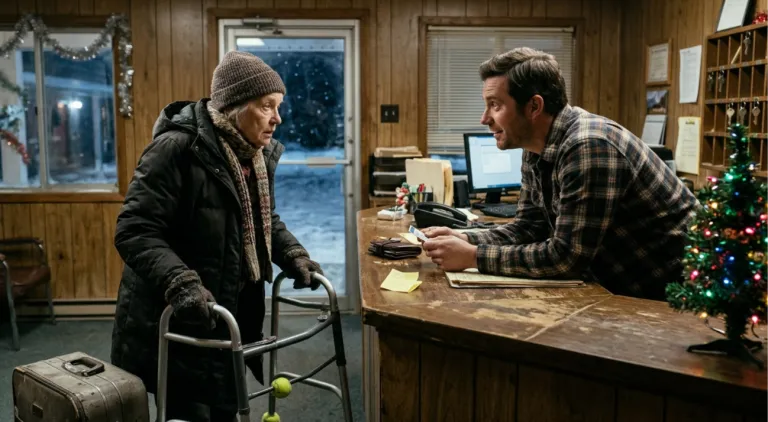
And the man behind the desk who had looked at my license twice before recognizing my name.
If Darnell hadn’t been there, I might have spent Christmas alone, wondering what I had done wrong.
But life had reminded me of something I should have understood long ago.
Sometimes the people you raise aren’t the people who show up when you need them.
And sometimes the people you help along the way become the family that saves you.
I didn’t stop loving my son.
I didn’t stop wanting him in my life.
But I stopped believing that being a mother meant accepting whatever treatment came with the title.
I learned that I could forgive someone and still have boundaries.
I could love my family and still protect my home.
And I could grow old without becoming a burden.
On the little table beside my chair was the yellow sticky note Craig had given me that terrible afternoon.
I’d kept it.
Not because I wanted to remember the humiliation.
But because I wanted to remember the day I learned that my worth wasn’t determined by whether somebody had room for me.
I turned it over.
On the blank side, I wrote five words:
THERE IS ALWAYS ROOM FOR LOVE.
Then I placed it beside Darnell’s childhood photograph.
Because thirty years earlier, I had given a hungry boy a plate of supper.
And somehow, all those years later, that little act of kindness had found its way back to me.
The greatest gift I received that Christmas wasn’t a new room, a warm meal, or even an apology.
It was the reminder that I still mattered.
And I always had.

One Comment on “PART 5 – My Son Sent Me to a $59 Motel After Knee Surgery—But the Man Behind the Desk Recognized My Name and Changed My Christmas Forever”