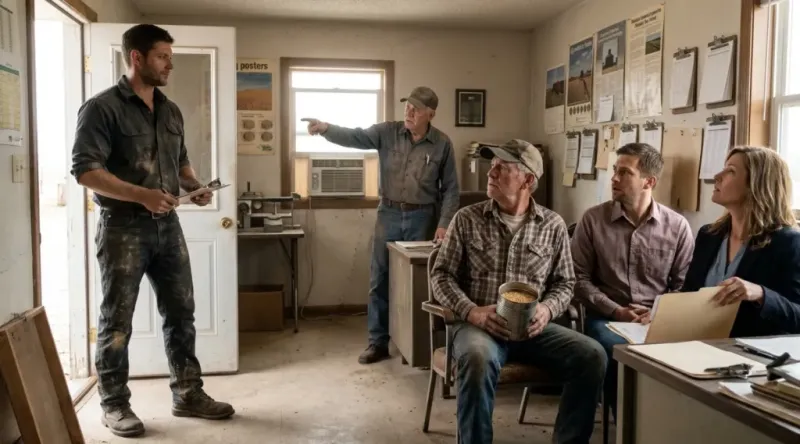
PART 3
I pulled out the chair across from him.
“Then let’s look at the numbers.”
Dad pushed the coffee can toward me.
“Twelve thousand bushels. Good wheat. Held it back because prices were supposed to improve.”
I opened the can and examined the sample.
The wheat looked reasonable at first glance. I rubbed a handful between my fingers, brought it closer to my nose, and smelled it.
Then I took another handful.
Dad watched me.
“Well?”
“Where has it been stored?”
“On the farm.”
“I mean which bins?”
“The north bins.”
“How long?”
“Since last harvest.”
I nodded and placed the sample on the table.
“Some of it may have a storage problem.”
Dad’s expression hardened.
“There’s nothing wrong with that wheat.”
“I haven’t finished testing it.”
“Your grandfather taught you how to grade wheat. I know that.”
I looked at him.
“Then you know I won’t change a grade just because somebody wants a better number.”
The room became quiet.
I sent the sample to the lab for a complete analysis. While we waited, Denise opened the bank folder.
“There’s another issue,” she said.
Dad shifted in his chair.
“What issue?”
“The collateral.”
She turned a page.
“The bank’s records show that the original home quarter was pledged against the construction loan for the hunting lodge. The loan is now delinquent.”
I looked at Dad.
The home quarter.
Grandpa’s 160 acres.
The land Dad had given Rance at that graduation party while telling sixty people that he only had one son.
Rance rubbed his forehead.
“We’re working on that.”
Denise continued.
“The property has an outstanding balance that exceeds what the bank originally expected. There are also unpaid property taxes and several contractor liens.”
Dad waved his hand.
“That’s between me and the bank. We’re here about the wheat.”
“Actually,” Denise replied, “the two are connected.
The grain proceeds are part of the repayment plan.”
I leaned back.
“What does the bank need from us?”
Denise looked at her papers.
“A firm contract. But we also need to know whether the cooperative can accept the entire quantity.”
I folded my hands.
“That depends on the quality, the available space, and our existing member commitments.”
Dad’s jaw tightened.
“You’re telling me you might turn away your own father’s wheat?”
I didn’t answer immediately.
That word again.
Own.
His own son.
His own father’s land.
His own family.
For twelve years, that word had been used to describe everything I was expected to give and nothing I was allowed to keep.
“Mr. Hogan,” I said, “I manage a cooperative. I don’t manage family favors.”
He stared at me.
“You’ve changed.”
“No,” I replied. “I learned.”
Lloyd looked down at his desk, hiding what might have been a smile.
The lab results arrived forty minutes later.
I read through them carefully.
Some of the wheat was marketable. Some had elevated moisture and a musty odor. It wasn’t all worthless, but it wasn’t the premium grain Dad had promised the bank.
I explained the results and gave him the available pricing options.
Dad listened with his arms crossed.
When I finished, he looked at me.
“Can’t you do something?”
“I’ve done something. I’ve tested it honestly and given you the options.”
“You’re the general manager.”
“That doesn’t mean I can change the results.”
Rance leaned forward.
“Maybe we can arrange a special contract.”
I looked at him.
“We can arrange a contract under the same terms available to other producers with the same grade and delivery conditions.”
He shook his head.
“That’s not what I meant.”
“I know.”
For a moment, I thought Dad might explode.
Instead, he stood up.
“Fine. We’ll take our business somewhere else.”
Denise closed her folder.
“Roger, another elevator may not offer better terms. We should review the numbers before making that decision.”
Dad grabbed his coat.
“I’ve had enough.”
Rance followed him.
At the doorway, Dad stopped.
“You think you’ve made something of yourself because you’ve got an office and people call you boss?”
I remained seated.
“No.”
“Then what?”
I looked at the sample sitting on the table.
“I think I’ve made something of myself because I know what my work is worth.”
He stared at me for several seconds.
Then he walked out.
I thought that would be the end of it.
I was wrong.
That evening, Carrie was making supper when I came home.
Josie was at the kitchen table, drawing a picture of our house.
She had colored the roof purple and added a yellow sun with an enormous smile.
“You’re late,” Carrie said.
“Family business.”
She looked up.
“Your father?”
I nodded.
She turned down the stove.
“How did it go?”
I told her everything.
The wheat.
The loan.
The hunting lodge.
The home quarter.
When I mentioned the land, she stopped stirring.
“Wait. The same land your grandfather wanted you to have?”
“Yes.”
“And it’s in trouble?”
“Apparently.”
Carrie sat across from me.
“How do you feel?”
I thought about giving her the easy answer.
Angry.
Bitter.
Satisfied that my father had finally seen me in a position of authority.
But none of those words quite fit.
“I feel like I’m twenty-two again,” I admitted. “Like I’m standing in that shed, listening to everybody laugh.”
Carrie reached across the table and took my hand.
“You aren’t twenty-two anymore.”
“I know.”
“And you don’t owe him your life just because he finally needs something from you.”
I looked at her.
That was one of the reasons I had married Carrie.
She never confused forgiveness with surrender.
Josie looked up from her drawing.
“Dad?”
“Yes, sweetheart?”
“Is Grandpa coming to my birthday?”
I glanced at Carrie.
We had never told Josie the whole story. She knew Grandpa lived far away and that we didn’t visit often. She knew Grandma sometimes called.
“I don’t know,” I said.
She nodded and returned to her drawing.
Then she added another little figure beside our house.
“That’s you,” she said, pointing at the picture.
“And that’s Mommy.”
“Who’s this?”
“Me.”
“Who’s the little one?”
She looked up.
“That’s Grandpa. I put him outside because I don’t know if he wants to come in.”
Carrie turned away.
I stared at the drawing for a long time.
Children have a way of asking questions adults spend years avoiding.
Three days later, Mom called.
I almost didn’t answer.
Her name appeared on my screen while I was reviewing a delivery schedule.
I picked up.
“Hello, Mom.”
There was a pause.
Then I heard her crying.
“Your father came home furious.”
“I’m sorry to hear that.”
“He says you humiliated him.”
I closed my eyes.
“I didn’t say anything about him. I graded the grain.”
“I know.”
She sounded exhausted.
“He’s telling everyone you refused to help him because of something that happened twelve years ago.”
I leaned back.
“Did he tell them why I left?”
Silence.
“Mom?”
“No.”
“Did he tell them he took my paychecks?”
Another silence.
“Did he tell them about Grandpa’s land?”
She began crying harder.
“No, honey.”
I looked through the office window at the trucks waiting to unload.
“Then what exactly is he telling them?”
“That you’ve become successful and forgotten your family.”
I almost laughed.
Not because it was funny.
Because I had spent twelve years building a life without asking him for a single dollar, and somehow I was the one accused of forgetting family.
“Mom, I haven’t forgotten anybody.”
“I know you haven’t.”
“Then why are you calling?”
She took a shaky breath.
“Because Rance is in trouble.”
I waited.
“The bank has given them thirty days.”
“Thirty days for what?”
“To make the payment or agree to a sale.”
I rubbed my forehead.
“What does that have to do with me?”
“Your father thinks you can buy the land.”
I stared at the desk.
There it was.
Not an apology.
Not an invitation.
Not even an acknowledgment of what had happened.
A request disguised as family concern.
“Mom, I can’t use cooperative money to buy somebody’s private property.”
“I know.”
“And I won’t use my position to get a special deal.”
“I know that too.”
She hesitated.
“But there’s something else.”
I waited.
“Your grandfather left something.”
My hand stopped moving.
“What?”
“A letter.”
“What letter?”
“He gave it to me before he died. He told me not to open it unless the family ever came to a point where one of his grandchildren needed to know the truth.”
I sat up.
“Why didn’t you tell me?”
“I was afraid.”
“Afraid of what?”
“Your father.”
The answer was so quiet that it hurt more than if she had shouted.
“Where is it?”
“At the house. In the old cedar box in my closet.”
I looked toward the window again.
“What does it say?”
“I haven’t opened it.”
“Then how do you know it’s important?”
“Because your grandfather told me it was about the home quarter.”
My throat tightened.
“Mom, I’ll come get it.”
“Please don’t tell your father.”
“I won’t.”
After we hung up, I sat alone for nearly twenty minutes.
Grandpa had been dead for nine years.
Nine years.
And somehow, even after all that time, he was still finding a way to speak.
I drove to Highmore the following Saturday.
The old Hogan house looked smaller than I remembered.
The porch still sagged on the left side. The windmill still turned behind the machine shed. A row of sunflowers stood beside the driveway, their heads heavy and bent.
Mom opened the door before I knocked.
She looked older.
Her hair had turned almost completely white, and the lines around her eyes had deepened.
She hugged me.
Not the quick kind of hug people give when they’re afraid of being seen.
A real one.
“I’m glad you came,” she whispered.
We went into her bedroom.
From the closet, she pulled out a small cedar box with a brass latch.
It smelled faintly of dust and Grandpa’s old tobacco.
Inside were several photographs, a pocketknife, two yellowed envelopes, and a folded document tied with string.
Mom handed me the larger envelope.
My name was written across the front.
Not Rance.
Not Roger.
Mine.
The handwriting was unmistakable.
Grandpa’s.
I sat on the edge of the bed.
My hands trembled as I opened it.
The letter began:
To my grandson,
If you’re reading this, something has happened that I hoped would never happen. I hope you are still the kind of young man who believes hard work matters, because that is the one thing nobody can take away from you.
I stopped.
My eyes burned.
I continued.
I know your father believes the land should go to the son who makes the most noise about it. I also know which one of you has spent his life learning how to care for it.
You are not required to stay on this farm to prove your love for it.
But I want you to know something.
The home quarter was never meant to be a prize.
It was meant to be a responsibility.
I looked up at Mom.
She was crying silently.
I returned to the letter.
I have made arrangements concerning the land. There is a document with this letter that explains them. Your father was not told everything because I wanted the truth protected until the proper time.
The final paragraph was underlined.
If someone tells you that you are no longer family because you chose a different road, remember this: blood makes you related. Character makes you family.
I lowered the letter.
For a moment, I couldn’t speak.
Then I reached into the envelope again.
There was another folded paper.
A legal document.
I unfolded it carefully.
At the top was the name of a local attorney.
Below it was a reference to the original deed for the home quarter.
And then I saw a sentence that made me read the entire paragraph twice.
Grandpa had established a trust before his death.
The land had been placed into that trust, with specific conditions governing its transfer and sale.
I looked at Mom.
“Does Dad know about this?”
She shook her head.
“He believes the land was transferred directly to Rance. That’s what he told everybody.”
“But the trust…”
“I don’t know all the legal details. Your grandfather’s lawyer handled it.”
I looked at the document again.
There was a date.
There was a signature.
And there was a name listed as the intended beneficiary.
Mine.
I couldn’t breathe for a moment.
Then I noticed something else.
The document had an attachment.
A page showing that the trust’s land could not be sold or used as collateral without satisfying certain conditions and obtaining the required authorization.
I read it twice.
“Mom, where did Dad get the loan for the hunting lodge?”
She looked frightened.
“I don’t know.”
“Did Grandpa’s land actually secure it?”
“I don’t know, honey.”
I folded the papers carefully.
“Then we need to find out.”
She grabbed my wrist.
“Please be careful. Your father is going to be furious.”
I looked at her.
“Mom, he’s already furious.”
Then I said something I had never said before.
“But this time, I’m not the one who’s going to walk away without asking questions.”
On Monday morning, I contacted the attorney whose name appeared on Grandpa’s document.
His name was Martin Ellsworth.
He was retired now, but his former office still maintained the old files.
After verifying my identity, he agreed to meet me.
I brought the letter, the trust document, and a copy of the loan information Mom had managed to find in an old folder.
Martin studied everything.
He adjusted his glasses.
Then he looked at me.
“Your grandfather was a careful man.”
“Did he really leave the land to me?”
“That’s not quite how the arrangement works.”
He opened a file.
“The land was transferred into a family trust. Your grandfather named you as the beneficiary under the conditions specified in this document.”
“What conditions?”
Martin pointed to a paragraph.
“Primarily, the land was to remain available for agricultural use and could not be transferred, mortgaged, or sold outside the trust without following the procedures outlined here.”
I frowned.
“Then how did Rance receive it?”
Martin didn’t answer immediately.
He turned another page.
“That’s what we need to investigate.”
He showed me a recorded deed.
It appeared that my father had attempted to transfer the property to Rance after Grandpa’s death.
But the document contained something unusual.
The transfer did not appear to include the trust’s required authorization.
Martin leaned back.
“If this document was recorded without the necessary authority, it may not have conveyed the ownership rights your father believed it did.”
I stared at him.
“So the land may still belong to the trust?”
“Potentially, yes. But we need to examine the entire chain of title, the trust provisions, and the bank’s mortgage documents before reaching a conclusion.”
I nodded.
“Can the bank take the land?”
“That depends on whether it received a valid security interest and whether the trust’s restrictions were properly addressed. We shouldn’t assume anything until we review the original loan documents.”
I looked down at Grandpa’s letter.
For twelve years, I had thought the home quarter was gone.
Now I was learning that the story might have been very different.
Martin closed the folder.
“There’s one more thing.”
“What?”
“Your grandfather asked me to keep a separate envelope.”
He stood, walked to a filing cabinet, and returned with a smaller envelope.
“This was not part of the trust paperwork. He instructed me to give it to you if you ever came asking about the land.”
My name was written on it again.
I opened it.
Inside was a photograph.
Grandpa and me.
I was sixteen, standing beside him in a wheat field, holding a handful of golden grain. He had one arm around my shoulder.
On the back, he had written:
To the boy who knows the difference between good wheat and bad wheat. Don’t let anybody convince you that your worth depends on the name printed on a diploma.
I pressed the photograph against my palm.
Martin waited quietly.
Then I asked him the question that had been sitting in my mind since I opened the envelope.
“Why didn’t Grandpa tell me?”
Martin looked at me carefully.
“He wanted you to make your own life. He didn’t want you spending your twenties fighting over land.”
I nodded.
That sounded exactly like Grandpa.
But there was one more sentence Martin said before I left.
“Your grandfather also believed that people reveal themselves when money is involved.”
I looked at him.
“What do you mean?”
He tapped the file.
“Let’s just say I think we should examine every document connected to the hunting lodge.”
That evening, I sat in my truck outside the old Hogan farmhouse.
The kitchen light was on.
Through the window, I could see Dad sitting at the table with a stack of papers.
Rance stood beside him, talking with his hands.
I couldn’t hear them, but I knew what they were discussing.
The loan.
The land.
The thirty-day deadline.
And probably me.
I took out my phone.
There was a message from Mom.
Your father knows you came here Saturday. He wants to talk to you. Please don’t let this become another fight.
I stared at the screen.
Then another message arrived.
This one was from an unknown number.
This is Denise Parker from the bank. We reviewed the preliminary property records. There is a serious issue with the collateral documentation. I believe you should know before your next meeting with your father.
I read it twice.
Then my phone rang.
It was Rance.
I almost let it go to voicemail.
But I answered.
“What?”
His voice was unusually calm.
“Look, I know things have been difficult between us.”
I said nothing.
“We need to talk.”
“About what?”
“The land.”
I watched Dad through the window.
Rance continued.
“There’s something Dad hasn’t told you.”
My stomach tightened.
“What?”
He took a breath.
“Grandpa didn’t just leave a trust.
There’s another document. Dad has it.”
I gripped the steering wheel.
“What document?”
Rance lowered his voice.
“The original agreement. And if what I heard is true, it could change everything.”
Before I could respond, I heard another voice in the background.
Dad’s.
“Who are you talking to?”
Rance went silent.
Then the call ended.
I sat in the darkness, looking at the farmhouse.
For twelve years, I had believed my father had taken everything Grandpa intended for me.
Now I was beginning to understand that the truth was much bigger.
And whatever was inside that original agreement, my father had spent years making sure I never saw it.
I didn’t sleep much that night.
Rance’s words kept circling through my head.
There’s something Dad hasn’t told you.
By sunrise, I had made three decisions.
First, I would not confront my father without knowing the facts.
Second, I would not use my position at the cooperative to influence anything involving his farm.
And third, whatever Grandpa had left behind, I would find out the truth.
At 8:15 Monday morning, I called Martin Ellsworth.
“Martin, I need to ask you something.”
“Go ahead.”
“Did Grandpa ever mention another agreement besides the trust?”
There was a pause.
“Yes.”
I sat forward.
“What was it?”
“Your grandfather had a separate agreement concerning the original home quarter. It dealt with the circumstances under which the land could eventually be transferred to you.”
“Why wasn’t it included in the envelope?”
“Because it was part of a separate legal file. I didn’t have authorization to release it until certain conditions were met.”
“What conditions?”
“Your father’s attempted transfer and the subsequent mortgage dispute may have triggered the review provisions. I need to examine the original records.”
I looked at the green notebook on my desk.
