PART 5
This time, she wasn’t asking for money.
“Adam, could we meet?”
I hesitated.
“Why?”
“I want to talk about everything.”
“About the trust?”
“About us.”
I wasn’t sure I believed her.
But I agreed to meet at a quiet coffee shop.
When I arrived, Mom was already there.
She looked older than I remembered.
Her hair had more gray in it, and the tiredness around her eyes was impossible to miss.
She stood when she saw me.
“Thank you for coming.”
I sat down.
For a few moments, neither of us spoke.
Then she reached into her handbag and pulled out an old photograph.
It showed me and Steven as children.
I was holding a toy airplane, and Steven was standing beside me with his arms around my shoulders.
Mom placed it between us.
“Do you remember this?”
I looked at the picture.
“Yes.”
“It was taken the summer after Steven came home.”
I nodded.
“You were so excited to have a brother.”
“I was.”
She touched the edge of the photograph.
“I think I forgot that.”
I looked at her.
She continued.
“After we adopted Steven, I became terrified that he would never feel secure. I worried about his past. I worried that he would think we didn’t love him enough. Every time he became upset, I tried to fix it immediately.”
I listened.
“And somewhere along the way, I convinced myself that you didn’t need the same attention because you were doing well.”
I looked down.
“That’s what you always said.”
“I know.”
“You called me responsible.”
She nodded, tears filling her eyes.
“You were responsible. But you were also a child. You needed someone to notice when you were sad. You needed someone to show up at your school events.
You needed to know that your birthdays mattered.”
I didn’t respond.
For the first time, she wasn’t defending herself.
She wasn’t mentioning Steven.
She wasn’t asking me to help pay a bill.
She was actually talking about what had happened.
Then she whispered:
“I’m sorry, Adam.”
I looked at her.
“Are you?”
She nodded.
“I’m sorry for your birthdays. I’m sorry for the Christmas mornings when you watched your brother receive things you had wanted. I’m sorry I didn’t come to your concert. I’m sorry I didn’t ask about your science fair trophy. I’m sorry I made you feel like you had to earn your place in our family.”
My throat tightened.
She wiped her face.
“And I’m sorry that on your eighteenth birthday, when you were standing at the door with two bags, I let you walk away without asking whether you had somewhere safe to go.”
I looked out the window.
For years, I had imagined hearing those words.
I had imagined my mother crying, admitting everything, and asking me to forgive her.
But now that she was saying them, I realized something.
An apology couldn’t give me back the birthdays.
It couldn’t return the school performances she had missed.
It couldn’t put the money back into my hands without a proper legal process.
And it couldn’t erase the little boy who had spent years wondering what was wrong with him.
“Thank you for saying that,” I finally replied.
She reached toward me.
I didn’t move my hand.
“Can you forgive me?”
I took a slow breath.
“I don’t know yet, Mom.”
She nodded.
“I understand.”
I looked directly at her.
“But I need you to understand something too. I’m not going to become the person who fixes every problem in this family.
I’m not going to pay for Steven’s cars. I’m not going to cover your debts. And I’m not going to pretend the past didn’t happen just because you’re sorry now.”
“I know.”
“Do you?”
She nodded again.
“I think I’m beginning to.”
We sat quietly for several minutes.
Before leaving, I told her that any discussion about the trust would continue through the attorney.
She agreed.
For once, she didn’t argue.
Steven contacted me two weeks later.
I hadn’t heard his voice in years.
When his name appeared on my phone, I almost let it go to voicemail.
But I answered.
“Hello?”
“Adam?”
“Yes.”
“It’s Steven.”
“I know.”
There was an awkward silence.
Then he said:
“Mom told me about the inheritance.”
I leaned back in my chair.
“Okay.”
“She said you think they used your money.”
“I don’t think it, Steven.
I’ve seen the records.”
He exhaled.
“Look, I didn’t know.”
I believed that he might not have known about the trust.
But I also knew that he had benefited from the unequal treatment for years.
“Okay.”
“I swear, Adam. I didn’t know Grandpa left you money.”
I remained silent.
“Mom and Dad always told me they were doing everything they could for me because of what happened before I was adopted. I knew they sometimes bought me things. I knew you were angry about it. But I didn’t understand how bad things were.”
I rubbed my forehead.
“Steven, I was your brother. I never wanted you to have less.”
“I know.”
“No, I don’t think you did.”
He went quiet.
Then he said something unexpected.
“I found something.”
“What?”
“An old box in the garage. It had some papers from Grandpa.
Mom was going to throw it away when we were cleaning.”
My heartbeat quickened.
“What papers?”
“I don’t know everything. There were some letters, a few bank documents, and something with your name on it.”
I sat forward.
“Do you still have them?”
“Yes.”
“Can you send me pictures?”
“I can. But there’s something else.”
“What?”
He hesitated.
“There’s a letter from Grandpa. It mentions both of us.”
I felt a strange chill.
“What does it say?”
“I haven’t read all of it. But I think you should see it.”
I gave him my email address.
An hour later, a message arrived.
There were several photographs attached.
I opened the first one.
It was a handwritten letter from my grandfather, dated three months before his death.
I began reading.
To my two grandsons, Adam and Steven,
If you are reading this, I hope you have grown into men who understand that love is not something that must be divided like money.
I have established separate funds for each of you because I want you both to have opportunities.
Adam, I know you have always tried to be the responsible one. Please remember that you are allowed to ask for help.
Steven, I know life has not always been easy for you. You deserve security, patience, and kindness.
But neither of you should ever believe that one brother must lose something for the other to be happy.
I stopped reading.
My eyes filled with tears.
Then I continued.
To your parents, I leave one instruction: treat these boys as equals. Do not use one child’s future to repair the mistakes of the other. Do not confuse protection with favoritism. And never make Adam feel that being strong means he must go without.
I covered my mouth.
I couldn’t continue for a moment.
My grandfather had seen it.
Maybe he hadn’t known every detail, but he had recognized something.
He had known that I was the child everyone expected to be strong.
And he had tried to protect me.
I opened the next photograph.
It was a handwritten note from Steven.
Adam, I don’t know if you want to hear from me, but I wanted to tell you something.
When I was younger, I thought you hated me because you never wanted to share things. I didn’t understand why you became quiet whenever Mom and Dad bought me something. I thought you were just jealous.
Now that I’m older, I realize I was wrong.
I remember your sixteenth birthday. I remember the chocolate cake. I remember you asking Mom why they had bought it. I also remember being angry because I thought you were trying to ruin my celebration.
I didn’t understand that it was your birthday.
I’m sorry, Adam.
I don’t expect you to forgive me. I just wanted you to know that I finally understand.
I read the message twice.
Then I sat quietly for a long time.
Steven wasn’t the only person who had been shaped by our parents’ decisions.
He had grown up believing that everything he received was normal.
I had grown up believing that everything I didn’t receive was something I had to accept.
We had both been children.
But we had not been treated the same.
I replied to his message.
Me: Thank you for telling me. I don’t hate you, Steven. I never did. I just needed someone to understand that I was your brother too.
He responded:
Steven: I know. I’m sorry it took me so long.
For the first time in years, I felt that maybe a relationship between us could exist.
Not the relationship our parents had tried to force on us.
Something honest.
Something built by two adults who were finally willing to speak.
Six months after I first contacted Mr. Henderson, the legal review was completed.
The findings were difficult for my parents.
The records established that money from my trust had been transferred and used for purposes that required further legal scrutiny. Some of the transactions had benefited my parents directly, while others had supported expenses associated with Steven.
The attorney explained the available recovery options and helped me pursue the appropriate claims.
I won’t pretend the process was easy.
There were arguments.
There were difficult letters.
There were meetings where my father refused to look at me.
But I continued.
Eventually, a settlement was reached.
My parents agreed to repay the amount determined to be improperly used, with an additional amount reflecting the financial terms negotiated through the legal process.
The repayment was arranged over time, secured by appropriate documentation.
I also received the remaining funds that belonged to me.
It wasn’t the same as receiving the full inheritance when I turned eighteen.
Those years were gone.
But at least the truth was finally on paper.
During the process, my parents were forced to confront something they had spent years avoiding.
Their decisions had consequences.
Steven also had to face his own responsibilities.
He sold the expensive car and purchased a cheaper used vehicle that he could afford.
He found steady employment and began paying his own expenses.
It wasn’t an easy transition.
For the first time, my parents couldn’t simply solve every problem by giving him something.
And for the first time, Steven had to build a life without expecting someone else to pay for it.
My parents eventually sold their house to settle their financial obligations and moved into a smaller place.
Aunt Linda told me that the move had been difficult for them.
I felt sad hearing that.
Not because I believed I had caused it.
But because I knew how much that house meant to them.
It had been the place where I grew up.
It had also been the place where I learned that being surrounded by people didn’t necessarily mean being loved properly.
I didn’t celebrate their financial difficulties.
I didn’t want them to suffer.
I simply refused to sacrifice my own future to protect them from decisions they had made.
Almost a year after the first meeting at the pizza restaurant, I received an invitation from Aunt Linda.
She was organizing a small family dinner.
She told me that my parents would be there, along with Steven.
At first, I declined.
I wasn’t ready.
But after speaking with Mark, I decided I could attend for a short time.
Not because everything was suddenly fixed.
Because I wanted to see whether we could sit at the same table without pretending the past hadn’t happened.
The dinner was held at Aunt Linda’s house.
When I arrived, Steven was standing near the kitchen.
He smiled awkwardly.
“Hey, Adam.”
“Hey.”
He walked toward me and offered his hand.
I shook it.
Then, after a moment, he pulled me into a quick hug.
I wasn’t expecting it.
But I didn’t pull away.
Mom was sitting at the dining table.
When she saw me, her eyes filled with tears.
“Adam.”
“Hi, Mom.”
She stood.
For a second, she looked as if she wanted to hug me.
Instead, she waited.
I appreciated that.
We sat down for dinner.
At first, the conversation was awkward.
Aunt Linda talked about work, the weather, and a vacation she was planning.
Steven mentioned his new job.
Dad asked me about my career.
I answered politely.
Then Mom brought out a cake.
It was vanilla.
With raspberry filling.
I stared at it.
She placed it on the table and looked at me.
“I remembered,” she said softly.
I felt a lump form in my throat.
She continued.
“I know it’s not your birthday. But I wanted to do something I should have done a long time ago.”
I looked at the cake.
It was simple.
Nothing expensive.
Nothing extraordinary.
But it was the first time my mother had ever brought me a cake without making it about Steven.
She cut a slice and placed it on my plate.
“Happy birthday, Adam,” she whispered.
I looked at her.
Then I looked at Steven.
He gave me a small smile.
I took a bite.
It tasted exactly like the cake I had wanted when I was sixteen.
For a moment, I couldn’t speak.
Mom sat down.
“I’m sorry,” she said.
This time, I didn’t immediately answer.
I finished chewing and placed my fork down
“Thank you.”
She nodded.
Then she added something that surprised me.
“I know one cake doesn’t fix anything.”
I looked at her.
“No, it doesn’t.”
“I know one apology doesn’t bring back those years.”
“No.”
“And I know you might never trust me the way you used to.”
I watched her carefully.
“But I want to try to be better. Even if you only let me be part of your life a little.”
I thought about that.
For years, I had wanted my parents to become different people.
I had wanted them to understand everything.
I had wanted them to wake up one morning and finally see what they had done.
But I was beginning to understand that healing didn’t require me to wait for them to become perfect.
It required me to stop making my happiness dependent on their behavior.
“Mom,” I said, “I’m willing to try.
But we have to start slowly.”
She nodded.
“I understand.”
“And Steven?”
He looked up.
“What?”
“We’re brothers. I don’t want us to spend the rest of our lives blaming each other for decisions our parents made.”
He swallowed.
“I don’t want that either.”
I looked around the table.
For the first time, nobody asked me to give up something.
Nobody told me to be the responsible one.
Nobody expected me to pretend I wasn’t hurt.
It wasn’t a perfect family reunion.
But it was honest.
And that was a beginning.
Two years later, my life looked very different.
I had received a promotion at work and moved into a comfortable apartment with enough space for a small office.
I had also started saving toward buying my own home.
I kept in touch with Steven.
We weren’t suddenly inseparable, and we didn’t pretend that childhood had been easy for both of us.
But we occasionally had lunch.
Sometimes he called to ask about work.
Once, he even invited me to help him move into his new apartment.
He had finally learned to manage his money.
Mom and Dad also began rebuilding their relationship with me.
It wasn’t always smooth.
There were moments when old habits returned.
Sometimes Mom still tried to use guilt when she wanted something.
Sometimes Dad became defensive when we discussed the past.
But I had learned to set boundaries.
I could love them without giving them unlimited access to my life.
I could forgive without pretending nothing had happened.
And I could say no without feeling like a bad son.
One Saturday afternoon, I visited Grandpa Robert’s grave.
I brought flowers and sat quietly for a while.
I told him about my job, my apartment, and the people who had become important in my life.
Then I told him about the inheritance.
I thanked him for thinking of me when I was too young to understand what it meant to have someone in my corner.
I remembered his letter.
Never believe that being responsible means you deserve less love.
I placed my hand on the headstone.
“You were right, Grandpa,” I whispered.
“I was allowed to ask for help. I just didn’t have anyone willing to listen.”
A breeze moved through the trees.
I sat there for another few minutes before standing.
As I walked back to my car, my phone vibrated.
It was a message from Mom.
Mom: Are you free for dinner next Sunday? I would like to cook your favorite meal. And don’t worry, I won’t make chocolate cake.
I smiled.
Then I replied.
Me: Sure. I’ll come.
I put my phone away and looked toward the road.
For the first time, I didn’t feel like I was walking toward the family I had spent my childhood trying to earn.
I was walking toward a relationship I had chosen for myself.
And that made all the difference.
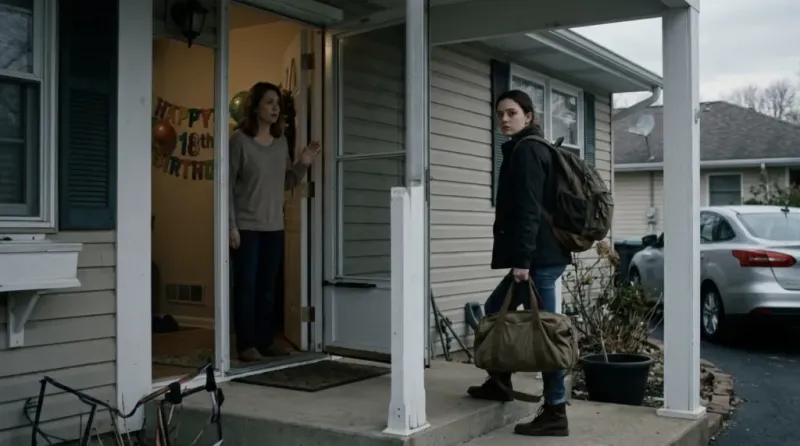
I still remembered the morning I turned eighteen.
Two duffel bags.
A brass doorknob.
My mother asking whether I was leaving because they had bought Steven a car.
And my answer:
No, Mom. It’s because nobody notices whether I’m here or not.
Back then, I thought leaving meant losing my family.
I didn’t understand that sometimes leaving is the only way to stop losing yourself.
My parents had spent years believing I was the strong one, the responsible one, the son who didn’t need anything.
But I finally learned that being strong didn’t mean accepting less.
It meant knowing when to walk away.
It meant protecting the life you worked so hard to build.
And sometimes, it meant allowing people back into your life only after they learned to respect the person you had become.
I never needed my brother to have less. I only needed my parents to understand that I deserved love, too.
And after all those years, that was the one thing I finally gave myself.

One Comment on “PART 5 – My Parents Chose My Adopted Brother Over Me for 10 Years—At 18, I Left With Two Bags. Five Years Later”