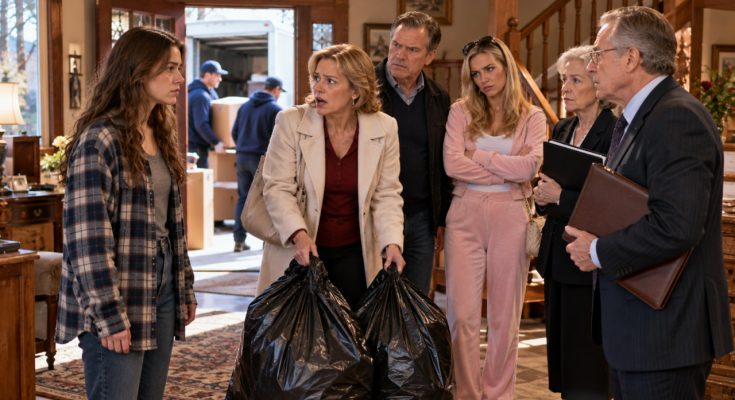
Mr. Harrison waited patiently.
“Are you all right?” he asked.
I nodded, although tears still ran down my cheeks.
“I think I am beginning to be.”
He reached into his briefcase and removed another document.
“There is one more matter. Your grandfather instructed me to give you the opportunity to review his complete estate plan. He also left instructions concerning a charitable foundation he established several years ago.”
“A foundation?”
“Yes. It provides assistance to children who have lost parental support and to young adults who need help continuing their education.”
I looked at him in surprise.
“Grandpa never mentioned anything like that.”
“He wanted the foundation to operate independently. He believed that children who grow up without support should not have to beg for the opportunities other children receive naturally.”
I thought about the countless evenings Grandpa had spent helping me with my schoolwork.
He had never had much formal education himself, but he took my studies seriously. When I wanted to attend university, he sat down with me and calculated every expense.
Tuition.
Books.
Transportation.
Food.
He wrote everything in a little notebook and made a plan.
When I worried that I would be a financial burden, he simply said, “Education is not a burden, Emily. It is a door.”
I had graduated with my degree because he had worked so hard to keep that door open.
“What do I have to do?” I asked.
“Nothing immediately. The foundation has its own governing arrangements. Your grandfather wanted you to have the option of becoming involved when you felt ready.”
I looked down at the documents.
For the first time, the inheritance did not feel like a weapon my parents had failed to take from me.
It felt like a responsibility.
And I knew exactly what I wanted to do with it.
“I’d like to learn more about the foundation,” I said. “But first, I need to understand what happened to Grandpa’s money.”
Mr. Harrison nodded.
“That is sensible. We will review the records together.”
He then gave me a copy of the correspondence between Grandpa and my father.
I read it slowly.
There was no dramatic secret revealing that my parents had secretly loved me from afar. No hidden explanation that would erase seventeen years of silence.
There were simply letters, requests for money, and Grandpa’s careful responses.
Some of my father’s letters were angry. Others were coldly practical.
One sentence stayed with me.
If you insist on leaving everything to Emily, don’t expect me to pretend this arrangement is fair.
I stared at the words.
Grandpa had been right.
My parents had returned because they believed there was something to gain.
I was right.
Two days later, Dad called.
I almost let the call go to voicemail.
But I answered.
“What do you want?”
His voice sounded different from the day before.
Less angry.
More careful.
“Emily, we need to talk.”
“About what?”
“About the family.”
I almost laughed.
“What family?”
There was a long silence.
Then he sighed.
“Your mother is very upset. Brianna is upset, too. This whole situation has become unnecessarily hostile.”
“You brought a moving truck to Grandpa’s house the morning after his funeral.”
“We thought the property would eventually come to us.”
“You never even asked whether I was okay.”
“Emily, we made mistakes.”
“You said that already.”
Another silence followed.
Finally, he said, “We want to come over and talk things through.”
I looked out the kitchen window.
Grandpa’s garden was beginning to lose its autumn color. The tomato plants had withered, and a few dry leaves rested on the stone path he had built himself.
I remembered how he used to kneel beside those plants, showing me how to prepare the soil for the following season.
“You can come,” I said. “But we’re not discussing the house as if it belongs to you.”
Dad agreed quickly.
Too quickly.
That evening, my parents arrived without the moving truck.
Mom carried a box of pastries from a bakery. Dad brought a bottle of wine he knew I would never drink.
They sat at the kitchen table where Grandpa had taught me to do my homework.
For several minutes, nobody spoke.
Then Mom reached across the table.
“Emily, sweetheart, we know things have been difficult.”
I pulled my hand back.
She paused.
“We should have visited more often.”
“More often?” I repeated.
Her expression tightened.
“I know we made mistakes.”
“You didn’t visit me once.”
“We were dealing with our own problems.”
“I was five years old.”
Mom looked away.
“I know.”
“No, I don’t think you do.”
My voice was quiet, but I could feel years of buried hurt rising to the surface.
“I used to think you were coming back every weekend. Grandpa told me you needed more time. When Christmas came, I thought you would surprise me. When I turned ten, I thought maybe you had forgotten my birthday. When I turned sixteen, I stopped expecting you to come.”
Mom’s eyes filled with tears.
“I was young,” she whispered.
“So was I.”
She covered her mouth.
For a moment, I saw something that might have been genuine shame.
Then Dad interrupted.
“We can’t change the past. We need to focus on the future.”
I looked at him.
“What does that mean?”
He cleared his throat.
“Your grandfather left you a substantial estate. You’re young, and managing property and investments can be complicated. We thought it might be sensible for us to help you.”
There it was.
The real reason for the visit.
I felt the last of my uncertainty disappear.
“You want control of the inheritance.”
“That’s not what I’m saying,” he replied quickly. “We’re your parents. We have experience with these things.”
“You left me with Grandpa and disappeared for seventeen years. What experience do you have managing my life?”
Dad’s face hardened.
“You’re being disrespectful.”
“No. I’m finally being honest.”
Mom started crying.
“Emily, please. We are still your family.”
I looked at her for a long time.
“Then why did you come back with a moving truck instead of a hug?”
She had no answer.
Dad stood abruptly.
“If this is how you’re going to behave, there’s no point in talking.”
He headed toward the door.
Mom followed him, wiping her eyes.
At the threshold, she turned back.
“You’ll understand when you’re older,” she said.
I watched her leave.
For years, I had imagined that hearing those words from my mother would hurt less if she said them gently.
It didn’t.
After the door closed, I sat alone at the kitchen table.
Then I noticed something on the floor.
Mom had left the bakery box behind.
I opened it.
Inside were six pastries, carefully arranged in a row.
Beneath them was a small envelope.
My name was written on it.
I opened the envelope and found a photograph of Brianna and me as toddlers. We were sitting together on a blanket in a garden, and Brianna was holding my hand.
On the back, Mom had written:
I know I don’t deserve forgiveness. But I hope one day you’ll let me explain why I left.
I stared at the photograph.
For the first time, I wondered whether there was something about that day seventeen years ago that I still didn’t know.
But I also understood something important.
An explanation might help me understand the past.
It would not automatically excuse it.
I placed the photograph in a drawer beside Grandpa’s letter.
Then I went upstairs to the room where I had grown up.
And I began to make plans for my future.
Part 4: The Sister Who Wanted Everything
Brianna called me the following week.
I almost didn’t recognize her voice.
She had always spoken to me as if I were an inconvenience. When we were children, she rarely came to Grandpa’s house, and when she did, she treated it like a place she had outgrown.
Now she sounded nervous.
“Emily, can we meet?”
“Why?”
“I just want to talk.”
I hesitated.
Then I agreed to meet her at a small café near the university I had attended.
When I arrived, she was already sitting by the window.
Her sunglasses were gone. Her hair was tied back, and she looked exhausted.
For the first time in years, she looked less like the confident woman who had announced that she was taking Grandpa’s master bedroom and more like the girl I remembered from our childhood.
She stood when she saw me.
“Hi.”
“Hi.”
I sat across from her.
She looked at her coffee for a long time before speaking.
“Mom told me what happened when you were little.”
I waited.
“She said Grandpa offered to raise you because they were struggling financially. She told me they had planned to bring you home eventually, but things became complicated.”
I looked at her.
“Did you believe her?”
Brianna swallowed.
“I didn’t know what to believe.”
“Did you ever wonder why they never visited me?”
She didn’t answer immediately.
Then she whispered, “Yes.”
“Did you ever ask them?”
“Once. When I was fourteen.”
I felt my chest tighten.
“What did they say?”
“They told me you were happy with Grandpa. They said visiting would confuse you.”
I stared at her.
“That was their excuse?”
She nodded.
“I thought they might have been telling the truth. I was young, too, Emily. I didn’t understand what was happening.”
I wanted to be angry.
Part of me was.
But another part remembered that Brianna had been a child when I was abandoned. She hadn’t been responsible for the choices our parents made.
That didn’t mean her behavior was harmless.
“You came into Grandpa’s house and announced that you were taking his bedroom,” I said. “You didn’t even ask whether I was okay.”
Her eyes filled with tears.
“I know.”
“You called the house depressing.”
“I know.”
“You watched Mom hand me garbage bags.”
She covered her face.
“I know, Emily.”
For several seconds, neither of us spoke.
Then she lowered her hands.
“I thought if I acted like I belonged there, everything would be fine. I thought the house would be ours, and we’d never have to worry about money again.”
I studied her face.
“Were you having financial problems?”
She nodded.
“My husband lost his job last year. We have debts, and I was afraid we would lose our apartment. I thought Grandpa’s house would solve everything.”
I understood desperation.
But I also understood that desperation didn’t give anyone the right to take what belonged to another person.
“You could have asked me for help,” I said. “You could have called before the funeral. You could have told me the truth.”
“I was ashamed.”
“So you decided to take the house?”
She began to cry.
“I didn’t think about what I was doing to you.”
That was the first honest thing she had said.
I looked through the café window at people walking along the sidewalk.
For a moment, I imagined what our lives might have been like if our parents had made different choices. Perhaps Brianna and I would have grown up together. Perhaps she would have known Grandpa’s stories and the smell of his garden after the rain.
Perhaps we would have been sisters in more than name.
But we couldn’t return to those years.
“I don’t know whether I can forgive you,” I told her.
She nodded.
“I understand.”
“And I won’t give you the house.”
“I know.”
“If you need help finding financial counseling or work opportunities, I can help you look. But I won’t hand over Grandpa’s estate just because you need money.”
Brianna wiped her eyes.
“I wouldn’t ask you to.”
I held her gaze.
“You already did. You just didn’t use those words.”
She lowered her head.
For a while, we sat in silence.
Then she reached into her bag and removed a folded piece of paper.
“I brought this because I thought you should have it.”
It was a copy of an old letter from Grandpa to my parents.
I recognized the handwriting immediately.
Brianna explained that Mom had given it to her years earlier, saying it was proof that Grandpa had interfered in their lives.
I unfolded it.
Richard and Linda,
Emily asked me yesterday whether she did something wrong that made you leave.
She is seven years old.
She believes that if she becomes quieter, studies harder, and never causes trouble, you will want her back.
I cannot describe the pain of watching a child blame herself for the decisions of adults.
I will continue to raise her, and I will never allow her to believe that she is a burden to me.
But I am asking you one last time to remember that she is your daughter.
Please don’t let her grow up thinking she was too difficult to love.
I could barely breathe.
I had no memory of asking Grandpa that question.
But I remembered being seven years old.
I remembered trying to be perfect.
I remembered helping him wash dishes without being asked, keeping my room spotless, and never complaining when he couldn’t afford something I wanted.
I had believed that good children were the ones who never caused problems.
I had believed that perhaps my parents would return if I became good enough.
Grandpa had known.
He had known all along.
I folded the letter and placed it carefully in my bag.
“Thank you for bringing this.”
Brianna nodded.
“I can’t change what I did. But I want you to know that I’m sorry.”
I looked at her.
“Then start by respecting my boundaries. Don’t demand anything from me. Don’t ask me to pretend we’re close. If we ever become sisters, it will have to happen slowly.”
She nodded again.
“I can do that.”
When we left the café, we didn’t hug.
We weren’t ready.
But for the first time in our lives, we had spoken honestly to each other.
And that was a beginning.
Part 5: The Truth About Grandpa’s Final Months
A month passed.
The estate administration continued, and Mr. Harrison helped me understand the documents Grandpa had left behind.
I learned that he had been more financially careful than I ever imagined. He had saved steadily, invested cautiously, and purchased the small rental property years before I was born.
His wealth had not come from a sudden windfall.
It had come from decades of discipline.
He had lived simply because he believed money should provide security, not define a person’s worth.
I also learned that the foundation he had established had already helped several young people complete their education.
One of them was a young woman named Sarah, who had grown up in foster care and received assistance with university tuition.
When I met her, she was finishing her nursing degree.
She had heard about Grandpa through the foundation’s administrators and wanted to thank the family.
“I never met your grandfather,” she told me, “but his help changed my life. I was working two jobs and nearly dropped out. The foundation covered my remaining tuition expenses.”
She smiled shyly.
“Someone believed I deserved a chance before I could believe it myself.”
I thought about the little girl I had once been.
The child who believed she had to earn love by being perfect.
The child who waited by the window for parents who never came.
I wondered how different my childhood might have been if someone had told me sooner that I was worthy of love simply because I existed.
That evening, I sat in Grandpa’s study and began writing down ideas for the foundation.
I wanted to support children who had been abandoned, young adults leaving foster care, and students who were struggling to pay for education.
I wanted them to receive more than money.
I wanted them to have mentors, guidance, and someone who would answer the phone when they needed help.
It would take time to develop the program properly, but for the first time since Grandpa’s funeral, I felt excited about something.
Then Mr. Harrison called with news that changed my understanding of my parents once again.
He had found a series of financial records among Grandpa’s papers.
Years earlier, Grandpa had offered my father a loan to help him establish a small business. The loan had been documented, and my father had agreed to repay it under written terms.
He had repaid only part of it.
Later, Grandpa had offered to restructure the remaining balance after the business struggled.
My father had refused to provide the requested financial information.
Eventually, the arrangement ended.
“What does this mean?” I asked.
“Only that your grandfather kept careful records of his financial dealings,” Mr. Harrison explained. “It does not automatically establish wrongdoing. We need to review the documents in context.”
I appreciated his caution.
I had no desire to turn Grandpa’s death into a legal battle unless it was necessary.
But there was another detail.
Shortly before his death, Grandpa had received a letter from my father asking him to reconsider the estate plan.
The letter claimed that I was emotionally unstable and incapable of managing money.
I read it twice.
I had never been in trouble with the law. I had never mismanaged my finances. I had worked part-time during university and saved what I could.
My father barely knew me.
How could he judge my ability to manage my life?
Mr. Harrison explained that the letter itself did not change the estate plan.
“Your grandfather was entitled to make his own decisions while competent,” he said. “He had independent legal advice and documented his wishes. If anyone challenges the estate, we will respond through the appropriate legal process.”
I nodded.
I wanted to believe that the worst was behind me.
But two weeks later, I received a formal letter from a law firm representing my parents.
They were questioning Grandpa’s decision and seeking information about the estate.
For one terrible moment, I felt like the five-year-old girl again.
I imagined losing the house, losing the money Grandpa had saved, and losing the one place where I had ever felt safe.
Then I remembered what he had written.
Do not let their anger frighten you.
I called Mr. Harrison.
He assured me that he would handle the legal response and that I should not sign anything or make financial decisions under pressure.
So I did exactly that.
I did not threaten my parents.
I did not argue with them over the phone.
I gathered the records, followed my attorney’s guidance, and waited.
Months passed.
The legal review confirmed that Grandpa’s estate plan had been properly documented. The property transfer and trust arrangements had been completed with independent advice, and there was no evidence that he lacked the capacity to make his decisions.
My parents had the right to seek legal advice, but they had no automatic entitlement to the house or the assets simply because of their relationship to Grandpa.
Eventually, their challenge was withdrawn.
The day Mr. Harrison told me, I sat in the study and cried.
Not because I had defeated my parents.
Because I finally understood that I didn’t have to spend my life fighting to prove that I deserved to exist.
Grandpa had already given me the security he wanted me to have.
Now it was my turn to decide what kind of person I wanted to become.
Part 6: The Master Bedroom
Spring arrived.
The garden came back to life, and the trees along the driveway began to bloom.
I spent the first warm weekend cleaning the house from top to bottom.
I washed the curtains, polished the old wooden furniture, and opened every window to let the fresh air inside.
When I reached the master bedroom, I stopped in the doorway.
It had been Grandpa’s room.
Brianna had claimed it the morning after his funeral, as if she were choosing a hotel suite.
At the time, I had been too overwhelmed to say anything.
Now I stood in the doorway and looked at the room carefully.
The bed was neatly made. Grandpa’s reading lamp stood beside the chair near the window. His books lined the shelves.
I could almost picture him sitting there in the evening, reading with his glasses low on his nose.
For a moment, I considered leaving everything exactly as it was.
Then I remembered that Grandpa had never wanted the house to become a museum.
He had loved life too much for that.
He had always encouraged me to move forward, even when I was frightened.
So I made a decision.
I would turn the master bedroom into a quiet reading room and library.
I kept Grandpa’s chair, his books, and his reading lamp. I added a comfortable sofa, a small desk, and shelves for the books I had collected during university.
I placed a framed photograph of Grandpa beside the window.
Underneath it, I put a small brass plaque engraved with his favorite saying:
“A home is built by the people who show up.”
The room became my favorite place in the house.
On rainy evenings, I sat there with tea and a book. On difficult days, I worked at the desk. Sometimes I simply watched the garden and remembered the man who had given me a home when I had nowhere else to go.
One afternoon, Brianna visited.
She stood in the doorway of the library and looked around.
“You changed the room,” she said.
“I did.”
She walked slowly toward Grandpa’s chair.
“I thought you would keep it exactly as it was.”
“I thought about that. But Grandpa wouldn’t have wanted me to stop living because he was gone.”
She nodded.
Then she noticed the plaque.
Her eyes rested on the words for a long time.
“A home is built by the people who show up,” she read quietly.
“Yes.”
She swallowed.
“I wasn’t there for you.”
“No,” I said gently. “You weren’t.”
She didn’t defend herself.
She didn’t ask me to forgive her.
Instead, she sat on the sofa and looked at Grandpa’s photograph.
“I wish I had known him better.”


One Comment on “My Parents Abandoned Me at 5—17 Years Later, They Returned With a Moving Truck After Grandpa’s Funeral”