PART 4
By Friday evening, my father had called me eleven times.
I knew because I counted.
The first three calls were angry. The next four were carefully worded warnings about embarrassment, family reputation, and my grandmother’s age. The final four came with a strange urgency I had never heard in his voice before.
On the last voicemail, he said, “Daniel, whatever you think you’ve discovered, don’t sign anything. You don’t understand what you’re getting yourself involved in.”
I replayed that message twice.
Then I put my phone away.
For the first time, I wondered whether Dad knew something about Grandma’s money that the rest of us didn’t.
Saturday morning, I drove back to Wyoming.
When I reached the cabin, Grandma was sitting beside the window with a blanket over her knees. Her white hair was neatly combed, and a pot of tea sat on the table beside her.
She looked pleased to see me, but I noticed how carefully she pushed herself up from her chair.
“There’s my boy.”
I hugged her longer than usual.
“You should have told me you weren’t feeling well.”
She smiled against my shoulder.
“And miss the opportunity to have you worry about me? Never.”
I pulled back.
“Grandma.”
Her smile faded a little.
“I know, sweetheart. I know.”
We sat together for a while, drinking tea and watching the snow fall over the pine trees.
Eventually, she reached beneath the coffee table and pulled out an old wooden box.
It was the same box I remembered seeing in Grandpa’s study when I was a child. Its brass corners had darkened with age, and a small brass key hung from a ribbon around Grandma’s neck.
She unlocked it.
Inside were photographs, letters, property documents, and a thick folder bearing my grandfather’s handwriting.
She placed the folder in front of me.
“Your grandfather started his business with almost nothing,” she began. “He repaired farm equipment, sold tools, and eventually opened a small supply company. He worked hard, but he never cared much about becoming rich.”
I remembered Grandpa Walter as a quiet man who smelled of cedarwood and coffee. He’d taught me to use a hammer when I was seven and once spent an entire afternoon helping me build a birdhouse that leaned so badly it looked like it might collapse in the wind.
He’d never talked about money.
“He sold that business when he was sixty,” Grandma continued. “The money was invested over the years. Some went into property, some into other investments, and some was placed into trusts. We lived simply because we liked our life that way.”
I turned the first page.
There were account summaries, legal agreements, and records of investments going back decades.
The figures made my head spin.
“Grandma, how much money did you and Grandpa actually have?”
She took a sip of tea.
“Enough to be comfortable.”
I gave her a look.
She laughed softly.
“All right. Enough to be more than comfortable.”
“Six million dollars for each of us?”
“That was the amount I decided to distribute directly to the five beneficiaries named in my current estate plan.”
I looked up.
“Five?”
“Yes, dear. You, your father, your mother, Eric, and Olivia.”
“But you said four at the bank—”
“The bank manager was discussing the four other family members besides you. I imagine you misunderstood one another.”
I nodded, embarrassed.
Then I looked at the documents again.
There was something else.
A property description listed a large tract of land in northern Wyoming. The legal description included the area surrounding Grandma’s cabin and extended far beyond the trees I could see from the porch.
“What’s this?”
She leaned closer.
“Your grandfather bought that land decades ago. At the time, everyone thought he was foolish. It was remote, difficult to access, and covered in trees. He liked the quiet.”
I looked at the map.
The property covered thousands of acres.
“Grandma, how much is this land worth?”
“That depends on what someone wants to do with it. Some of it is protected woodland. Some has development restrictions. Some contains mineral rights that your grandfather retained.”
She paused.
“Your grandfather always said land should be valued for what it can give future generations, not merely what someone might pay for it tomorrow.”
I turned another page.
Then I found the document.
It was a recent appraisal, accompanied by an attorney’s letter.
My eyes moved down the page.
I read the estimated valuation once.
Then again.
I couldn’t make sense of the number.
“Grandma.”
“Yes?”
“Is this saying the property and associated rights are worth more than forty million dollars?”
She didn’t look surprised.
“Approximately, according to that appraisal. The final value would depend on the assets involved, restrictions, market conditions, and any future transactions.”
I sat back.
Forty million dollars.
And that was separate from the investments that had funded the checks.
“Why didn’t you ever tell anyone?”
“Because I didn’t want my grandchildren growing up believing they were entitled to wealth they hadn’t earned.”
She reached for my hand.
“I wanted you to learn how to work, how to treat people, and how to build a life you could be proud of. Your grandfather and I had money, Daniel. But money was never the thing we wanted to leave behind most.”
I swallowed.
“What did you want to leave behind?”
She squeezed my hand.
“People who remember that kindness matters, even when there is nothing to gain from it.”
I looked away because my eyes were beginning to sting.
Then she opened a second folder.
“This is the part your father may have been looking for.”
Inside were copies of correspondence between Grandpa and an attorney, along with records of an offer to purchase part of the property.
The offer had been made years earlier.
The proposed buyer was a development company interested in the land’s potential.
At the bottom of one letter was my father’s name.
I recognized his signature immediately.
I stared at it.
“Why is Dad’s name here?”
Grandma was silent for a moment.
“Your father learned about the property years ago. He approached your grandfather about selling it. Walter refused.”
“What happened?”
“Your father believed we were wasting an opportunity. He thought we should sell the land, distribute the proceeds, and enjoy the money while we were still alive.”
“Was that so terrible?”
“No. Wanting financial security isn’t terrible. But he became angry when your grandfather refused to let him make the decision.”
She adjusted the blanket on her knees.
“Your father stopped visiting for a long time after that. When he returned, he was polite, but he never truly accepted that the land wasn’t his to control.”
I looked at the signature again.
“Did Dad try to sell it without Grandpa’s permission?”
“No. Not that I can prove. But he continued to argue that your grandfather should reconsider.”
She closed the folder.
“Your father has always believed that because he is our son, he deserves a say in everything we own.”
I felt a chill that had nothing to do with the weather.
“Does he know about the checks?”
“He knows I have made arrangements. He doesn’t know every detail.”
“Then why is he calling me?”
Grandma looked toward the window.
“Because I suspect someone has told him that the estate arrangements are more complicated than he imagined.”
Before I could ask another question, headlights swept across the living room.
A car pulled into the driveway.
Then another.
My father stepped out of the first vehicle, followed by Mom.
Eric and Olivia arrived in the second.
Dad didn’t even knock.
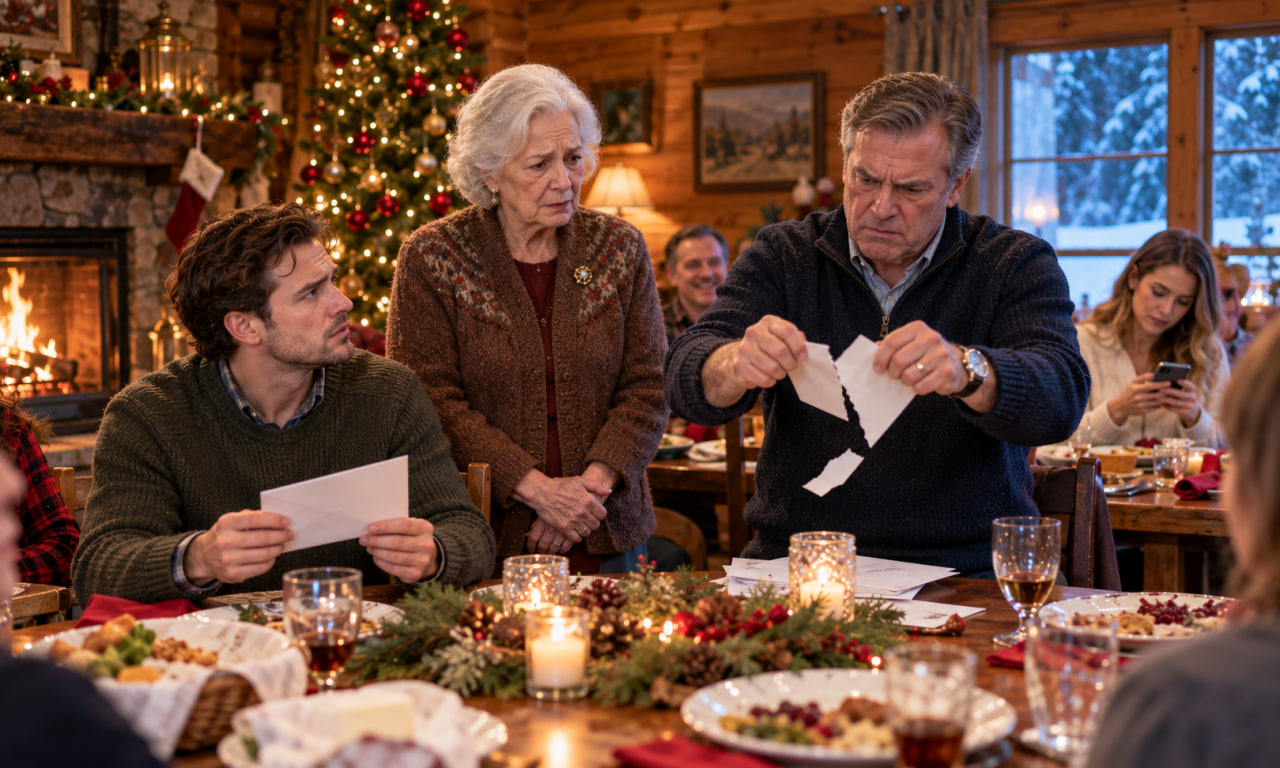
He opened the door and walked straight into the cabin.
“Mom, we need to talk.”
Grandma remained seated.
“Good afternoon, Daniel.”
“Don’t start with that calm voice,” Dad snapped. “I’ve spent the entire week trying to understand what’s happening, and nobody is telling me anything.”
Grandma gestured toward the chairs.
“Then sit down.”
He remained standing.
“Did you give Daniel a real check?”
“Yes.”
“And the rest of us?”
“Yes.”
Eric let out a short laugh.
“So you’re actually serious about this?”
Grandma looked at him.
“I have never been more serious about anything.”
Olivia’s smile disappeared.
Mom sat slowly on the edge of the sofa.
Dad took a step toward the table.
“Then explain the trust. Explain the land. Explain why Daniel is sitting here looking at documents that nobody else has seen.”
I stood.
“Grandma invited me.”
“I wasn’t talking to you.”
“Then perhaps you should stop speaking to me as though I don’t belong here.”
His eyes narrowed.
For a moment, I thought he might shout.
Instead, he turned toward Grandma.
“You’ve made a terrible mistake.”
“No, son. I made a decision.”
“You’ve given away millions of dollars without consulting the family.”
Grandma’s expression hardened.
“It’s my money.”
“It’s family money!”
“It belonged to Walter and me. We earned it, invested it, and managed it. You were never promised any of it.”
Dad’s face turned red.
“You can’t just hand out six million dollars to everyone and expect us not to ask questions!”
“I expected you to ask questions before tearing up your check.”
The room fell silent.
Eric looked at the floor.
Olivia slipped her phone into her handbag.
Dad’s mouth opened, but no words came out.
Grandma continued.
“You didn’t ask whether the check was real. You didn’t ask how I could afford it. You didn’t even ask why I wanted to give it to you. You decided that because you couldn’t understand something, it had to be a joke.”
Dad stared at her.
Then he said the words that changed the room.
“Fine. If you’re determined to give away your money, I want my share of the land, too.”
Grandma looked at him for a long time.
“Your share?”
“Yes. I’m your son. I have a right to know what will happen to the property.”
“You have a right to ask. You do not have a right to demand.”
He slammed his palm against the table.
“After everything I’ve done for this family—”
“What have you done for me, Daniel?”
Grandma’s question was quiet.
It stopped him more effectively than a shout could have.
She looked around the room.
“When was the last time you called me just to ask how I was? When was the last time you came here without needing something? When did any of you last stay long enough to help me stack firewood, fix a pipe, or shovel the snow?”
Nobody answered.
Then Grandma looked at me.
“Daniel stayed after Christmas. He didn’t know about the land. He didn’t know about the trust. He didn’t even know whether his check was real. He stayed because he wanted to spend time with me.”
My throat tightened.
Dad looked at me with an expression I had never seen before.
Not quite anger.
Something closer to humiliation.
Grandma opened the wooden box and removed a sealed envelope.
“This is from your grandfather. He asked me to keep it until I felt the time was right.”
She handed it to Dad.
He looked at the envelope as though it might burn him.
“What is this?”
“A letter.”
He opened it.
I watched his eyes move across the page.
At first, his expression was impatient.
Then confused.
Then pale.
“What does it say?” Eric asked.
Dad folded the letter.
“Nothing.”
Grandma held out her hand.
“Read it aloud, Daniel.”
He shook his head.
“Mom, this is private.”
“It concerns the decisions you’re demanding that I explain. If you want to discuss your rights, you can begin by reading your father’s words.”
Dad gripped the paper.
Then, with visible reluctance, he began.
“Dear Daniel,
If you are reading this, it means I am no longer here to have this conversation with you myself.
I know you believe selling the property would have been the sensible thing to do. Perhaps, from a purely financial perspective, you are right. But your mother and I have spent our lives trying to understand the difference between something being valuable and something being ours to take.
The land is not simply an investment. It is a responsibility.
I want our family to benefit from what we built, but I do not want the land to become the reason our family destroys itself.
No one has been promised a particular inheritance. Your mother will decide how to distribute what remains, according to her own judgment and the legal documents we have prepared.
I ask only one thing: do not mistake inheritance for entitlement.
You are my son, and I love you. That will never change.
But love does not mean I must surrender every decision to you.
Your father,
Walter.”
Dad stopped reading.
Nobody spoke.
Grandma took the letter from him and returned it to the envelope.
“Your father understood you better than you think,” she said.
Dad sat down heavily.
For the first time that day, he looked old.
Grandma waited until everyone had settled before opening the final folder.
“I’ve spent a great deal of time thinking about what happens after I’m gone,” she said. “I’m not going to pretend that I haven’t. I’m eighty-two years old, and I know my time is limited.”
“Don’t say that,” Mom whispered.
Grandma smiled gently.
“Growing old isn’t an insult, Margaret. It’s a privilege not everyone receives.”
Then she continued.
“I’ve made arrangements with my attorney. The financial gifts are one part of those arrangements. The property is another. And the cabin is something else entirely.”
She placed a document on the table.
The heading read: Evelyn Harper Family Land Stewardship Plan.
It wasn’t a simple will.
It was a proposal to place much of the remaining woodland into a professionally managed conservation trust, subject to legal review and the necessary approvals. The plan would protect the most sensitive parts of the land while allowing carefully limited use of other areas.
The cabin itself would remain available for family gatherings, provided the maintenance costs were covered and the property was treated with respect.
Grandma had also arranged for a portion of the estate to support a scholarship fund for students who wanted to become teachers.
I looked up.
“Teachers?”
She nodded.
“Your grandfather believed education was one of the few things that could change a person’s life without asking where they came from. I wanted to help students who have the ability and determination but not always the money.”
I thought about my classroom in Boulder.
The students who worked evening shifts.
The young woman who had once apologized for turning in an assignment late because she’d been caring for her younger siblings.
The boy who stayed after class because he didn’t have a quiet place to study at home.
I imagined what a scholarship could mean to them.
“Grandma, this is wonderful.”
“I hope it will be.”
Dad stared at the documents.
“And what do we get?”
Grandma didn’t flinch.
“You each have the financial gift I’ve already offered. The rest of my estate will be distributed according to the documents prepared with my attorney.”
“That isn’t what I asked.”
“I know.”
He leaned forward.
“What happens if we don’t agree with the plan?”
“You are free to discuss your concerns with my attorney. I am not asking anyone to sign away legal rights today. I am telling you what I want, and I have taken steps to make sure my wishes are properly documented.”
For the first time, Dad seemed to realize that raising his voice wouldn’t change the outcome.
Eric picked up the land map.
“Wait. So this property is worth tens of millions, and we’re supposed to just leave it sitting here?”
“Not all of it,” Grandma said. “Some portions may be used or developed in ways that comply with the plan and the law. But I won’t sell the entire property simply because someone wants the money now.”
Olivia finally spoke.
“Grandma, I thought you were just living off Grandpa’s savings. I didn’t know any of this existed.”
“I know, sweetheart.”
“Why didn’t you tell us?”
Grandma gave her a sad smile.
“Because I wanted you to visit me without feeling that you were visiting an inheritance.”
Olivia’s eyes filled with tears.
She looked at the floor.
“I haven’t been here since last Christmas.”
“No.”
“And I didn’t bring you anything.”
“You brought yourself.”
“But I barely even talked to you.”
Grandma reached across the table and touched her hand.
“Then perhaps you can begin by talking to me now.”
Olivia began to cry.
It wasn’t a dramatic performance. She didn’t take out her phone or look around to see whether anyone noticed.
She simply covered her face with both hands.
“I thought you were just old,” she whispered. “I thought you didn’t understand anything anymore.”
Grandma’s expression softened.
“I am old. And sometimes I forget where I put my glasses. But that doesn’t mean I have forgotten what matters.”
Eric put the map down.
For a while, he looked as though he wanted to make a joke. Then he seemed to reconsider.
“Grandma, I really thought the checks were fake.”
“I know.”
“I shouldn’t have laughed.”
“No, you shouldn’t have.”
He nodded, accepting the answer.
Then Dad stood up.
“I need some air.”
He walked outside and shut the door behind him.
Mom followed.
Eric and Olivia remained seated, staring at the table.
I watched the snow drifting past the window and thought about how different the room felt from Christmas night.
Back then, everyone had been loud.
Now nobody knew what to say.
After a few minutes, Grandma reached for her tea.
“Daniel, would you help me with something?”
“Of course.”
“There’s a small box in the bedroom closet. The one with the blue ribbon. Bring it here, please.”
I found the box on the top shelf.
Inside was a collection of old photographs, postcards, and a handful of letters tied with string.
At the bottom lay a small envelope with my name written on it.
I recognized Grandpa’s handwriting.
My heart began to beat faster.
“What’s this?”
Grandma looked at me.
“Your grandfather wrote it shortly before he died. He wanted you to have it when you were old enough to understand what he meant.”
I opened the envelope carefully.
The letter was short.
“Dear Daniel,
You may grow up believing that people who inherit money have been given an easy life. Sometimes that is true. Sometimes the money becomes a burden they never learned to carry.
If you ever receive something you did not earn, remember that you are not required to prove yourself worthy by giving it away, nor are you required to spend it to impress anyone.
You are allowed to use it wisely.
Pay your bills. Build a home if you want one. Help people when you can. Save for the future. Give yourself permission to enjoy the life you work so hard to build.
But never allow money to become the reason you forget who you are.
The best inheritance your grandmother and I can give you is the freedom to make your own choices.
With love,
Grandpa Walter.”
I read the letter twice.
Then I pressed it against my chest.
For years, I’d thought of Grandpa as the man who taught me to use a hammer and made terrible jokes over breakfast.
I hadn’t realized how carefully he’d considered the kind of person he hoped I’d become.
When I looked up, Grandma was watching me.
“He loved you very much,” she said.
“I loved him, too.”
“I know.”
She patted the seat beside her.
I sat down and rested my head against her shoulder, just as I had when I was a little boy.
Outside, my father stood alone in the snow.
And for the first time in my life, I wondered whether he was beginning to understand that he couldn’t purchase the things he had spent so many years neglecting.

One Comment on “PART 4”