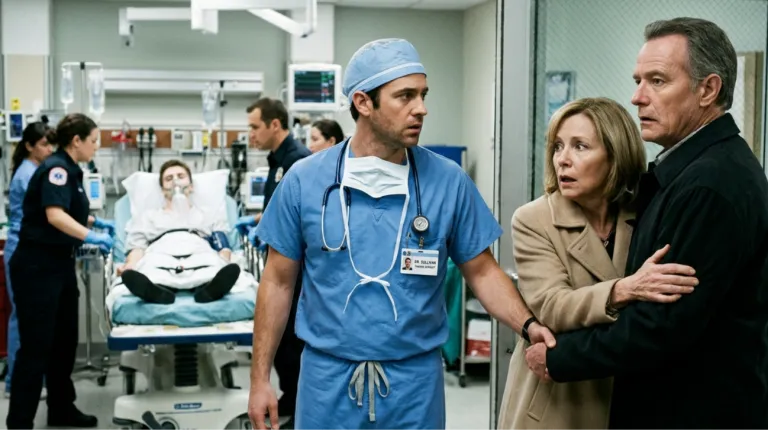
PART 4
He was conducting a review because the trust was supposed to be transferred to you after your graduation.”
I stared at her.
“What happened?”
My father looked toward Julian.
“He told us you had signed documents giving him permission to manage the funds.”
I laughed once.
A short, empty sound.
“Of course he did.”
Julian began crying.
“I didn’t know how to fix it.”
“You had five years.”
“I know.”
“You had five years to tell the truth.”
“I know!”
His voice broke.
Then he said something I wasn’t expecting.
“I was jealous of you.”
I looked at him.
He continued.
“After Grandfather died, Dad started talking about how you were going to become a doctor. Mom kept showing everyone your scholarship letters. Every family gathering became another conversation about Arthur.”
I shook my head.
“So you decided to destroy me?”
“I didn’t plan everything.”
“You intercepted my letters.”
“Yes.”
“You told them I quit medical school.”
“Yes.”
“You told them I was unstable.”
He began crying.
“Yes.”
“You let them miss my graduation.”
He couldn’t answer.
“You let them miss my wedding.”
His face crumpled.
I leaned closer.
“Do you know what I wanted most on my wedding day?”
Julian looked at me.
“I wanted my father to walk me into the reception and complain that I was taking too many pictures. I wanted Mom to hug Clara and tell her she was beautiful. I wanted you standing beside me, making some stupid joke about how I was finally getting married.”
My voice cracked.
“I didn’t want your money. I didn’t want your position. I wanted my family.”
Nobody spoke.
Then my mother began sobbing.
And for the first time that night, I saw my father cry.
But tears couldn’t return five years.
They couldn’t bring Sarah back.
They couldn’t put my parents in the empty chairs at my wedding.
And they couldn’t give me back the birthdays I had spent wondering whether they even remembered me.
I straightened.
“I’m going back to work.”
My father reached for me.
“Arthur, please.”
I stopped.
“Please don’t make any decisions tonight,” he said.
I looked at his hand.
Then at his face.
“I made enough decisions based on what I thought my family might eventually become. I’m done doing that.”
I walked out.
This time, nobody followed me.
The following morning, I received a call from the hospital’s legal department.
It was about Julian’s medical records.
His insurance information had been processed, but there was a discrepancy in his emergency contact and financial documentation.
The administrator wanted to confirm whether I had any personal involvement that could create a conflict of interest.
I explained the situation.
I told them Julian was my brother, that I had performed the emergency surgery because I was the available trauma surgeon, and that all future treatment decisions would be handled according to hospital policy.
They documented everything and arranged for another attending surgeon to oversee his ongoing care.
I had saved his life.
I wasn’t going to compromise my professional responsibilities because of what he had done.
Around noon, Clara arrived with coffee and a sandwich.
She found me sitting alone in the physicians’ lounge.
“You look terrible,” she said gently.
“Thank you. That’s exactly what every surgeon wants to hear.”
She smiled faintly and sat beside me.
“Have you eaten?”
I shook my head.
She placed the sandwich in front of me.
Then she noticed the expression on my face.
“What happened?”
I told her about the inheritance.
She listened without interrupting.
When I finished, she took my hand.
“Arthur, you need to speak with the estate attorney.”
“I know.”
“And you need to protect yourself. Don’t let anyone pressure you into signing anything.”
“I won’t.”
She squeezed my fingers.
“Good.”
Then she leaned her head against my shoulder.
For a few minutes, we sat quietly.
It was strange.
My parents had spent five years convincing themselves that I was the problem.
Yet the woman who had never met them until after I was already building my life understood me better than they ever had.
That afternoon, I contacted the law firm handling my grandfather’s estate.
The attorney’s name was Margaret Ellis.
She had represented my grandfather for nearly twenty years.
When I introduced myself, she went silent.
Then she said:
“Arthur Vance?”
“Yes.”
“Oh, my goodness.”
She sounded genuinely emotional.
“Your grandfather spoke about you constantly.”
I closed my eyes.
“He did?”
“Every time we discussed his estate, he asked whether you were still pursuing medicine.”
I swallowed.
“Yes. I am.”
“I know. I’ve been following your professional achievements through the university’s public announcements.”
I wasn’t sure what to say.
Then Margaret continued.
“Arthur, there’s something important you need to understand. Your grandfather anticipated that someone might attempt to interfere with the medical trust.”
I sat upright.
“What do you mean?”
“He established specific protections. The trust could only be used for your approved education, and any withdrawal required your written authorization.”
I felt my chest tighten.
“So Julian couldn’t legally transfer that money?”
“Not without violating the trust agreement.”
I stared at the desk.
“Do you have the original documents?”
“Yes. And I have the transaction records showing where the funds went.”
I rubbed my forehead.
“Why wasn’t I informed?”
“We attempted to contact you using the last address provided in the estate file. Several notices were returned.
Later, your father contacted us and said you had withdrawn from medical school and no longer wished to receive anything from the estate.”
I closed my eyes.
Another lie.
Margaret continued.
“However, your grandfather left instructions that the trust must not be terminated simply because someone claimed you had abandoned your education. We were required to verify that directly with you.”
“Did anyone?”
“No. The investigation began after discrepancies appeared in the financial records.”
I took a slow breath.
“Margaret, I want the truth. Everything.”
“I understand. I suggest we arrange a formal meeting.”
We scheduled it for the following week.
Before hanging up, she said something that stayed with me.
“Your grandfather once told me that he didn’t want his money to make his grandsons successful. He wanted it to protect them from people who might take advantage of their trust.”
I looked through the glass wall of the lounge.
A nurse was pushing a wheelchair past the corridor.
For the first time in years, I felt that perhaps my grandfather had understood exactly what kind of family problem he was trying to prevent.
Three days later, Julian was moved out of intensive care.
His condition was improving, although he still faced a long recovery.
I visited him after my shift.
He looked considerably better.
His color had returned, and he was able to speak without struggling.
When I entered, he looked at me.
“Arthur.”
I pulled a chair toward the bed.
“Hey.”
He looked surprised that I had come.
“I thought you wouldn’t visit.”
“I came to check on you.”
He nodded.
For a moment, we said nothing.
Then he asked:
“Did you speak to Margaret Ellis?”
I looked at him.
“How do you know her name?”
He swallowed.
“Because she contacted me last month.”
I leaned forward.
“What did she say?”
“She told me the trust was being investigated. She asked me to provide documentation.”
“And what did you give her?”
“Nothing.”
“Why?”
“Because I couldn’t.”
I stared at him.
He continued.
“I didn’t have the money anymore. I had investments, business expenses, debts. I kept thinking I could recover everything before anyone found out.”
“Did you use the money for your business?”
He nodded.
“Some of it.”
“And the rest?”
He looked away.
“Personal expenses.”
I shook my head.
“Do you understand what you’ve done?”
“Yes.”
“No, Julian. I don’t think you do.”
I leaned back.
“You didn’t just steal money. You took something our grandfather left for my future. You lied to our parents. You destroyed my relationship with them. And you watched me struggle while you knew exactly what you had done.”
He covered his face.
“I know.”
“Why did you let it continue?”
He lowered his hands.
“Because every year it became harder to admit the truth.”
I stared at him.
“That’s not an explanation. That’s an excuse.”
He nodded.
“I know.”
Then he reached toward the bedside table.
There was a small envelope.
“I found this in my apartment before the accident. It was from Grandfather.”
I took it.
My name was written across the front.
Arthur.
I recognized the handwriting immediately.
My hands began trembling.
“Where did you get this?”
“Dad gave it to me after Grandfather died. I never opened it.”
I stared at the envelope.
“Why are you giving it to me now?”
Julian looked at me.
“Because I’m tired of lying.”
I opened it carefully.
Inside was a letter written on cream-colored paper.
The first line made my eyes fill immediately.
My dear Arthur,
If you’re reading this, I hope you’re already doing something that makes you proud of the person you have become.
I know you want to become a doctor. I also know that you sometimes feel responsible for everyone around you.
Remember something, my boy. You cannot save every person, and you should never sacrifice your entire life trying to prove that you deserve to be loved.
I stopped reading.
I pressed the paper against my knee.My Brother Lied That I Quit Medical School,
Then I continued.
I have arranged a medical education trust for you. It is yours, and it is protected for your benefit. I hope you will use it wisely.
But there is something more important than the money.
Never confuse being successful with being worthy. You were worthy long before you earned your first degree.
I am proud of you.
Love,
Grandfather.
I couldn’t speak.
For five years, I had wondered whether my family had ever been proud of me.
Now I was holding a letter from the one person who had believed in me without needing to see a diploma.
I folded it carefully.
Julian watched me.
“I’m sorry,” he whispered.
I looked at him.
“I believe you’re sorry.”
His eyes filled with hope.
“Does that mean—”
“No.”
His expression changed.
“I can’t pretend everything is fine.”
He nodded slowly.
“But I won’t hate you for the rest of my life either. I have too much to live for.”
He looked down.
“I understand.”
I stood.
“Get better, Julian.”
He looked up.
“Arthur?”
I turned.
“Thank you for saving me.”
I paused.
Then I answered honestly.
“I would have done the same for any patient.”
And I left.
The meeting with Margaret Ellis took place the following Thursday.
My parents attended.
Julian was still recovering and participated remotely with his attorney.
I arrived with Clara.
Margaret greeted us in a conference room overlooking downtown Hartford.
There were several folders on the table.
She began by explaining the estate structure.
My grandfather had established a separate educational trust worth $250,000.
The trust had been intended to cover tuition, approved living expenses, professional development, and other educational costs.
Any withdrawal required Arthur’s written authorization.
The records showed that Julian had transferred money from an account connected to the trust without the required authorization.
Margaret also explained that the remaining estate distribution had been handled separately.
My grandfather had left equal inheritance shares to both grandsons, with the intention that each would receive the funds directly once the estate administration was complete.
There was no condition requiring me to maintain a relationship with my parents.
There was no clause disqualifying me for taking an approved medical leave.
And there was no document showing that I had voluntarily surrendered my educational trust.
My father stared at the paperwork.
“I was told Arthur signed something.”
Margaret opened another folder.
“We have no such document.”
My mother looked at Julian’s attorney on the screen.
“Then why did he tell us that?”
Nobody answered.
Margaret continued.
“The estate has already referred the unauthorized transfers to the appropriate financial professionals and legal representatives. Any recovery will be handled through the proper process.”
I looked at her.
“What happens to my educational trust?”
“Your grandfather’s instructions remain valid. We can calculate the remaining amount, determine what was improperly withdrawn, and pursue recovery where legally appropriate.”
I nodded.
“I want that handled properly.”
My father looked at me.
“Arthur, perhaps we can settle this privately.”
I turned toward him.
“What do you mean?”
“We’re family. We don’t need lawyers fighting each other.”
I took a breath.
“Dad, you didn’t seem concerned about family when you refused to open my letters.”
He looked down.
“I know.”
“You didn’t seem concerned about family when you believed Julian without asking me one question.”

One Comment on “PART 4 – My Brother Lied That I Quit Medical School, Destroyed My Family for 5 Years—Then He Arrived in My ER, and I Was the Surgeon Who Saved His Life”