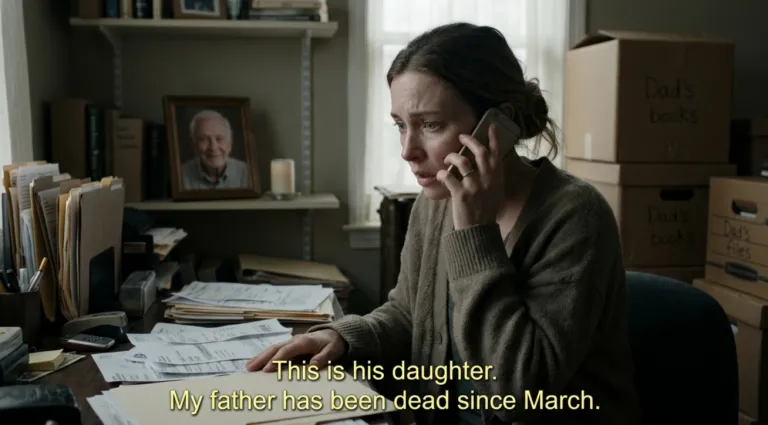
PART 3
Dave slowly closed the folder.
“Then we have a serious problem.”
I almost laughed.
A serious problem.
My brother had apparently used our dying father as a financial instrument, and the bank was calling it a serious problem.
“Mr. Carlson, how much money has my brother already borrowed using Dad’s name?”
Dave took a breath.
“That’s what we’re trying to establish. Right now, we have the $40,000 line of credit from February and the $180,000 application from April. There may be other accounts.”
“Other accounts?”
“Possibly.”
I looked at him.
“How many?”
“I don’t know yet.”
He leaned forward.
“There’s something else. The February credit application contains a document stating that your father personally appeared before the notary. It also says he presented valid identification and confirmed that he understood the financial obligations.”
I shook my head.
“That couldn’t have happened.”
“Why?”
“Because Dad was in a rehabilitation facility on the date printed on that document.”
Dave stopped typing.
“What facility?”
“Westbrook Rehabilitation Center.”
He wrote it down.
“Do you remember the dates?”
“January 18th through February 12th.”
He checked the paperwork.
Then he looked up.
“The notarization is dated February 6th.”
I felt something cold settle in my stomach.
February 6th.
Dad had been in rehabilitation that entire week.
And Brian had known it.
I remembered visiting Dad on February 6th. He had been sitting beside the window in his wheelchair, wearing his favorite blue sweater.
He had looked frustrated because he couldn’t button the sleeve properly.
I had spent nearly an hour helping him eat lunch.
At one point, he had asked me to bring his glasses.
He wanted to read the newspaper.
That was my father.
A man who couldn’t hold a spoon comfortably, supposedly appearing before a notary to guarantee a $40,000 business loan.
“Mr.
Carlson,” I said quietly, “I think my brother has been stealing from him.”
Dave nodded.
“I think we need to consider that possibility.”
Then he asked me something that made my heart drop.
“Does your brother currently have access to your father’s house?”
“Yes.”
“Does he have access to his personal documents?”
I closed my eyes.
“Yes.”
“Bank statements? Checkbooks? Identification?”
“Yes.”
Dave took off his glasses.
“Ma’am, I strongly recommend that you don’t confront him yet.”
I looked at him.
“Why?”
“Because if he’s involved in fraudulent loan applications, confronting him could give him an opportunity to destroy evidence or move money.”
He slid a business card toward me.
“I want you to speak with our fraud department. And I want you to contact an attorney who handles estate fraud.”
I picked up the card.
But before I could stand, Dave reached for another document.
“There’s one more thing.”
I looked down.
It was a copy of a bank transfer.
The date was February 14th.
The amount was $39,500.
The money had been transferred from the line of credit into an account belonging to Brian’s company.
But that wasn’t what made me stop breathing.
At the bottom of the transfer authorization was another signature.
My father’s name.
And beneath it, in smaller handwriting, were the words:
Authorized by family representative.
I pointed at the page.
“Who is the family representative?”
Dave turned the paper toward himself.
“Jennifer Reed.”
My brother’s wife.
Again.
I stood up so quickly that the chair scraped against the floor.
“I need to go.”
“Please be careful.”
I gathered my purse and the documents Dave had agreed to provide copies of.
Before I reached the door, he spoke again.
“One more thing.
We haven’t released the $180,000.”
I turned around.
“Good.”
“But Brian has already called twice this morning asking why the funds haven’t arrived.”
My stomach tightened.
“What did he say?”
Dave hesitated.
“He said his father had personally approved everything before passing away.”
I stared at him.
Then I asked the question that had been bothering me since the beginning.
“Did Brian tell you my father was dead?”
Dave nodded.
“He said the family was still handling the paperwork.”
I couldn’t believe it.
Brian knew Dad was dead.
He knew Dad couldn’t sign.
And he had still submitted a loan application dated three weeks after the funeral.
I walked out of the bank with shaking hands.
For the first time since Dad died, I wasn’t crying because I missed him.
I was crying because I was beginning to understand what had happened to him.
And I wasn’t sure I knew my brother anymore.
I didn’t go home immediately.
I drove to a small coffee shop two streets away from the bank, ordered a cup of coffee I couldn’t drink, and called my father’s attorney.
His name was Robert Mitchell.
He had handled Dad’s estate planning for almost twenty years.
When he answered, I could barely get the words out.
“Robert, I need your help.”
“Of course. What’s happened?”
“Someone has been using Dad’s signature on bank documents.”
There was a pause.
“Who?”
“I think it’s Brian and Jennifer.”
His voice changed immediately.
“Don’t say anything to them yet. Can you come to my office?”
I arrived forty minutes later.
Robert listened without interrupting while I explained everything.
The $180,000 loan.
The $40,000 line of credit.
Jennifer’s notary stamp.
Dad’s stroke.
The rehabilitation dates.
When I finished, Robert sat quietly for a moment.
Then he opened a drawer and pulled out a thick envelope.
“I was actually planning to contact you about something.”
My eyes moved to the envelope.
“What is it?”
“Your father came to see me in December. Before his stroke.”
He removed several pages.
“He was concerned about Brian.”
I frowned.
“Concerned how?”
Robert folded his hands.
“Your father believed Brian was having serious financial problems. He told me he had been pressured to provide money several times. He also said some financial documents had appeared in his home that he didn’t remember signing.”
My throat tightened.
“What documents?”
“Loan guarantees. Business agreements. A few transfers.”
I stared at him.
“Did Dad tell you who was responsible?”
“He suspected Brian, but he didn’t have proof.”
Robert opened the envelope.
Inside was a handwritten letter.
I recognized Dad’s handwriting immediately.
The familiar capital H.
Two little gates.
My eyes filled with tears.
Robert gently pushed the letter toward me.
“He specifically asked me to keep this with his estate records.”
I unfolded it.
The letter was dated December 17th.
Robert,
I love both my children. I have spent most of my life trying to help Brian because I believed every father should give his son another chance.
But I am getting older, and I am beginning to understand that sometimes helping someone repeatedly only teaches them that there will never be consequences.
I am worried that Brian is no longer asking me for help. He is beginning to expect access to everything I own.
I don’t want my daughter to inherit a mess. She has always been the one who takes care of things without asking for anything in return.
If something happens to me, please make sure my wishes are followed.
And please don’t let anyone pressure her into signing anything.
Harold.
I read the last sentence twice.
Then I put my hand over my mouth.
Dad had known something was wrong.
He had tried to protect me.
And I had been so overwhelmed by his death that I had allowed Brian to walk into the house and take whatever he wanted.
“Robert,” I whispered, “what were Dad’s wishes?”
He reached for another document.
“Your father left a properly executed will. He also established a trust several years ago.”
“A trust?”
“Yes. His house, investment accounts, and a portion of his savings were placed into it. You and Brian were named beneficiaries.”
I nodded slowly.
“How much?”
Robert hesitated.
“The trust currently holds approximately $620,000 in assets, excluding the house.”
I stared at him.
Six hundred and twenty thousand dollars.
That was a lot of money.
But it wasn’t the amount that frightened me.
It was what Brian might have known.
“Did Brian have access to the trust?”
“No. He was not a trustee. You were named successor trustee, along with an independent financial institution.”
I felt my stomach turn.
“Then why did he say he was handling the estate?”
Robert looked at me.
“Because someone needed to tell him that he wasn’t.”
He closed the folder.
“There’s something else you should know. Your father changed his will last December. He didn’t disinherit Brian, but he added specific protections against creditors and unauthorized withdrawals.”
I looked down at the letter again.
Dad hadn’t wanted to punish my brother.
He had wanted to stop him from destroying everything.
And now I wondered whether Brian had discovered those protections and decided to get the money another way.
That evening, I drove to Dad’s house.
My brother’s SUV was parked in the driveway.
The living room lights were on.
I used my key and walked inside.
Brian was sitting at the kitchen table with a laptop open in front of him.
Jennifer was standing beside the counter, holding a glass of wine.
They both looked up.
“Well, look who finally decided to visit,” Brian said.
I didn’t respond.
I placed my purse on the chair.
“How have you been?”
He shrugged.
“Busy. Someone has to take care of Dad’s affairs.”
Jennifer gave a small smile.
“There’s been so much paperwork. You wouldn’t believe it.”
I looked at her.
“Actually, I believe there’s quite a bit of paperwork.”
Her smile disappeared for half a second.
Then she looked at Brian.
He closed his laptop.
“What’s that supposed to mean?”
I pulled out a chair.
“First Union Bank called me today.”
Brian’s expression changed.
Only slightly.
But I noticed.
“What about?”
“They wanted to confirm Dad’s signature on a $180,000 loan.”
He leaned back.
“Oh, that.”
I stared at him.
“That?”
“Yeah. It’s a business loan. Dad agreed to help me before he passed.”
“Really?”
“Of course.”
“Then why is the application dated April 3rd?”
Brian didn’t answer immediately.
Jennifer put her glass down.
“Maybe there’s been some confusion.”
I turned toward her.
“The application carries your notary stamp.”
The kitchen became completely silent.
Brian’s jaw tightened.
“You’re making this into something it isn’t.”
“Then explain it.”
“Explain what?”
“How Dad signed a loan application three weeks after he died.”
Brian stood up.
“Listen. You don’t understand how these things work.”
“You’re right. I don’t understand how a dead man signs a document.”
Jennifer crossed her arms.
“Your father wanted Brian to succeed. He always supported him.”
I looked at her.
“Did Dad personally appear before you to notarize the February loan?”
Her face changed.
Brian stepped between us.
“That’s enough.”
I stood too.
“No. It isn’t.”
For the first time, I raised my voice.
“Dad had a stroke. He couldn’t even hold a coffee cup. He was in rehabilitation when you notarized that document. How did you verify his identity and his signature?”
Jennifer looked at Brian.
That was all I needed to see.
She looked at him before answering.
Not at me.
At him.
Brian rubbed his forehead.
“You’re grieving. You’re exhausted. You’re looking for someone to blame.”
I stared at him.
“I don’t need to look for someone. I have the documents.”
He walked toward me.
“Give me a break. Dad wanted me to have that money.”
“Then why didn’t you ask me to verify it with the attorney?”
“Because you always make everything difficult!”
His voice echoed through the kitchen.
Jennifer grabbed his arm.
“Brian.”
But he wasn’t finished.
“You think you’re better than me because you have a steady job and a quiet little life? Dad helped me because he knew I had potential. He understood that I needed capital.”
I looked at him for a long moment.
Then I asked quietly:
“How much money did Dad give you before he died?”
Brian looked away.
“That’s none of your business.”
“Was it $40,000?”
He said nothing.
“Was it another $180,000?”
“You’re twisting things.”
“How much, Brian?”
He slammed his palm against the table.
“Enough!”
The silence afterward was unbearable.
Jennifer looked frightened now.
I picked up my purse.
“Don’t contact the bank again. Don’t submit any more documents using Dad’s name. And don’t remove anything else from this house.”
Brian laughed bitterly.
“You don’t get to tell me what to do.”
I looked at him.
“Actually, I think I do.”
He frowned.
I took a breath.
“Robert Mitchell says I’m the successor trustee. You are not handling Dad’s estate. You never were.”
Brian’s face went pale.
For the first time that evening, he looked genuinely afraid.
Then he said something I will never forget.
“You shouldn’t have gone to Robert.”
I froze.
“What?”
He looked at Jennifer.
She looked down.
Brian took a step closer.
“Some things were better left alone.”
I stared at him.
“What things?”
He didn’t answer.
Instead, he picked up his laptop and walked toward the hallway.
“Get out of my way.”
I didn’t move.
“Brian, what did you do?”
He stopped.
Then he turned around.
And his answer was so quiet that I almost didn’t hear it.
“Ask Mom.”
I drove home with those two words repeating in my head.
Ask Mom.
Our mother had died two years earlier.
At least, that was what everyone had told me about the financial affairs Dad handled after she passed.
But suddenly, I remembered something.
Three months before her death, Mom had called me.
She had asked whether I could come over because she needed help organizing some paperwork.
I had been working late that week.
I told her I would come on Saturday.
But on Friday morning, Brian called and said Mom was too tired for visitors.
I never saw those papers.
I never asked what they were.
And Dad had never mentioned them.
I arrived home, took the letter from Robert out of my purse, and read it again.
Then I noticed something I hadn’t paid attention to before.
At the bottom of the letter, beneath Dad’s signature, he had written a final sentence.
If Brian ever tells you to ask your mother, find the blue box.
I read it again.
The blue box.
I immediately called Robert.
“Did Dad ever mention a blue box?”
There was a pause.
Then he said:
“Yes.”
My heart started beating faster.
“Where is it?”
“Your father told me he kept it in the locked cabinet in his study. He said it contained documents your mother had asked him to preserve.”
I looked toward my front door.
“Did you know what was inside?”
“No. He never showed me.”
I hung up.
Then I drove back to Dad’s house.
It was nearly ten at night.
The lights were still on.
But Brian’s SUV was gone.
I entered quietly and went straight to Dad’s study.
The locked cabinet stood behind his desk.
I had seen it hundreds of times.
Dad kept old tax records, insurance papers, and family photographs inside.
I found the key taped underneath the bottom drawer, exactly where he used to hide it.
The cabinet opened with a soft click.
Inside were several folders.
And at the bottom sat a small blue metal box.
My hands trembled as I lifted it onto the desk.
There was a keyhole.
I tried the cabinet key.
Nothing.
Then I remembered Dad’s old key ring.
It was hanging beside the kitchen telephone.
I found it and returned to the study.
The third key fit.
Inside the box were three things.
A small flash drive.
A stack of bank statements.
And a sealed envelope addressed to me.
My name was written in Dad’s handwriting.
I opened the envelope.
There was only one page.
My dear daughter,
If you’re reading this, then something has happened that I hoped would never happen.
I need you to understand something before you read the documents in this box.
Your mother discovered something about Brian’s finances before she died. She wanted to tell you, but she was afraid of what would happen to the family.
I promised her I would handle it.
I made mistakes. I gave Brian money when I should have said no. I believed that if I kept helping him, he would eventually become the man I knew he could be.
But there is one thing I never agreed to.
I never agreed to let him use your mother’s name, your mother’s signature, or your mother’s death to take what wasn’t his.
The documents will explain everything.
Please don’t confront him until you understand what you’re holding.
I love you.
Dad.
I sat down.
My mother’s name.
Her signature.
Her death.
I looked at the bank statements.
The first one was dated eleven months before Mom died.
It showed a transfer of $25,000.
The recipient was Brian’s company.
The second showed $60,000.
The third showed $85,000.
Then I found a document titled:
GUARANTOR AGREEMENT — JOAN REED.
My mother’s signature was at the bottom.
I stared at it.
Something about it looked familiar.
Then I realized why.
It was the same handwriting style as the signature on the February loan application.
The same unnatural capital letters.
The same uneven spacing.
I pulled the flash drive from the box.
There was a small handwritten label:
For Robert — if necessary.
I immediately called him.
He answered on the second ring.
“Did you find it?”
“Yes.”
“Don’t open the flash drive on your computer. Bring it to my office tomorrow morning. And don’t tell Brian you found it.”
I swallowed.
“Robert, what happened to Mom?”
He was silent for a moment.
Then he said:
“Your mother was the first person who discovered the unauthorized loans.”
My chest tightened.
“What do you mean?”
“She confronted Brian. Shortly afterward, she became very ill.
