Mr. Cole located Patricia Whitaker through an old address listed in a newspaper archive.
She was living in a small town about two hours away.
Before contacting her, he verified her identity through public records and arranged to meet her with our permission.
Mom insisted on coming.
“I owe her an apology,” she said.
I looked at her.
“For what?”
“For not asking more questions when Daniel disappeared.”
“Mom, you didn’t know what happened.”
“Neither did she. That’s the point.”
We drove there on a cold Friday morning.
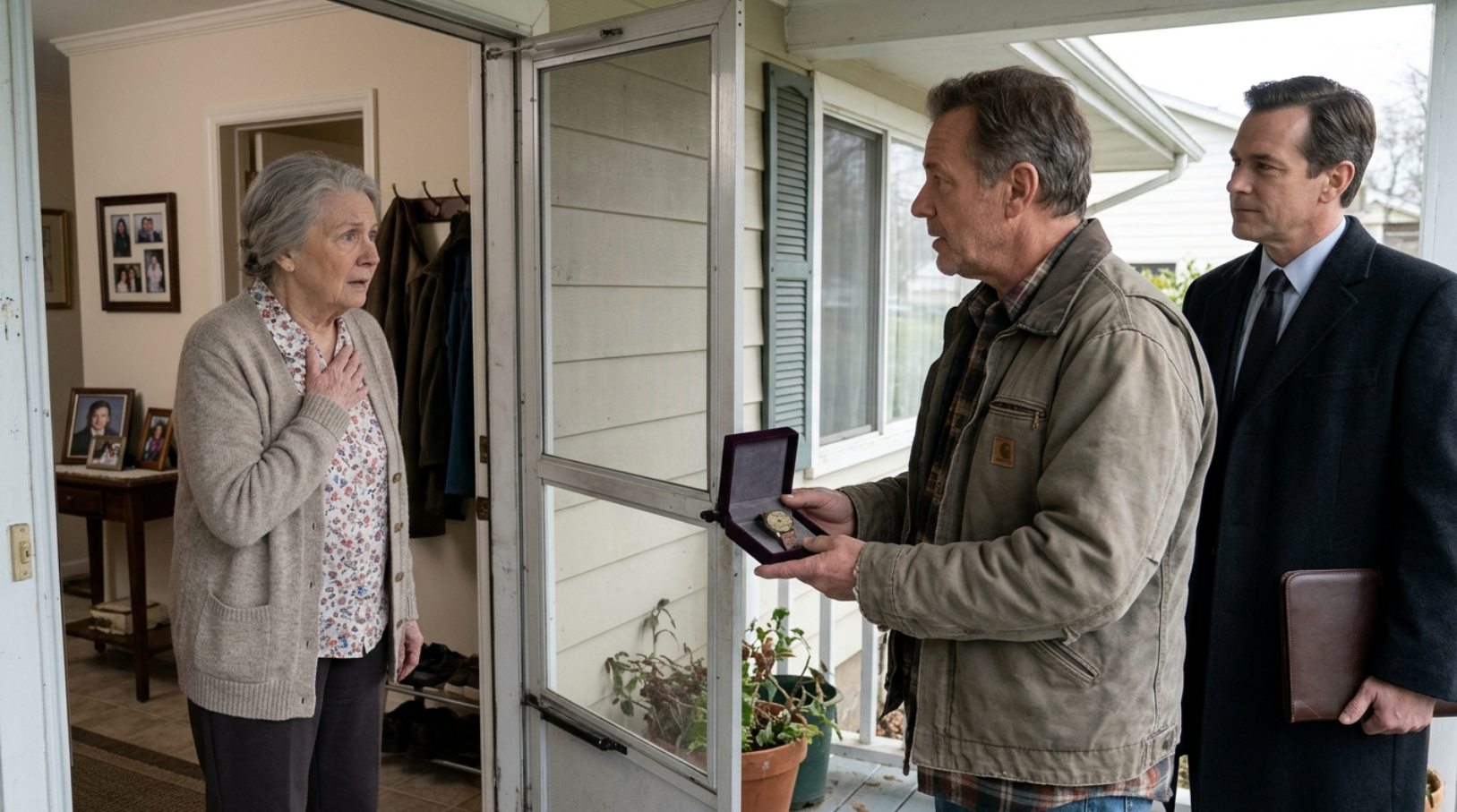
Patricia lived in a modest brick house with a white porch and a small garden. A wind chime hung beside the front door.
She answered after our second knock.
She was in her late seventies, with silver hair and a face marked by time. Her eyes were sharp, but there was a sadness in them that seemed older than the house itself.
“Yes?”
Mr. Cole introduced himself and explained why we had come.
When he said Daniel’s name, Patricia gripped the doorframe.
For several seconds, she stared at Mom.
Then she stepped aside.
“Come in.”
The living room was filled with books, family photographs, and neatly arranged furniture.
On a shelf beside the fireplace was a picture of a young man holding a little girl.
Daniel.
His daughter.
Patricia sat down slowly.
“I wondered when someone would finally come.”
Mom began to cry.
“I’m so sorry.”
Patricia looked at her.
“Why?”
“Because Harold knew Daniel. Because he came to our house the night before he disappeared. And because I never asked enough questions afterward.”
Patricia stared at her for a long moment.
Then she shook her head.
“You don’t owe me an apology for something you didn’t understand.”
She looked at Mr. Cole.
“Tell me what you’ve found.”
He explained the watch, the note, the locker, and the ledger.
When he showed her the photograph, Patricia’s hands began to shake.
She touched Daniel’s face.
“Oh, Danny.”
She pressed the photograph to her chest.
“He told me he was going to fix everything.”
Mom leaned forward.
“What do you mean?”
Patricia wiped her eyes.
“Daniel worked in the purchasing department. He discovered that money was being diverted through false invoices. Equipment was being recorded as delivered when it never arrived. Payments were being approved for companies that had no real operations.”
She looked at the ledger.
“He told me that Robert Vale was involved.”
I felt my heart pound.
“Robert Vale knew about the theft?”
Patricia nodded.
“Daniel believed Robert had helped organize it. But there was more to it than money. Some of the equipment was supposed to be used to improve safety at the mill.”
She looked toward the window.
“Workers had complained about defective machinery. Daniel believed that the money being diverted was supposed to pay for repairs and replacement parts. When the money disappeared, the repairs never happened.”
My throat tightened.
“Did someone get hurt?”
Patricia closed her eyes.
“My brother worked at the mill. He lost two fingers in an accident that might have been prevented if the equipment had been repaired properly.”
The room fell silent.
I suddenly understood why Dad had carried the burden for so long.
This hadn’t merely been about missing money.
It had been about people who went to work every morning believing someone was responsible for keeping them safe.
And someone had betrayed that trust.
Patricia continued.
“Daniel gathered copies of invoices and payment records. He wanted to take them to the authorities. But Robert found out.”
“What happened next?” I asked.
Patricia took a shaky breath.
“Daniel came home late one night and told me that he had to meet Harold. He said Harold had agreed to help him preserve the evidence.”
Mom nodded slowly.
“That was the night he came to our house.”
“Yes.”
Patricia looked at the ledger.
“Daniel told me he was afraid. He believed Robert had powerful friends, and he thought the company might try to destroy the evidence.”
“Did Daniel ever tell you what happened on September 17?” Mr. Cole asked.
Patricia shook her head.
“He never came home.”
She stared at the photograph.
“The police asked me if he had been unhappy. They asked if we had argued. They asked if he had debts or another woman. They searched our house and looked through his personal belongings.”
Her voice grew bitter.
“They wanted to believe he had run away. It was easier than believing someone had made him disappear.”
I felt tears gather in my eyes.
“Do you think Robert killed him?”
Patricia looked at me.
“I don’t know what happened to my husband. I have spent forty-five years wondering. But I know this: Daniel would never have abandoned his daughter without saying goodbye.”
She rose and walked to a cabinet.
From a drawer, she removed a small envelope.
“I kept this because I couldn’t bring myself to throw it away.”
Inside was a letter.
The paper was faded, and the writing had begun to blur.
Patricia handed it to Mr. Cole.
“This arrived three days after Daniel disappeared. There was no return address.”
Mr. Cole unfolded it carefully.
The message was brief.
Mrs. Whitaker,
Your husband made a serious mistake. For your family’s safety, you should stop asking questions. He has left town, and he will not be returning.
Do not contact the mill again.
There was no signature.
No explanation.
Only a typed sentence at the bottom.
Some doors are better left closed.
Patricia stared at the letter.
“I gave a copy to the police. They said there was no way to identify who sent it.”
Mr. Cole placed the letter beside the ledger.
“This may be relevant to the investigation.”
Patricia nodded.
Then she looked at Mom.
“Did Harold ever tell you what happened to Daniel?”
Mom shook her head.
“No. But he spent the rest of his life carrying something that seemed to be connected to him.”
Patricia’s eyes filled with tears.
“Then perhaps he knew more than he was able to say.”
She paused.
“There’s something else.”
We all looked at her.
“About a year before Daniel disappeared, he told me that if anything happened to him, I should look for a woman named Eleanor.”
Mom went rigid.
“Eleanor Vale?”
Patricia nodded.
“Daniel said she was the only person inside the company who might be willing to tell the truth about what Robert was doing.”
I thought about the photograph.
The circled face.
The signature in the ledger.
“Did Eleanor ever contact you?”
Patricia shook her head.
“Not while she was alive. But after her death, I received a package.”
Mr. Cole leaned forward.
“When?”
“Early 1984. It contained no letter, only a photograph of Daniel and a key.”
“A key?”
Patricia rose again and returned to the cabinet.
From a small wooden box, she removed a key wrapped in tissue paper.
It was old, brass, and stamped with a number.
214.
Mom covered her mouth.
The key to Locker 214.
Patricia looked at us with tears running down her cheeks.
“I never knew what it opened. I kept it because it was the only thing I had left that connected me to my husband.”
Mr. Cole examined it.
“Did you ever try to return to the mill?”
“Once. I went there in 1984, but the property manager told me the old locker rooms had been closed. I was frightened, and I left.”
She sat down again.
“Then, in 1985, I received a telephone call from a man who said he was calling on behalf of Robert Vale. He told me that continuing to search for Daniel would only bring trouble to my daughter.”
Patricia’s voice broke.
“I was a mother. I was terrified. I had already lost my husband. I couldn’t risk losing my child too.”
Mom reached across the table and held her hand.
For a moment, the two women sat together, bound by a grief that had begun decades before I was born.
Then Patricia looked at me.
“Did Harold leave anything else?”
I thought about Dad’s watch.
The note.
The ledger.
The notebook.
And the final entry.
Find her before they do.
“Yes,” I said quietly. “He left a message.”
I told her about the words Dad had written shortly before his death.
Patricia began to cry again.
“He was looking for me.”
“Yes.”
She lowered her head.
“After all these years, he was still trying to make things right.”
I looked at the old key resting on the table.
For the first time, the pieces of the mystery were beginning to fit together.
But there was still one question we hadn’t answered.
Why had Dad waited until the end of his life to reveal what he knew?
And what exactly had happened to Daniel Whitaker on the night he disappeared?
Mr. Cole gathered the documents.
“I believe we have enough evidence to request a formal review of the original investigation. The ledger, the anonymous letter, and the key may help establish what happened. But we need to proceed carefully.”
Patricia nodded.
Then she reached into the wooden box one final time.
“There was something else in the package,” she said.
She pulled out a folded piece of paper.
“I never showed anyone this because I didn’t understand what it meant.”
She handed it to Mr. Cole.
He unfolded it.
There was a single sentence, written in handwriting none of us recognized.
The man who took the money was not the man who signed the papers.
Mr. Cole looked at the ledger.
Then at the signature beside the final payment.
Margaret Brennan.
He went very still.
Because if the sentence was true, someone had used my mother’s name to authorize a transaction she knew nothing about.
And that meant the woman who had spent forty-five years believing her husband had hidden a secret might have been made part of that secret without ever knowing it.
My Brother Sold Dad’s 51-Year-Old Watch for $40—Then a Shop Owner Found a Secret Inside That Changed Our Family Forever

One Comment on “My Brother Sold Dad’s 51-Year-Old Watch for $40—Then a Shop Owner Found a Secret Inside That Changed Our Family Forever”