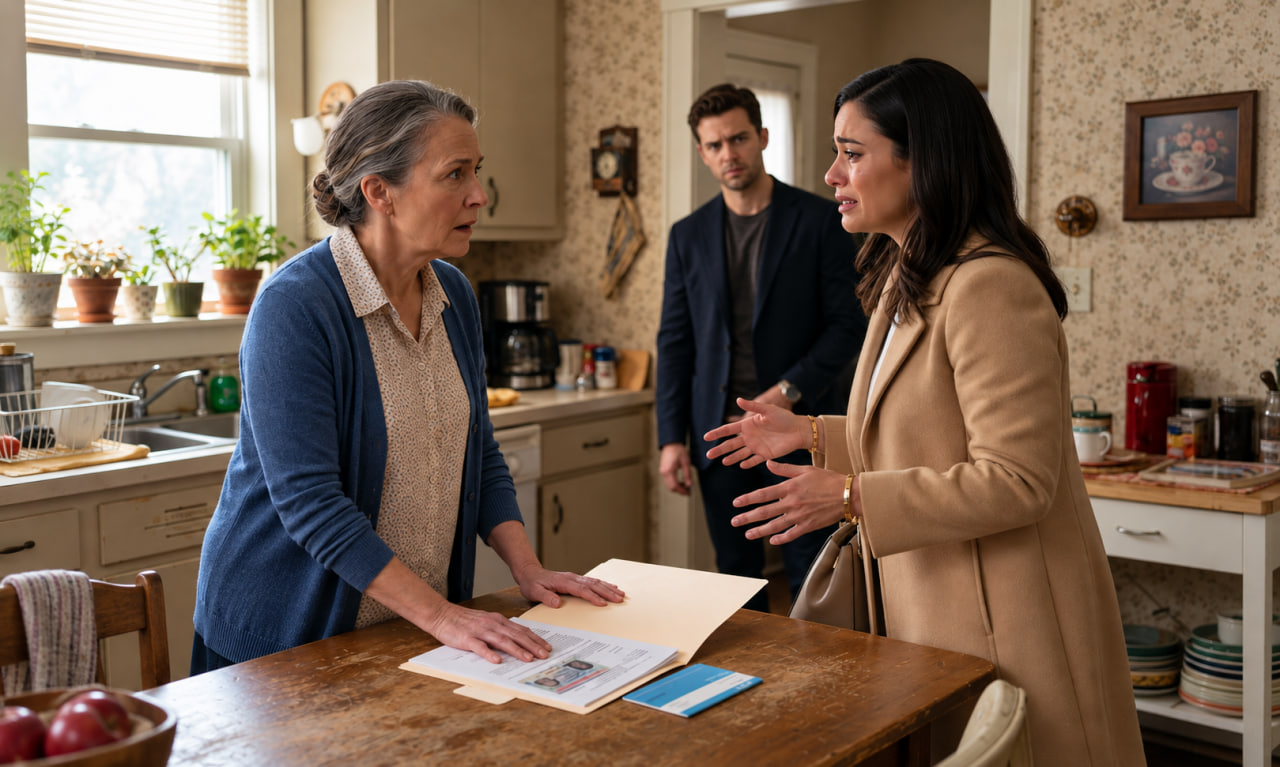
I remembered all the times she had held mine as a little girl.
I remembered walking her to school.
I remembered the night she had a fever and I sat beside her bed until morning.
I remembered the graduation ceremony.
And I remembered the sentence that had changed everything.
We only invited important people.
“I can forgive you for hurting me,” I said quietly. “But forgiveness doesn’t mean I will pretend the hurt never happened.”
She nodded, tears falling down her cheeks.
“And it doesn’t mean I will pay your bills again.”
“You may need to find another apartment. You may need to make difficult decisions about your marriage. You may need to accept consequences you don’t like.”
“I understand.”
“Then perhaps we can begin again someday. Not as the mother who solves every problem and the daughter who expects her to. But as two adults who tell each other the truth.”
Valerie cried harder.
“I want that, Mom.”
I hugged her.
It was the first time I had held her since the wedding.
And even though I loved her, I knew that one embrace could not repair everything.
Trust would have to be rebuilt slowly.
With honesty.
With responsibility.
And with time.
Two weeks later, the investigation uncovered the most important piece of evidence yet.
The lender had located records connected to the digital authorization used in the loan application. The financial company was working with the appropriate investigators to determine who had submitted the documents and whether any laws had been violated.
Meanwhile, the landlord provided the attorneys with the original lease renewal and the emails connected to the request.
The handwriting and signatures were being reviewed.
The evidence was still being examined, and no final determination had been made.
But the documents revealed something that none of us had expected.
Susan had been communicating with the lender before the wedding.
And Brandon had been copied on several of the emails.
The messages discussed the loan, the business account, and a plan to transfer certain expenses to the company receiving the funds.
There was also a message from Susan to Brandon sent two days before the ceremony.
Once the paperwork is complete, she won’t have a reason to interfere. Valerie will be married, and we can finally move forward.
I read the sentence in Mr. Harrison’s office.
Then I read it again.
“She was talking about me,” I whispered.
Mr. Harrison nodded.
“It appears that way, but we’ll need the surrounding messages to understand the full context.”
I felt a chill move through me.
They had discussed me as if I were an obstacle.
A problem to be managed.
A woman whose name could be used when convenient and whose presence could be avoided when inconvenient.
I thought about the lunch I had prepared for Valerie.
The mashed potatoes.
The green beans.
The good tablecloth.
I had spent that afternoon hoping to hear about her wedding plans.
Instead, she had sat at my table and told me she had already married.
I had been so hurt that I hadn’t even asked what she wanted for dessert.
Now I understood that the cruelty of that moment had been only one part of a much larger story.
I looked at Ms. Carter.
“What happens now?”
“We continue cooperating with the investigation. We dispute any accounts or obligations you did not authorize. We also follow the appropriate legal process regarding the apartment.”
“And Susan?”
“If the evidence supports further action, the appropriate authorities and institutions will determine the next steps.”
I nodded.
For the first time in weeks, I felt that I could breathe.
I didn’t need to confront Susan in public.
I didn’t need to shout at Brandon.
I didn’t need to expose them on social media or humiliate them in front of their friends.
I needed the truth to be documented.
I needed my identity protected.
And I needed to stop allowing other people’s choices to dictate the rest of my life.
That was enough.
The next major shock came from Valerie herself.
She called me on a Thursday evening.
“Mom, I need to tell you something.”
I was preparing dinner.
“What happened?”
“I found out that Brandon has been lying to me about his business.”
I turned off the stove.
“Tell me.”
“He told me his company was profitable. He said he had money coming in from several contracts. But I found letters from creditors in his desk.”
“What kind of letters?”
“Overdue payments. Collection notices. A demand for repayment from a business partner.”
I sat down.
“How much does he owe?”
“I don’t know the total. There are several accounts. Some of the letters are months old.”
I rubbed my forehead.
“Did you know any of this before the wedding?”
“I knew he had some debt. He told me it was normal for a business owner. I didn’t know how serious it was.”
She paused.
“Mom, I think he married me because he believed you would keep helping us.”
I didn’t answer immediately.
It was a painful possibility, but I didn’t want to encourage her to jump to conclusions without evidence.
“What makes you think that?”
“Because every time I told him we needed to reduce our expenses, he said we didn’t have to worry. He said you would help if anything went wrong.”
My heart sank.
“Did he tell you that directly?”
“Yes. He said you would never let your daughter lose her home.”
I looked around my little kitchen.
The worn wooden table.
The old curtains.
The refrigerator that sometimes made a rattling sound.
Everything in this house reminded me of the life I had built through hard work.
Brandon had apparently looked at my love for Valerie and seen a financial safety net.
And Valerie had allowed him to believe it would never end.
“Mom,” she whispered, “I’m so ashamed.”
“I know.”
“I thought I was marrying a man who had everything under control.”
“Sometimes people hide their problems because they’re afraid of being judged. But that doesn’t excuse using someone else’s identity or money.”
“I know.”
She took a shaky breath.
“I’ve asked him to meet with me and explain everything. He says he won’t discuss his finances while you’re trying to ruin his life.”
I shook my head.
“That’s his choice. You can only make decisions based on what you know.”
“What if the marriage was a mistake?”
I closed my eyes.
There was no answer that could remove her pain.
“Then you will have to decide what to do next. But don’t stay in a situation that harms you simply because you are ashamed to admit that you made a mistake.”
She cried quietly.
Then she asked, “Can I come home for a few days?”
The question took me by surprise.
She hadn’t asked to come home because she needed money.
She hadn’t asked me to pay the rent.
She had asked for a place to think.
I looked toward the spare bedroom, where I had kept her old books and childhood drawings.
“Yes,” I said. “You can stay for a few days while you make arrangements. But we will keep clear boundaries. I won’t pay your debts, and I won’t hide anything from the investigation.”
“Thank you, Mom.”
“And Valerie?”
“Yes?”
“If you want to rebuild your life, you must be honest with yourself first.”
“I will be.”
That night, I made the bed in the spare room.
I found an old photograph of Valerie at eight years old, standing beside me in front of our first little house.
She had a missing front tooth and a grin so wide that her eyes were almost closed.
I placed the photograph on the dresser.
Not because I wanted to pretend she was still that little girl.
Because I wanted to remember that the person I loved and the person who had hurt me were the same person.
And loving her did not require me to deny either truth.
By the time the next month arrived, the financial company had taken steps to investigate the disputed loan, and the unfamiliar credit account had been formally reported as unauthorized.
My attorneys helped me document the claims, respond to the lender, and protect my remaining finances.
The lease issue was also being handled through the appropriate legal process.
I did not attempt to throw Valerie or Brandon out overnight. I followed the procedures required by the lease and the law, and I made sure every communication was documented.
It was a slower process than I wanted.
But I had learned that doing things correctly was more important than doing them quickly.
Meanwhile, Valerie began to rebuild her life.
She found a temporary place to stay with a former college friend. She returned the expensive bracelet she had purchased shortly before the wedding, using the refund to cover her own immediate expenses.
She also began meeting with a counselor to understand why she had spent so much of her life trying to earn approval from people who treated her poorly.
I didn’t pay her rent.
I didn’t cover her credit card bills.
But I did listen when she needed to talk.
Sometimes, she cried.
Sometimes, she became angry at herself.
Sometimes, she defended Brandon, then remembered something else he had said or done and fell silent.
Healing was not a straight line.
Neither was accountability.
One evening, she came to my house and sat with me on the porch.
“Mom, do you remember when I was little and you used to tell me that money doesn’t make someone important?”
I smiled sadly.
“Yes.”
“I used to think you said that because we didn’t have much.”
I looked at her.
“What do you think now?”
She stared at the street.
“I think you said it because you knew something I didn’t.”
I waited.
“Money can buy a beautiful wedding. It can buy a nice apartment, expensive clothes, and a fancy dinner. But it can’t make someone loyal. It can’t make someone honest. And it can’t make someone love you.”
I felt tears gather in my eyes.
“No,” I said. “It can’t.”
She turned toward me.
“I wish I’d invited you.”
The words were so simple that they almost broke my heart.
Not because they could change the past.
Because she was finally acknowledging what she had done without blaming anyone else.
“I wish you had, too.”
She looked down at her hands.
“I don’t expect you to forget.”
“Good. Because I won’t.”
She nodded.
“But I hope one day you can trust me again.”
I reached over and took her hand.
“That depends on what you do from now on.”
For the first time, she didn’t ask me to promise that everything would be all right.
She simply held my hand and sat beside me.
And that was a beginning.
Several months later, the investigation reached an important stage.
The lender confirmed that the loan had been issued based on documents that were now being formally disputed. The company continued its review, and the matter involving the suspected misuse of my identity was referred to the appropriate authorities.
The attorneys also received additional records connected to the loan application and the lease renewal.
Those records strengthened the case that the documents had been submitted without my authorization, although the legal responsibility of each person involved still had to be established through the proper process.
Susan’s company was asked to provide information about the account that received the loan proceeds.
Brandon was also required to respond to questions about his communications with the lender.
For the first time, the people who had treated me as an inconvenience were being asked to explain their decisions to someone other than me.
I did not celebrate.
I didn’t feel triumphant.
I felt tired.
There is nothing glamorous about discovering that people you trusted may have used your identity. The paperwork is exhausting. The phone calls are frightening. Every new document brings another question.
But I no longer felt powerless.
I had a lawyer.
I had records.
I had the truth as far as it could be established.
And I had stopped making decisions out of fear that my daughter might be angry with me.
Eventually, Valerie made a decision of her own.
She separated from Brandon and began the legal process of ending their marriage.
She told me she couldn’t build a future with a man whose explanations changed every time someone asked for evidence.
“I don’t know what will happen to him,” she said one afternoon. “But I know I can’t keep living like this.”
I nodded.
“You don’t have to know everything about your future to take the first honest step.”
She hugged me.
This time, the embrace felt different.
There was no request hidden inside it.
No bill waiting to be paid.
No emergency that I was expected to solve.
Just a daughter who was beginning to understand the consequences of her choices.
As for Susan and Brandon, their legal and financial problems continued to unfold through the appropriate channels. I did not control the outcome, and I did not need to.
My responsibility was to protect myself and cooperate with the process.
Their responsibility was to answer for their own actions.
For the first time in decades, I understood the difference.
A year after the day Valerie told me that her wedding had already happened, I received an invitation in the mail.
It wasn’t an invitation to another wedding.
It was an invitation to Valerie’s graduation ceremony for a professional certification program she had completed while rebuilding her career.
The envelope contained a handwritten note.
Mom, I don’t know if I deserve to ask you to come. But I want you there because you’re my mother, not because I need anything from you. If you decide to come, I’ll save you a seat.
I read the note several times.
Then I placed it on the kitchen table and sat quietly for a long time.
I thought about the first graduation ceremony, years earlier.
I remembered my old dress, the aching feet, and the tears of pride I had cried while watching her receive her degree.
I remembered believing that if I gave her enough, she would always understand what it meant.
I had been wrong about that.
But perhaps I hadn’t been wrong to love her.
On the day of the ceremony, I wore a navy-blue dress I had purchased for myself. I did my hair, put on a little lipstick, and arrived early.
When Valerie saw me, she hurried across the room.
For a moment, she looked almost like the little girl who used to run into my arms after school.
Then she stopped in front of me.
“Thank you for coming, Mom.”
I smiled.
“Congratulations, sweetheart.”
She hugged me tightly.
“I saved you the best seat.”
I looked toward the front row.
There was a small card with my name on it.
Not Susan’s name.
Not Brandon’s.
Mine.
I sat down, and when Valerie walked across the stage, I clapped.
I didn’t clap because she was my daughter and therefore incapable of doing wrong.
I clapped because she had worked hard to build something of her own.
And because I hoped she was finally learning that the most important kind of success was not the kind that impressed other people.
It was the kind you could live with honestly.
After the ceremony, we went to a small restaurant.
No string quartet.
No expensive decorations.
No elaborate display.
Just the two of us, sharing a meal.
Valerie ordered a simple dinner and insisted on paying for it herself.
When the bill arrived, she placed her card on the table.
I didn’t reach for my purse.
I didn’t offer to split the cost.
I simply thanked her.
As we walked outside, she stopped beside my car.
“Mom, can I ask you something?”
“Of course.”
“Do you think we’ll ever be the way we were before?”
I considered the question.
“No,” I said gently.
Her face fell.
Then I continued.
“I hope we become something better.”
She looked at me.
“Better?”
“Yes. Before, I thought being a good mother meant making sure you never had to struggle. I thought loving you meant solving every problem before it could hurt you.”
I took her hand.
“But I was wrong about some things, too. I should have taught you that helping someone doesn’t mean taking responsibility for every choice they make. I should have set boundaries before resentment took the place of honest conversations.”
She listened without interrupting.
“And you have learned that love doesn’t give you permission to use someone. Trust must be earned, even in a family.”
Tears filled her eyes.
“I am so sorry, Mom.”
“I know.”
“I can’t change what happened.”
“No. But you can choose what happens next.”
She hugged me again.
And this time, I held her without wondering what she would ask me to pay for afterward.
Our relationship was not perfect.
The past had not disappeared.
There were still difficult conversations ahead, and the financial investigation had left consequences that would take time to resolve.
But something had changed.
Valerie was learning to stand on her own.
And I was learning that I could love my daughter without sacrificing myself.
That evening, I returned home and opened the little drawer beside my bed.
Inside was the blue bankbook I had kept for years.
It had once represented the money I was saving for Valerie’s future.
I took it out and looked at the balance.
For a long time, I had imagined that every dollar I saved would eventually help my daughter.
Now I had a different plan.
I would keep enough for emergencies.
I would repair the roof that had leaked during the last storm.
I would take the small trip I had postponed for years.
And I would finally replace the old kitchen table where I had spent so many nights worrying about everyone except myself.
I wasn’t going to stop being a mother.
I wasn’t going to stop loving Valerie.
But I was going to stop treating my own life as though it mattered less than hers.
The next morning, I made myself breakfast and sat by the window with a cup of coffee.
A woman passed on the sidewalk carrying a tray of homemade snacks, calling out to people as she walked.
For a moment, I remembered the years when I had done exactly the same thing.
Back then, I had believed that every sacrifice brought me closer to the future I wanted for my daughter.
I had never imagined that the hardest lesson I would learn would come after she had grown up.
Sometimes, the people we love hurt us.
Sometimes, they disappoint us.
Sometimes, they take our kindness for granted until we finally withdraw it.
But we do not have to become cruel in response.
We can set boundaries.
We can seek the truth.
We can forgive without pretending nothing happened.
And we can leave the door open to reconciliation without handing over the keys to our lives.
As for Valerie, she still called me every Sunday.
At first, our conversations were short and awkward. Over time, they became warmer.
She asked about my health.
She told me about her work.
She shared her worries without expecting me to solve them.
And when she needed help, she learned to ask honestly and accept my answer, even when it was no.
One Sunday, nearly a year after the wedding, she asked me a question I will never forget.
“Mom, do you know what I regret most?”
“What, sweetheart?”
“Not that you stopped paying my bills.”
I waited.
“I regret that I made you feel like you had to earn a place in my life.”
My eyes filled with tears.
“You never had to earn a place in my life, Valerie. You were my daughter from the moment I held you.”
She began crying.
“But I made you feel unimportant.”
“Yes,” I said softly. “You did.”
She didn’t argue.
She didn’t make excuses.
She simply apologized.
And for the first time, I felt that she truly understood.
I still don’t know whether every wound between us will ever completely heal.
Perhaps some never do.
But I know this: I am no longer the woman who will silently pay for her own humiliation just to keep her family comfortable.
I am still a mother.
I am still capable of forgiveness.
And I still believe that people can change.
But now I understand that love is not measured by how much you are willing to lose.
Sometimes, love means helping someone face the consequences of their choices.
Sometimes, it means saying no.
And sometimes, it means finally saying yes to yourself.
When my daughter told me that her wedding was only for “important people,” she believed she was deciding who belonged in her life.
She never imagined that I would finally decide who was allowed to use mine.
And that was the day I learned the difference between being needed and being loved.
Because I had spent thirty years making sure my daughter never went without.
It was time to make sure I didn’t lose myself trying to keep her comfortable.
And if there is one thing I hope every mother learns from my story, it is this:
You can love your children with your whole heart without handing them the power to break it again and again.
You can forgive them without funding their mistakes.
You can welcome them home without allowing them to walk all over you.
And you can remain a loving mother while finally becoming a woman who knows her own worth.
Because being a mother never meant I had to stop being a person.
And being family never meant anyone had the right to use my name, my money, or my love without my permission.
The wedding had taught me who they thought was important.
The truth taught me that I had been important all along—even when I was the only one who had forgotten it.

One Comment on “My Daughter Said Her Wedding Was Only for “Important People”—A Week Later, She Called Asking Me to Pay Her Rent”