PART 3
He stepped toward her wheelchair, reaching for the handles.
She pulled away.
“Don’t touch me.”
Those three words came out so softly that I almost missed them.
But Roscoe heard them.
So did Jasmine.
And so did the boys.
His mother had spent most of her life defending that man.
When he was a little boy, she defended him when he broke windows, skipped school, and got into fights.
When he was a teenager, she defended him when he came home drunk.
When he married me, she told everyone that her son had finally found a woman who knew how to take care of him.
Even after her stroke, when she couldn’t walk without help, she’d tell me how proud she was of him.
“He works so hard, Libby-girl,” she’d say. “He never had an easy life.”
I never argued.
I knew she loved her son.
But now she was looking at the same son who had just stood in front of his wife and grandchildren and explained why another woman deserved a place in his truck.
“How long?” she asked.
Roscoe rubbed the back of his neck.
“Mother, this isn’t the place.”
“How long have you been bringing that woman around?”
Jasmine rolled her eyes.
“Look, I don’t think we need to do this.”
His mother slowly turned her head toward her.
“Excuse me?”
Jasmine crossed her arms.
“I’m just saying, this is between adults. There’s no reason to make everybody uncomfortable.”
His mother stared at her.
Then she gave a small, bitter laugh.
“Between adults?”
She pointed one trembling finger toward the boys.
“Those are children. Those children came here with a sign because they love their grandfather.
And you think the problem is that somebody is making you uncomfortable?”
Jasmine’s smile disappeared.
Roscoe stepped between them.
“That’s enough, Ma.”
“No, son. It isn’t.”
His mother took a breath.
“I’ve spent my whole life making excuses for you. I told myself you were a good boy who sometimes made bad decisions. I told Libby to be patient when you were gone for weeks. I told her you were tired when you forgot birthdays. I told her you were under pressure when you came home angry.”
Her voice began to shake.
“And now I find out that while this woman was riding around with you, your wife was bathing me, feeding me, washing my clothes, and making sure I never felt like a burden.”
I felt my throat tighten.
“Ma, please,” I whispered.
She looked at me.
“Don’t you dare apologize for anything, Libby-girl.”
Then she turned back to Roscoe.
“Do you know what she did last night?”
He said nothing.
“She stayed awake until nearly three in the morning because I was having trouble breathing. She sat beside my bed and held my hand. She called the nurse. She changed my sheets. And when I finally fell asleep, she went downstairs and packed your sandwiches because she thought you were coming home today.”
Roscoe looked down.
His mother continued.
“She did all that while you were kissing somebody else.”
For the first time, Jasmine let go of his arm.
“Roscoe, maybe we should go.”
His mother looked at her.
“Yes. You should.”
Roscoe snapped.
“Mother, stop treating me like I’m a child!”
His mother’s eyes filled with tears.
“I’m not treating you like a child.
I’m treating you like a man who has forgotten what being a husband and father means.”
The silence that followed was unbearable.
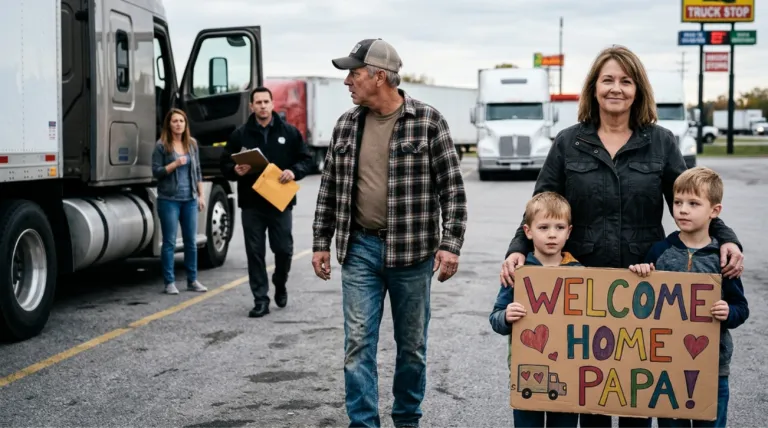
Then my oldest grandson tugged on my coat.
“Grandma?”
I looked down.
“Yes, sweetheart?”
“Is Grandpa still our grandpa?”
That question nearly broke me.
I knelt in front of him.
“Of course he is, honey. Nothing changes how much you boys deserve to be loved.”
“But why did he kiss that lady?”
I didn’t have an answer.
Not one that a seven-year-old should have to hear.
I pulled him into my arms.
“Sometimes grown-ups make choices that hurt people. But that’s never the children’s fault.”
Behind me, Roscoe cleared his throat.
“Come on, boys. Grandpa’s home. Let’s get out of here.”
The little one didn’t move.
He looked at the pizza-box sign in his hands.
Then he looked at Roscoe.
“We made this for you.”
Roscoe forced a smile.
“I know, buddy.”
“We worked on it all morning.”
“I know.”
“I wanted you to put it in your truck.”
Roscoe looked at the sign.
For a second, I thought he might finally understand what he’d done.
Then he said something I’ll never forget.
“Well, maybe next time.”
My grandson lowered the sign.
And just like that, something changed in his little face.
He wasn’t crying.
He wasn’t angry.
He just looked disappointed.
Sometimes disappointment is much harder to watch than tears.
I stood up and took the sign from his hands.
“Come on, sweetheart. Let’s go sit with Great-Grandma.”
Roscoe frowned.
“Where are you going?”
“Home.”
“We haven’t even talked.”
I looked at him.
“You’ve talked enough for one afternoon.”
“Libby, don’t start acting crazy.”
His mother closed her eyes.
“Roscoe.”
But I was already turning away.
I pushed his mother’s wheelchair toward the restaurant entrance while the boys followed.
Behind us, I heard Jasmine whisper something.
Then I heard Roscoe say, “Just wait here.”
I didn’t turn around.
Not once.
Inside the restaurant, I helped his mother settle near the window.
The boys sat on either side of her.
I ordered hot chocolate for them and coffee for myself.
For several minutes, nobody said anything.
Then his mother reached across the table and took my hand.
“Libby-girl.”
I looked at her.
“I’m sorry.”
I shook my head.
“You don’t have anything to apologize for.”
“Yes, I do.”
She swallowed.
“I raised him.”
I squeezed her hand.
“You raised a little boy. You didn’t make every decision that man made afterward.”
Her eyes filled again.
“I always thought he’d take care of you.”
I looked out the window.
“I thought so too.”
A few minutes later, Roscoe walked into the restaurant.
Jasmine wasn’t with him.
He came straight to our table.
“Can we talk?”
I kept stirring my coffee.
“About what?”
“About what happened.”
“What part?”
He looked irritated.
“Don’t do that, Lib.”
I put my spoon down.
“You told me you were lonely. You told me Jasmine wasn’t the only woman. You kissed her in front of our grandsons. What exactly would you like to explain?”
He glanced at the boys.
“Not in front of the kids.”
“Then perhaps you should have thought about that before doing it in front of them.”
His jaw tightened.
“Forty years, Libby. Forty years together. You’re really going to throw all that away over one mistake?”
I looked at him.
“One mistake?”
He sighed.
“Fine. It wasn’t just one time.”
His mother gasped.
I didn’t move.
He continued.
“I’ve known Jasmine for about eight months.”
Eight months.
I repeated those words inside my head.
Eight months.
Eight months of me making his favorite meals.
Eight months of me telling his grandchildren that Grandpa was working hard.
Eight months of me believing that every phone call from the road meant something.
“Does she know you’re married?” I asked.
He gave me a look.
“Of course she knows.”
“Does she know you have a wife at home taking care of your mother?”
He didn’t answer.
“Does she know that when your mother falls at night, I’m the one who gets her up?”
“Libby, don’t make this about Ma.”
I laughed.
Not because anything was funny.
Because I suddenly understood how little he thought about the things I did.
“You’re right, Roscoe. It isn’t about your mother. It’s about you.”
He pulled out the chair opposite me.
“Look, I don’t want a divorce. I just want things to calm down. Jasmine and I have something, but that doesn’t mean I don’t care about you.”
His mother pushed her coffee away.
“Get out.”
Roscoe turned.
“Ma—”
“Get out of this restaurant and leave your wife alone.”
“You’re choosing her over your own son?”
His mother looked at him with tears running down her cheeks.
“No, son. I’m choosing the woman who has been there for me when I needed someone.”
He stood there for a moment.
Then he looked at me.
“I’ll be home tonight. We can discuss this properly.”
I didn’t respond.
He walked away.
Through the window, I watched him cross the parking lot toward his pickup.
Jasmine was waiting beside it.
She said something.
He shook his head.
Then she climbed into the passenger seat.
They drove away.
I sat there for another ten minutes.
Then I took out my phone.
There was one person I needed to call.
My sister, Martha.
She lived about twenty minutes away and had always been the person I called when life became too heavy.
She answered on the second ring.
“Libby? Everything okay?”
I looked at the boys.
Then at the old woman sitting beside me.
“No, Martha. Nothing is okay.”
“What happened?”
I took a breath.
“Can you come over tonight? I think I need you.”
She didn’t ask another question.
“I’ll be there.”
We got home around four-thirty.
I helped the boys wash their hands and put their coats away.
Then I warmed some soup for everyone.
His mother barely ate.
She kept staring at the front window.
“Do you think he’ll come home?” she asked.
I sat beside her.
“I don’t know.”
“He’s still my boy.”
“I know.”
“I don’t want to lose him.”
I held her hand.
“You aren’t losing him because of something I did. He’s responsible for his own choices.”
She nodded slowly.
Then she said something that surprised me.
“There’s something I need to tell you, Libby-girl.”
I turned toward her.
“What is it?”
She looked toward the hallway to make sure the boys weren’t listening.
“Before my stroke, I heard Roscoe talking on the phone.”
My stomach tightened.
“What did you hear?”
“He was talking about money.”
“What money?”
She shook her head.
“I couldn’t understand everything. But I heard him say something about selling the property.”
I frowned.
“What property?”
“The little house.”
I stared at her.
The little house was the property his father had left behind.
It sat on three acres outside town.
It wasn’t fancy, but it had been in his family for generations.
Roscoe had always said he wanted to keep it for the grandchildren.
“Did he say he was selling it?”
“He said somebody was going to pay him a lot of money. He also said you didn’t need to know.”
My hands went cold.
“Ma, when was this?”
“About six months ago.”
Six months.
Almost exactly when Jasmine entered his life.
I looked at her carefully.
“Did you tell him you heard?”
“No. I wanted to ask him, but then I had the stroke.”
I sat back.
Something about the conversation didn’t feel right.
Roscoe had always handled our finances.
He paid the mortgage, insurance, and truck expenses.
I handled groceries, household bills, and everything involving his mother.
We had one joint checking account and a savings account.
At least, that’s what I thought.
“Do you know if he sold the property?”
His mother shook her head.
“I don’t know.”
I reached for my phone.
Then I stopped.
There was no point making accusations without knowing the facts.
For forty years, I’d trusted my husband with almost everything.
But that afternoon had taught me something important.
Trust should never mean refusing to look at the truth.
Martha arrived just after six.
She brought a casserole and a bottle of wine.
One look at my face told her that the situation was worse than I’d explained over the phone.
She hugged me in the kitchen.
Then she listened.
I told her everything.
The truck stop.
The kiss.
Jasmine.
His mother’s words.
The eight months.
And finally, the little house.
Martha didn’t interrupt.
When I finished, she sat quietly for a moment.
Then she asked, “Libby, do you know how much money you two have?”
I frowned.
“Of course. We have our savings.”
“How much?”
I opened my mouth.
Then closed it.
I knew we had been saving for retirement.
I knew Roscoe had a pension through his company.
I knew we had paid off the house several years ago.
But I couldn’t tell her the exact amount in our accounts.
Martha leaned forward.
“Have you checked your bank statements recently?”
I shook my head.
“Roscoe handles the banking.”
She looked at me.
“Then maybe it’s time you started handling it too.”
I knew she was right.
After dinner, while the boys watched television with their great-grandmother, I opened the banking app on my phone.
I had the login information because Roscoe had helped me install it years earlier.
I hadn’t used it much.
The first account looked normal.
Then I opened the savings account.
I stared at the screen.
The balance was $18,420.
I remembered it being over $76,000.
I refreshed the page.
The number didn’t change.
My fingers started trembling.
I opened the transaction history.
There were withdrawals.
Large withdrawals.
$5,000.
$8,500.
$12,000.
Another $7,500.
All transferred to an account I didn’t recognize.
The transfers had started eight months earlier.
My heart began beating faster.
I opened another document.
There was a payment of $14,800 to a property management company.
Then a transfer of $9,200.
Then another withdrawal of $6,000.
I called the bank.
After verifying my identity, the representative explained that the transfers had been authorized through the joint account.
“Can you tell me the name of the receiving account holder?” I asked.
“I’m sorry, ma’am. I can explain the transaction details associated with your joint account, but I can’t disclose private information about another customer’s account.”
I understood.
I thanked her and hung up.
Martha was standing behind me.
“How bad?”
I turned the phone toward her.
She read the numbers.
Then she sat down.
“Libby…”
I nodded.
“I know.”
For a few minutes, neither of us spoke.
Then I noticed something else.
There was a recent email notification from the bank.
It was about a change to our account contact information.
I opened it.
The primary phone number had been changed.
It was Roscoe’s number.
The email address was still mine, but the bank had sent a notification explaining that the change had been made three weeks earlier.
I stared at the date.
Three weeks.
The same day Roscoe had called me from the road and told me he was working overtime.
My hands were shaking so badly that Martha took the phone from me.
“Tomorrow,” she said firmly. “We’re going to the bank tomorrow.”
I nodded.
But before I could answer, my phone rang.
It was Roscoe.
I looked at Martha.
She shook her head.
I answered anyway.
“Hello?”
“Libby, we need to talk.”
“About what?”
“Don’t start. I know you’re upset.”
I said nothing.
He continued.
“I want you to understand that Jasmine isn’t the issue anymore.”
I felt my stomach tighten.
“Then what is?”
There was a long pause.
Then he said:
“I need you to sign something for me.”
I sat up straighter.
“What?”
“Some paperwork. Nothing complicated.”
“What paperwork?”
“It’s related to the property.”
My eyes moved toward Martha.
She had stopped breathing.
“What property, Roscoe?”
“The little house. I told you about it before.”
“No, you didn’t.”
He sighed.
“Don’t make this difficult. I need your signature because the property is in both our names.”
I stared at the phone.
“What are you talking about?”
“Just trust me. I’ll bring the papers home tonight.”
I almost laughed.
Trust him.
After everything I’d seen that afternoon.
After discovering that nearly $58,000 had disappeared from our savings.
After hearing about the property from his own mother.
He still expected me to trust him.
“Roscoe?”
“What?”
“I’m not signing anything until I have a lawyer look at it.”
Silence.
Then his voice changed.
“Libby, don’t be stupid.”
I felt my face grow hot.
“Excuse me?”
“You heard me. You don’t understand property paperwork. This is business.”
“Then you shouldn’t have any problem letting a lawyer review it.”
He exhaled sharply.
“You’ve changed.”
I looked at the kitchen table.
At the bank statements.
At the little pizza-box sign the boys had made.
“No, Roscoe. I think I’m finally seeing things clearly.”
I hung up.
Martha put her hand on my shoulder.
“Good.”
But the worst part of that evening hadn’t happened yet.
At 8:17 p.m., someone knocked on the front door.
I assumed it was Roscoe.
I opened it.
But it wasn’t my husband.
