PART 5
I stared at him.
He looked ashamed.
“I was wrong.”
For a long time, I said nothing.
Then I reached into my handbag and removed a small envelope.
He looked at it.
“What is that?”
“Something I wanted you to have.”
He hesitated before taking it.
Inside was a photograph.
It was taken thirty-eight years earlier.
Myles and I were standing outside the church where we had been married.
I was twenty-six.
He was twenty-eight.
We were smiling like two people who believed the world was going to be kind to them.
He stared at the picture.
“So do I.”
I sat across from him.
“I kept this photograph because I wanted to remember the beginning. Not because I wanted to pretend the ending didn’t matter.”
He looked at me.
“Are you leaving me?”
I took a slow breath.
“I’m not making that decision tonight.”
He reached across the table.
I didn’t take his hand.
“I need time. And I need you to understand that saying sorry doesn’t automatically put everything back where it was.”
He nodded.
“Whatever you need.”
I looked at him.
“Then here’s what I need. Full financial disclosure. No hidden accounts. No secret arrangements. No more contact with Trudy. And we’ll continue working through the legal process with Denise.”
He nodded again.
“And counseling,” I added. “If we’re going to have any chance of rebuilding trust, we need professional help.”
“I’ll do it.”
I stood and picked up my coat.
“Good.”
He looked surprised.
“You’re leaving?”
“Yes.”
“But it’s Thanksgiving.”
“I know.”
I looked at the burned turkey.
“And Myles?”
“Yes?”
“Next year, buy a thermometer.”
For the first time in weeks, he laughed.
I smiled politely.
Then I walked out.
The following months weren’t easy.
There were legal meetings, difficult conversations, and many nights when I wondered whether I was doing the right thing.
Trudy provided the messages and financial records she had promised.
Those records helped clarify what had happened and allowed our attorney to address the unauthorized transactions through the proper legal channels.
Myles had to answer for his decisions.
The money wasn’t magically restored overnight, and our marriage certainly wasn’t repaired by a few apologies.
But for the first time, he stopped pretending that nothing had happened.
He attended counseling.
He began taking responsibility for the household.
He fixed the kitchen sink.
Not because Trudy asked him.
Because I had asked him for four years.
One afternoon, I found him underneath the sink with a wrench in his hand.
“Well,” I said, standing in the doorway. “Look at that.”
He glanced up.
“Finally got around to it.”
I smiled.
“Only took a public scandal.”
He laughed quietly.
We weren’t the same couple who had entered that church in September.
And perhaps we never would be again.
I still had moments of anger.
Sometimes a cherry pie at the grocery store would remind me of Trudy.
Sometimes I would wake in the middle of the night remembering Myles grinning when she told me she’d have him by Thanksgiving.
Those memories didn’t disappear.
But I stopped allowing them to control my days.
In January, I returned to church.
I wore my blue sweater and sat in my usual pew.
Myles sat beside me, leaving a little space between us.
The pastor greeted us warmly.
After the service, several women approached me.
One squeezed my hand.
Another told me she admired my courage.
I thanked them, but I didn’t want to become the church’s Thanksgiving story forever.
I wanted to be Claudette again.
The woman who loved coffee.
The woman who made green chile casserole.
The woman who could laugh until her stomach hurt.
A few weeks later, I received a handwritten letter from Trudy.
She had returned to her daughter’s home and was planning to stay there.
She wrote that she was sorry for what she had done and that she had started speaking with a counselor.
She also said something that surprised me.
I thought I wanted your husband. But what I really wanted was to feel wanted. I convinced myself that taking somebody else’s place would make me feel less alone. It didn’t.
I read the letter.
Then I folded it and placed it in a drawer.
I didn’t write back.
I wasn’t angry enough to wish her harm.
But I wasn’t obligated to become her friend, either.
Spring arrived.
The snow melted.
The church planted flowers outside the fellowship hall.
And one Sunday, after service, I found myself standing in the parking lot with Myles.
He was carrying a small cardboard box.
“What’s that?” I asked.
He smiled awkwardly.
“I thought we could take this home.”
I looked inside.
It was a coconut cream pie.
I stared at it.
Then I looked at him.
“Really?”
He nodded.
“I know you like it.”
I laughed.
“Myles, I haven’t liked coconut cream pie since 1998.”
He looked confused.
“Then why did I think you did?”
“Because you never asked.”
His smile disappeared.
For a moment, neither of us spoke.
Then he nodded slowly.
“You’re right.”
I looked at the pie.
“Well, we can give it to Marlene.”
He smiled.
“She likes it.”
We walked toward the car.
And for the first time in a long while, I didn’t feel like I was walking beside a man I had to compete for.
I was simply walking beside someone who was finally learning that marriage wasn’t about being admired by strangers.
It was about respecting the person who had stood beside you when nobody else was watching.
Our relationship continued to change.
Some days were good.
Others were difficult.
We didn’t rush into pretending everything was wonderful.
We took our time.
And eventually, I realized that whether Myles and I stayed married or not, I had already reclaimed something important.
Myself.
One year after the Thanksgiving supper, our church held another holiday gathering.
The same fellowship hall.
The same folding tables.
The same paper turkeys.
The same enormous coffee urn.
I brought my green chile casserole.
Marlene brought a pumpkin pie.
And Myles carried in a box of napkins.
As we entered, I noticed the table where Trudy had sat the year before.
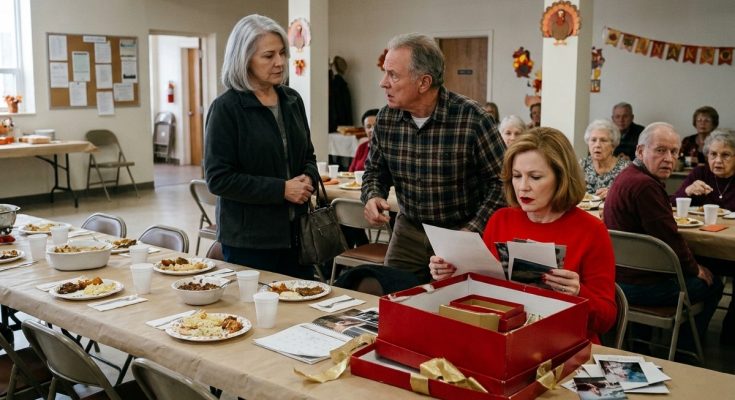
For a moment, I remembered her red sweater, her cherry pie, and the enormous present resting in her lap.
I smiled to myself.
The pastor approached.
“Claudette, would you like to say a few words before dinner?”
I hesitated.
Then I stood.
I looked around the room at the people who had witnessed the whole thing.
Some smiled.
Some looked embarrassed.
But nobody interrupted.
“I want to say something about marriage,” I began. “Not because I’m an expert, and certainly not because my own marriage has been perfect.”
A few people chuckled.
“I spent thirty-one years pouring coffee at a truck stop. I learned a lot about people there. Some came in tired. Some came in lonely. Some came in carrying more trouble than they could fit in their trucks.”
I paused.
“And one thing I learned is that people don’t always tell you the truth about where they’re going. But eventually, their actions show you.”
The room became quiet.
“I used to think being a good wife meant being patient with everything. I thought love meant swallowing every hurt and pretending it didn’t matter.”
I looked toward Myles.
He lowered his eyes.
“But I’ve learned that kindness doesn’t mean accepting disrespect. Forgiveness doesn’t mean forgetting what happened. And loyalty should never be a one-person job.”
I smiled.
“So this Thanksgiving, I’m grateful for the people who tell the truth, the people who show up, and the people who remember that a marriage is not something you share with whoever happens to bring a pie.”
Laughter rolled through the room.
Even Myles laughed.
I lifted my coffee cup.
“Happy Thanksgiving, everybody.”
Everyone applauded.
After dinner, Myles approached me.
“That was a good speech.”
“Thank you.”
He hesitated.
“Do you think we’ll ever get back to how we were?”
I considered the question.
Then I shook my head.
“No.”
He looked disappointed.
I reached for my coat.
“But maybe that’s not such a bad thing.”
He looked at me.
“We can’t go backward, Myles. We can only decide what kind of people we want to be from here.”
He nodded.
Then he offered me his arm.
I took it.
Not because I was afraid of being alone.
Not because I needed him to prove that I was still desirable.
And certainly not because another woman had decided she wanted what was mine.
I took his arm because I wanted to.
And that difference meant everything.
As we walked out of the fellowship hall, I glanced back at the tables.
I remembered the enormous red box.
The gold ribbon.
The photographs.
The silence.
And the look on Trudy’s face when she realized that the man she thought she was stealing had been lying to both of us.
People sometimes ask me whether I regret giving her that present.
I always give them the same answer.
“No.”
Because that box wasn’t really a gift for Trudy.
It was a gift for me.
It contained the truth I had been afraid to face.
It contained the courage to stop accepting disrespect.
And it contained the beginning of a life in which I no longer had to beg someone to choose me.
At sixty-four, I discovered something I wish I’d understood at thirty-four.
You can love someone deeply and still refuse to let them destroy your dignity.
You can forgive someone without giving them unlimited chances.
And you can spend thirty-eight years building a marriage without spending the rest of your life defending it against someone else’s lies.
As for Myles, he eventually learned to make his own coffee, repair his own sink, and ask me what I actually wanted instead of assuming.
Whether our marriage would survive forever was something neither of us could promise.
But I could promise myself one thing.
I would never again mistake silence for strength or disrespect for something I had to tolerate.
And if another woman ever told me she planned to have my husband by Thanksgiving?
I’d probably smile.
I’d probably offer her a slice of pie.
And I’d remember that I had already given away the biggest present of all.
My fear of losing someone who had forgotten how lucky he was to have me.

One Comment on “PART 5 – A Widow at Church Said She’d Have My Husband by Thanksgiving—So I Gave Her a Present in Front of the Entire Congregation”