PART 5
“It’s about family.”
I almost laughed.
“Those things seem to be connected.”
She sighed.
“Please, Ellen. Just come.”
After a moment, I agreed to meet her at Magnolia Court.
When I arrived, she was sitting in the common room beside a large window.
She looked smaller than I remembered.
Her hands rested on her walking cane.
I sat across from her.
“What did you want to discuss?”
She looked at me for a long time.
Then she said, “I didn’t know.”
I frowned.
“Didn’t know what?”
“About the money.”
I waited.
“I knew Russ was handling some financial matters for the company. Wayne told me there were temporary difficulties. I thought everything was being managed.”
“Did you know the Magnolia Court payments were going into Russ’s account?”
She looked down.
“No.”
“Did you know your property was being used as collateral?”
She hesitated.
“I knew about a loan.”
“Did you understand the risk?”
She shook her head.
“Wayne said it was temporary.”
I leaned back.
“Why did you keep telling Magnolia Court that Russ was handling everything?”
“Because he told me not to worry.”
“And when I asked questions?”
She looked embarrassed.
“I thought you were interfering.”
I stared at her.
For fifteen years, I had been the person she called whenever something needed fixing.
Yet when I asked a reasonable question, I was treated as an outsider.
Dolores began to cry.
“I made a mistake.”
I didn’t comfort her immediately.
I let her speak.
“Wayne said you were difficult. Russ said you were controlling. They told me you were making the family uncomfortable.”
I felt something inside me loosen.
Not because I was happy.
But because I finally understood how the story had been told behind my back.
Dolores continued.
“They said you cared more about money than family.”
I looked at her.
“Did you ever ask yourself why I was the one paying your bills?”
She didn’t answer.
“Did you ever ask who arranged your appointments, who handled your paperwork, who called Magnolia Court when you needed something?”
Her eyes filled with tears.
“I know.”
“No, Dolores. I don’t think you do.”
I stood.
“I helped you because I wanted to. I didn’t do it because I owed you. And I didn’t do it so your sons could use my name and money without telling me.”
She covered her face.
“I’m sorry.”
I believed she was sorry.
But an apology didn’t erase what had happened.
“I hope you can work things out with Magnolia Court,” I said. “But Russ needs to repay the money he diverted. I cannot keep doing it for him.”
She nodded.
Before I left, she said something unexpected.
“Ellen, I heard what Russ said at your anniversary dinner.”
I stopped.
“What about it?”
She looked down at her hands.
“I laughed because I thought it was funny. I didn’t think about what it would do to you.”
I waited.
“Fifteen years ago, when Russ brought you home, I told him he had found a woman who could take care of him. I suppose I never stopped thinking of you that way.”
I looked at her.
“Maybe that’s why you never learned to see me as a person who needed taking care of sometimes.”
She started crying again.
I left without another word.
Three months later, the situation with Whitmore Development Group was finally resolved enough for the family to understand the consequences.
The business had accumulated debts it could no longer comfortably manage.
Wayne was forced to negotiate with creditors and sell some business assets.
The loan secured against Dolores’s property was restructured after the necessary parties and legal representatives reviewed the documents.
The property was not immediately lost, but it was no longer the comfortable financial safety net the brothers had imagined.
Russ also had to address the money taken from our joint account.
The missing Magnolia Court payments were documented, and a repayment arrangement was established through the appropriate legal process.
I did not pay the $14,550 a second time.
I refused to accept responsibility for money I had never received.
The investigation into the questionable property paperwork also established that my father’s house had never been transferred out of my ownership.
The old agreement Russ had told me to find did not give him the unrestricted authority he had apparently believed it did.
My father’s house remained mine.
And I made sure the records were properly protected.
There were difficult conversations about the marriage.
Russ asked me to return.
Then he asked me to attend counseling.
Then he promised that Wayne would no longer be involved in our finances.
He said he would change.
He said he hadn’t realized how much I had been carrying.
He even sent flowers to my father’s house.
Beautiful white roses.
The same flowers he had brought me on our fifth anniversary.
I placed them in a vase.
But I didn’t mistake flowers for accountability.
Because something had changed inside me.
I no longer wanted to spend another fifteen years trying to convince someone that I deserved basic respect.
The divorce process was not easy.
There were lawyers, financial disclosures, arguments about assets, and long meetings where people discussed our fifteen years together as though they were numbers on a spreadsheet.
But I remained steady.
I had spent twenty-eight years in uniform learning how to remain calm when circumstances became difficult.
I used that discipline now.
We eventually reached a settlement through the legal process.
My separate property remained mine.
Our shared financial matters were divided according to the settlement.
The outstanding money issues were addressed separately.
I didn’t walk away wealthy.
I didn’t receive some enormous surprise inheritance.
I didn’t suddenly discover a secret fortune.
What I received was something far more important.
I received my independence.
Russ moved into a smaller apartment.
Wayne continued trying to rebuild his business.
Dolores remained at Magnolia Court, where her care arrangements were eventually stabilized.
Joanne and I spoke occasionally.
She apologized again, and I accepted her apology without pretending that everything was suddenly normal.
Some relationships can be repaired.
Others can only be remembered honestly.
Six months after the anniversary dinner, I returned to the steakhouse.
I hadn’t planned it.
I was driving past after meeting a former colleague for lunch when I noticed the restaurant sign.
For a moment, I considered continuing down the road.
Then I turned into the parking lot.
I walked inside and asked for a table.
The hostess recognized me.
“Good evening, ma’am. Are you dining alone?”
“Yes.”
She smiled.
“Of course. Right this way.”
I was seated near the window.
The same private dining room was visible down the hallway.
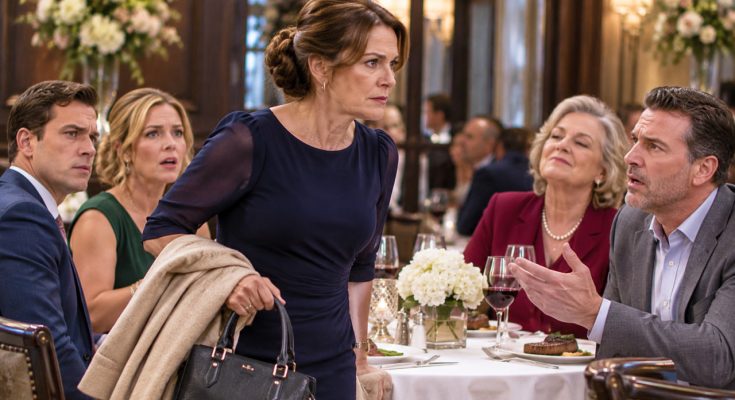
I looked at the table where we had celebrated fifteen years of marriage.
I remembered Russ tapping his knife against his glass.
I remembered Wayne laughing.
I remembered Dolores sliding the envelope beside my plate.
And I remembered the sentence that had finally pushed me out of my chair.
I still wish I’d never said ‘I do.’
I looked down at the menu.
For a few seconds, I felt sad.
Not because I wanted Russ back.
But because I missed the woman I had been before I learned how lonely a marriage could become.
The waitress approached.
“Are you ready to order?”
I smiled.
“Yes. I’ll have the filet mignon, please.”
“And something to drink?”
“Red wine.”
She wrote it down.
Then she asked, “Is there anyone joining you?”
I looked toward the empty chair across from me.
“No,” I said. “Just me tonight.”
When the food arrived, I took a moment to look at it.
Six months earlier, my dinner had sat untouched while an entire family laughed at my expense.
Tonight, I picked up my fork.
The steak was perfectly cooked.
The wine was good.
And nobody at the table was waiting for me to apologize for existing.
I finished every bite.
Then I ordered dessert.
A year after that night, I was sitting in my father’s kitchen when my phone rang.
It was Russ.
I hadn’t spoken to him in several weeks.
I answered.
“Hello?”
“Hi, Ellie.”
“Hello, Russ.”
He sounded older.
Not physically, exactly.
Just tired.
“I heard you’re doing well.”
“I’m doing fine.”
There was a pause.
“I wanted to apologize.”
I looked at the yellow kettle on the stove.
“For what?”
“For the anniversary dinner. For the money. For everything.”
I didn’t interrupt.
“I should never have let Wayne speak to you that way. I should never have taken the money. And I should never have treated you like you were responsible for fixing every problem in my family.”
I closed my eyes.
For years, I had imagined hearing those words.
I had thought they might make me feel something powerful.
Relief.
Victory.
Maybe even happiness.
But what I felt was quieter.
“Thank you for saying that,” I replied.
“I know I can’t undo what happened.”
“No, you can’t.”
“I miss you.”
I looked out the kitchen window.
A small bird was sitting on the fence.
“I miss parts of our life too, Russ. But missing something doesn’t mean it was good for me.”
He was silent.
Then he asked, “Do you think we could ever try again?”
I considered the question carefully.
There was a time when I would have said yes immediately.
I would have treated the question as an opportunity to rebuild everything.
But I had learned something during that year.
Forgiveness and reconciliation were not the same thing.
I could forgive him without returning to the marriage.
I could wish him well without giving him access to my life again.
And I could remember the good years without pretending the bad ones hadn’t happened.
“I hope you build a good life, Russ,” I said. “But I don’t want to go back.”
He breathed out slowly.
“Okay.”
We said goodbye.
When I placed the phone down, I didn’t cry.
I didn’t feel victorious.
I simply felt finished.
That evening, my father came into the kitchen carrying two cups of tea.
He placed one in front of me.
“Thinking about something?”
I smiled.
“Just remembering.”
“Good memories?”
“Some.”
He sat across from me.
“And the others?”
I looked around the kitchen.
At the old cabinets.
The photographs.
The yellow kettle.
The house I had once been told was a waste of money.
“The others taught me something.”
My father nodded.
“What’s that?”
I took a sip of tea.
“That being strong doesn’t mean staying where people hurt you. And being a good wife doesn’t mean accepting every insult just to keep a family together.”
He smiled gently.
“Your mother would have liked that answer.”
I laughed.
For the first time in a long time, the sound came easily.
Outside, the evening light was fading.
I had spent fifteen years believing that keeping a marriage together was proof that I had succeeded.
But I understood now that a marriage could last fifteen years and still leave one person feeling completely alone.
I also understood that leaving didn’t mean I had failed.
Sometimes leaving was the first honest thing you did for yourself.
And sometimes the most important promise you ever make isn’t the one you make at an altar.
It’s the one you make quietly, when nobody else is watching.
Never again will I sit at a table where people celebrate my humiliation and call it family.
That night, I turned off the kitchen light, locked the front door, and went upstairs.
My father’s house was warm.
My name was on the deed.
My finances were my own.
And for the first time in fifteen years, I didn’t have to wonder whether I would be welcomed in my own home.
I already was.
