PART 5
I was so afraid of disappointing people that I often agreed to things before I had time to ask myself whether I wanted them.
Thomas explained the estate arrangements.
Dad had left a will, investment accounts, and interests in commercial properties. Some assets would pass through the estate, while others were governed by separate legal arrangements. The estate also had legitimate expenses and outstanding accounts that needed to be settled.
Nothing would be distributed simply because someone expected it.
Most importantly, Thomas explained that my inheritance was not an automatic source of money for my husband’s relatives.
But I wasn’t obligated to do so.
When the meeting ended, I felt steadier than I had in weeks.
I had a process to follow.
I had an attorney who would explain the documents.
And I had time.
What I didn’t yet have was the truth about Paul.
That truth arrived three days later.
I was sorting through Dad’s old photographs when Denise called.
“Nora, can we talk?”
Her voice sounded different from usual.
“Of course.”
“Not over the phone. Can I come by?”
I hesitated.
“What’s wrong?”
She took a breath.
“It’s about the money Paul promised me.”
I sat down.
“What about it?”
“I need to tell you something.”
She arrived that afternoon carrying a folder.
For several minutes, she sat across from me without opening it.
Then she began to cry.
“I thought he had already talked to you.”
“Talked to me about what?”
Denise wiped her cheeks.
“Paul told me your father had promised to leave you enough money for everyone. He said the inheritance would be divided between the family, and that he was simply getting everything organized early.”
I felt my stomach tighten.
“He said Dad promised that?”
“Yes.”
“My father never told me that.”
“I know that now.”
She opened the folder.
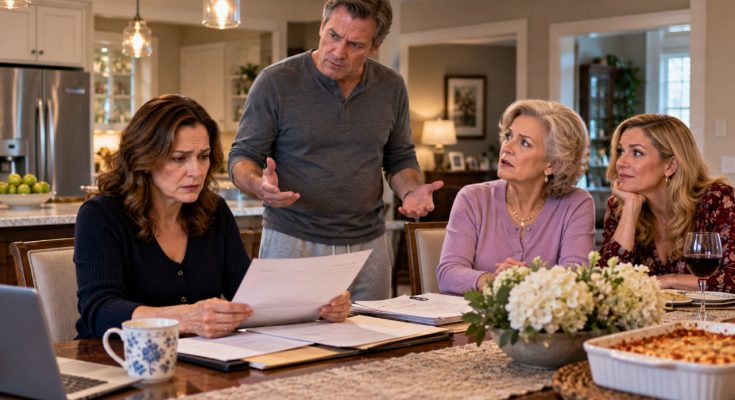
Inside were printed emails between her and Paul.
In one message, Paul had written that he expected my inheritance to be worth several million dollars and that he wanted to arrange financial help for his mother and sister as soon as the estate was settled.
In another, he had described his resignation as a retirement plan he could finally afford.
Then I saw a message dated nearly two months before Dad died.
Once Leonard’s estate is settled, we can take care of the house for Mom and get your business debt cleared. Nora won’t mind once she sees how much there is.
I read the sentence twice.
Nora won’t mind.
As if my agreement were merely a formality.
As if my father’s death were an event that would eventually release money he had already assigned to other people.
“Why are you showing me this?”
Denise began to cry harder.
“Because I believed him. I thought you knew. I thought he had spoken to you and that you had agreed to help us.”
She pushed another document toward me.
It was a preliminary agreement for a house she had been considering purchasing with Gloria.
Paul had signed it as a prospective financial supporter.
There was no evidence that the seller had received the promised money, but the document showed that Paul had already made commitments based on an inheritance he did not control.
“I never asked him to do this,” Denise said. “I was excited, Nora. I won’t lie. My business has been struggling for years, and I thought I finally had a way out. But I didn’t know he was making promises without your permission.”
I sat very still.
“Did you know about the $85,000 Dad lent him?”
Denise shook her head.
“No.”
“Did Paul tell you he had quit his job?”
“Yes. He said everything was taken care of.”
I looked at the emails again.
For months, Paul had been planning a future that depended on my father’s death and the assumption that I would agree to whatever he wanted.
I felt angry.
But beneath the anger was something sadder.
My husband had apparently mistaken my trust for a guarantee.
And his own family had believed him.
“Denise,” I said quietly, “I don’t know what happens next. I need to finish understanding Dad’s estate, and I need to make decisions about my marriage. I can’t promise you money.”
She nodded quickly.
“I understand.”
“I mean it. I won’t be pressured into anything.”
“You shouldn’t be.”
She stood, then hesitated.
“For what it’s worth, Nora, I am sorry. I should have spoken to you before accepting a promise that involved your father.”
After she left, I called Thomas.
I told him about the emails and the preliminary agreement.
He asked me to preserve the documents and send him copies. He reminded me not to make accusations publicly or assume that the emails alone resolved every legal question.
“We will deal with the estate on the basis of verified records,” he said. “And you should not sign anything simply to make this situation disappear.”
I promised I wouldn’t.
That evening, I returned home.
Paul was waiting at the dining table.
Gloria sat beside him, her purse resting on her knees.
Denise’s chair was empty.
Paul looked up as I entered.
“Where have you been?”
“Talking to Denise.”
His face changed.
“What did she tell you?”
“Enough.”
Gloria shifted uncomfortably.
Paul stood.
“Nora, we need to settle this before it gets out of hand.”
I took off my coat.
“Then let’s settle it.”
He gestured toward the chair opposite him.
“Sit down.”
I remained standing.
“No. I’m going to say something, and I need you to listen.”
He folded his arms.
I looked directly at him.
“My father died three days before you quit your job. You promised your mother a house. You promised Denise $200,000. You did all of this before you knew what the estate contained, and you did it without asking me.”
Paul opened his mouth.
I raised my hand.
“I’m not finished.”
He closed it.
“You also borrowed $85,000 from my father and never told me. You told your sister that my inheritance would take care of everyone. You planned your retirement around money that wasn’t yours to spend.”
Gloria stared at her son.
“Paul, is that true?”
He turned toward her.
“Mom, stay out of this.”
“No,” I said. “She deserves to know what she was promised.”
Gloria looked at me, visibly shaken.
“I thought you had agreed.”
“I hadn’t.”
Paul struck the table with his palm.
“This is ridiculous! We’re married. Everything we do affects both of us.”
“Our marriage doesn’t give you permission to make financial promises on my behalf.”
“I was trying to help my family!”
“And what about me?”
He stared at me.
“What about you?”
I felt tears gathering, but I didn’t look away.
“I lost my father. I am grieving. And instead of asking how I was doing, you started planning what you could buy with the money you thought he would leave me.”
For a moment, nobody spoke.
Then Paul said the words I would remember for the rest of my life.
“I knew you wouldn’t understand until you saw the numbers.”
I shook my head slowly.
“No, Paul. You knew I might disagree, so you made the promises first.”
His face reddened.
“After everything I’ve done for this family, you’re treating me like a criminal.”
“I’m treating you like a husband who kept important financial information from me.”
Gloria stood.
“I think I should leave.”
Paul turned toward her.
“Mom—”
She shook her head.
“No. I don’t want a house bought with money that hasn’t been inherited. I don’t want you fighting with your wife over something that isn’t yours to give.”
She looked at me.
“Nora, I’m sorry. I should never have let myself get carried away.”
I nodded, unable to speak.
After Gloria left, Paul and I stood alone in the dining room.
He looked exhausted.
For a moment, I saw the man I had married at 33. The man who had held my hand at my mother’s funeral, who had helped me through difficult years at work, who had once driven through a snowstorm because I was sick and wanted soup from my favorite restaurant.
Those memories were real.
But so were the emails.
So was the hidden loan.
So was the way he had treated my father’s death as the beginning of his retirement.
“Can we fix this?” he asked.
I wanted to say yes.
I wanted to return to the safety of what I had always believed about us.
But love was no longer enough to answer the question.
“I don’t know,” I said. “But I know we can’t fix it by pretending it never happened.”
He sat down and covered his face with his hands.
For the first time since the funeral, he didn’t argue.
He didn’t blame Thomas.
He didn’t mention the money.
He simply sat there.
And I realized that I no longer needed him to admit everything before I could begin protecting myself.
I could take the next step without knowing the final answer.
Over the following weeks, Thomas completed the initial estate review.
Dad’s assets were substantial, although the final distribution took time. His estate paid its legitimate obligations, and the outstanding loan to Paul was handled according to the agreement and the available records.
The review also confirmed that the estate arrangements Dad had created gave me financial security without requiring me to hand control of my inheritance to anyone else.
I didn’t suddenly become a different person.
I was still Nora.
I still missed my father every morning.
I still cried when I heard his favorite song or found one of his handwritten notes in an old book.
But I began making decisions differently.
I met with an independent financial adviser.
I reviewed my own accounts.
I learned exactly what I owned, what I owed, and what I could afford.
And I made one decision that surprised everyone, including me.
I did not give Paul control of the inheritance.
I also refused to hand out money simply because relatives had already begun imagining how they would spend it.
Denise eventually closed her struggling business location through a plan she developed with her creditors. I offered to help her find a qualified financial counselor, but I did not pay her $200,000.
Gloria remained in her apartment for the time being. She eventually found a smaller home within her own budget, and I wished her well.
Neither woman received the windfall Paul had promised.
But neither was left without the ability to make her own choices.
As for Paul, the weeks that followed were difficult.
He initially insisted that his decisions were no different from any husband making plans for retirement.
Then he accused me of letting my father’s lawyer turn me against him.
Finally, when I showed him the emails Denise had shared, he stopped arguing.
He admitted he had assumed the inheritance would be large enough to cover everything.
He admitted he had been embarrassed about the old business loan.
And he admitted he had convinced himself that telling me after the fact was easier than risking an argument beforehand.
“I didn’t think you would say no,” he told me one evening.
I looked at him across the table.
“That is exactly the problem.”
We tried counseling.
For several months, we attended appointments and discussed the patterns that had shaped our marriage. Paul began to understand that his habit of making decisions first and asking for forgiveness later was not generosity.
It was control disguised as good intentions.
But understanding something and changing it are different things.
I watched carefully.
I waited to see whether he could accept a boundary without punishing me for setting it.
Sometimes he could.
Sometimes he couldn’t.
Eventually, I realized that I could forgive him for the pain he had caused without agreeing to continue living the same way.
We separated.
The decision was not made in anger, and it wasn’t about punishing him with money. We worked with separate attorneys to address our finances and the practical questions involved in ending a 22-year marriage.
I kept the inheritance that legally belonged to me, subject to the terms of the estate and applicable law. Our marital assets were addressed separately through the proper process.
Paul had to make his own decisions about work, retirement, and the future he wanted.
For the first time in years, neither of us could make those decisions on behalf of the other.
On the anniversary of Dad’s death, I drove to the cemetery with a small bouquet of white roses.
I sat beside his headstone and told him everything.
I told him about the inheritance, the loan, the arguments, and the marriage I had tried so hard to save.
I told him that I still loved Paul in some ways, even though I could no longer live with him.
And I told him I was sorry I hadn’t understood sooner what he meant by giving me choices.
The wind moved gently through the trees.
For a long time, I sat in silence.
Then I remembered another line from Dad’s letter.
You don’t have to prove your love by giving everything away.
I placed the roses beside his name.
“I understand now, Dad,” I whispered.
“I really do.”
A year later, I was sitting in the small sunroom of the house I had chosen for myself.
It wasn’t a mansion.
It wasn’t a grand display of wealth.
It was a quiet home with a garden, a comfortable kitchen, and enough room for the people I loved to visit without making me feel that I owed them anything.
I still worked because I wanted to, not because I was afraid of running out of money.
I spent more time with friends.
I took a trip I had postponed for years.
And I learned that peace was worth more than the approval of people who only felt comfortable when I agreed with them.
One afternoon, Paul called.
We spoke politely about a few practical matters that still needed attention.
Before hanging up, he said, “I wish I had handled everything differently.”
I believed that he meant it.
But I had learned that regret could not undo a decision, and an apology did not obligate me to return to the life I had left.
“I wish that too, Paul,” I replied.
Then we said goodbye.
After the call, I walked into the garden and sat beneath the tree I had planted in Dad’s memory.
I thought about the question Thomas had asked me that first morning.
Has anyone already started spending money they think you inherited?
At the time, I thought the question was about money.
It wasn’t.
Not really.
It was about the people who had mistaken my future for their opportunity.
It was about the difference between sharing a life with someone and surrendering the right to make decisions about it.
And it was about a father who had understood that his daughter might one day need permission to choose herself.
I never learned every thought my father had carried into his final months.
Perhaps he had worried about Paul. Perhaps he had simply understood my generous nature and wanted to protect my choices.
But I knew what he had left me.
More than investments, property, or money, he had left me a reminder that my life belonged to me.
And that was the inheritance I would never give away.

One Comment on “PART 5 – My Husband Quit His Job 3 Days After My Dad Died—Then Promised His Sister $200,000 From My Inheritance”