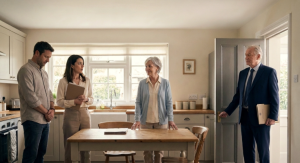
PART 3
One Year Later
The development company eventually purchased the surrounding parcels.
But they never got mine.
I refused every offer.
Then, unexpectedly, I received a letter.
The final offer was for $1.4 million.
I read it twice.
Then I laughed.
Eleanor asked why.
I handed her the letter.
She whistled.
“You could sell.”
“I could.”
“Will you?”
I looked through the window.
At the lake.
At the old oak tree Raymond had planted.
At the driveway where Mark had learned to ride his bike.
“No.”
She smiled.
“Good.”
I had another plan.
I turned the house into a small community gathering place.
Not a nursing home.
Not an assisted-living facility.
A place where older people could come together.
Have coffee.
Read.
Play cards.
Share stories.
And, most importantly, feel useful.
I called it Raymond House.
Mark helped renovate it.
His children helped paint the walls.
Even Eleanor contributed her famous banana bread.
The first day we opened, I stood at the front door.
There were twelve elderly people inside.
Laughing.
Talking.
Living.
Mark stood beside me.
“Dad would love this.”
I smiled.
“Yes.”
Then I looked at my son.
“You know something?”
“What?”
“Your father was right.”
“About what?”
I looked around the house.
“Home isn’t something you own.”
I touched his shoulder.
“It’s something you protect.”
He nodded.
“And Mom?”
“Yes?”
“Thank you for giving me another chance.”
I smiled.
“Don’t thank me yet.”
He laughed.
“Why?”
“Because I’m still going to make you work for it.”
He laughed harder.
And I laughed with him.
Epilogue
A year after everything happened, I found Raymond’s letter again.
I sat alone in the kitchen one evening.
My tea was warm.
The house was quiet.
I unfolded the paper.
I read his words again.
You have spent your whole life taking care of everyone else.
I smiled.
Then I read the final line.
For once, Dot, take care of yourself.
I finally understood what he meant.
Taking care of myself hadn’t meant becoming bitter.
It hadn’t meant cutting everyone off.
It hadn’t meant pretending I didn’t love my son.
It meant learning the difference between love and surrender.
I could love Mark without funding his mistakes.
I could forgive Alicia without trusting her.
I could help my grandchildren without handing over control of my life.
And I could grow old without becoming invisible.
That night, I walked outside.
The lake reflected the moon.
The same lake Raymond and I had watched for forty-five years.
I stood there for a long time.
Then my phone rang.
It was Mark.
I answered.
“Hi, Mom.”
“Hi, sweetheart.”
“What are you doing?”
“Looking at the lake.”
He laughed.
“You always look at that lake.”
“I know.”
There was a pause.
Then he said:
“I’m glad you stayed.”
I looked back at the house.
At the warm lights.
At the place where our family had nearly lost everything.
“No,” I said softly.
“I’m glad I remembered that I had a right to stay.”
And that was the real lesson.
The house had never been the thing I was fighting to keep.
I was fighting to keep my voice.
My dignity.
My choices.
My life.
And in the end, I didn’t lose my son.
I didn’t lose my home.
I didn’t lose myself.
I simply stopped handing pieces of myself to people who believed I wouldn’t notice they were taking them.
Raymond had left me many things.
Money.
Property.
Memories.
But the greatest inheritance wasn’t any of those.
It was the courage to say:
This is my life.
I am still here.
And I get to decide what happens next.
The next morning, I opened Raymond House.
There were already people waiting outside.
I unlocked the door.
The sunlight spilled across the wooden floor.
I smiled.
“Come in,” I said.
And for the first time in a very long time…
I wasn’t waiting for anyone to rescue me.
I was home.
THE END

